Protein timing for muscle building: the anabolic window myth
Do you really need a protein shake within 30 minutes of training? We debunk the anabolic window myth and show how protein distribution actually affects muscle growth.
Download Smaklig – now on the App Store and Google Play The Smaklig app is now on the App Store (iPhone) and Google Play (Android). Download it free.
Download SmakligShort answer: The anabolic window — the idea that muscle building collapses unless you consume protein within 30 minutes of training — is greatly overstated. Current research shows that total daily protein intake (1.6–2.2 g/kg) and even distribution across 3–4 meals matters far more than precise timing. If you had a solid breakfast with oats and cottage cheese, you are likely still in an anabolic state by the time you finish your session.
Gym culture thrives on myths. The anabolic window — the claim that muscle protein synthesis crashes unless you swallow a shake within thirty minutes of your last rep — is one of the most persistent. It is a simplification of real science, amplified by the supplement industry and social media.
Let us look at what the research actually says, and how to optimize your protein distribution around realistic daily eating habits.
Where the anabolic window myth came from#
The myth has roots in early studies examining muscle protein synthesis responses immediately post-exercise. It is true that protein synthesis is elevated in the hours following a resistance training session. The problem is that this was interpreted as "the clock is ticking — eat now." Later, better-controlled studies tell a more nuanced story.
A meta-analysis by Morton et al., 2018 covering more than 1,800 participants shows that total daily protein intake (1.6–2.2 g/kg body weight) is the strongest predictor of muscle mass gains with resistance training — not timing. The anabolic window exists, but it is far wider than advertised: 3–5 hours rather than 30 minutes.
Total intake beats timing — every time#
The practical implication is straightforward: if you eat three or four protein-rich meals per day and hit your total protein target, precise timing is secondary. A quality post-workout meal 90 minutes after training is better than quickly gulping a low-quality shake in the changing room.
What does matter is not being in a deeply catabolic state when you train — meaning you should not fast for 16 hours and then head straight to the gym without having eaten anything that morning.
Protein distribution: why four meals beats one large dinner#
Helms et al., 2014 highlight that protein distribution is underrated in muscle building. Enzymatic saturation in muscle protein synthesis means the body has an upper limit on how much protein it can effectively use per meal for anabolic purposes — roughly 0.4–0.55 g of protein per kg of body weight per occasion.
Practical consequence: an 80 kg person eating all their protein in one large dinner (say, 160 g protein in a single sitting) does not benefit from the extra protein. The body oxidizes it or converts it to energy instead of building muscle.
Optimal distribution for an 80 kg person (goal: 160 g protein/day):
| Meal | Example | Protein |
|---|---|---|
| Breakfast | 100 g dry oats + 250 g cottage cheese + 2 eggs | ~45 g |
| Lunch | 150 g chicken + rice + vegetables | ~40 g |
| Dinner | 200 g salmon or beef + potatoes | ~45 g |
| Evening | 200 g cottage cheese or 300 ml filmjölk (Swedish cultured milk) | ~30 g |
Scandinavian breakfast habits and muscle building#
Oats and cottage cheese are an underreported muscle-building combination in Nordic cuisine. A combination of 100 g dry oats (around 13 g protein) and 250 g cottage cheese (around 25–30 g protein) creates a breakfast with approximately 40 g of complete protein — without any supplement at all.
The casein in cottage cheese is also a slower protein than whey, keeping amino acid levels elevated in the blood for longer — 4–6 hours after consumption. This dampens catabolic signals and supports muscle building through to the next meal.
According to Leidy et al., 2015, a high-protein breakfast does not only provide satiety — it also reduces evening food cravings, which indirectly protects your calorie target during a muscle-gain phase.
The timing that actually matters: the pre-workout meal#
If you are concerned about timing, focus on the meal before training rather than after. A protein-rich meal 1–3 hours before your session ensures amino acid levels are elevated during and directly after training — effectively extending the anabolic window naturally.
A simple pre-workout breakfast:
- 200 g cottage cheese with berries
- 60–80 g oats with milk
- 1–2 eggs if you have time
This keeps you in an anabolic state throughout the session and supports the well-being needed to perform at RPE 7–9 (see our guide on progressive overload) rather than training in a half-fasted state.
Post-workout: what you actually need#
The post-workout goal is relatively simple: a meal containing 0.4–0.55 g of protein per kg body weight within 2–3 hours after training, ideally combined with carbohydrates to replenish muscle glycogen.
Simple post-workout options using whole foods:
- 200 g pre-cooked chicken + rice + sauce (~40–45 g protein)
- 3 eggs + 2 slices of bread + a portion of cottage cheese (~35 g protein)
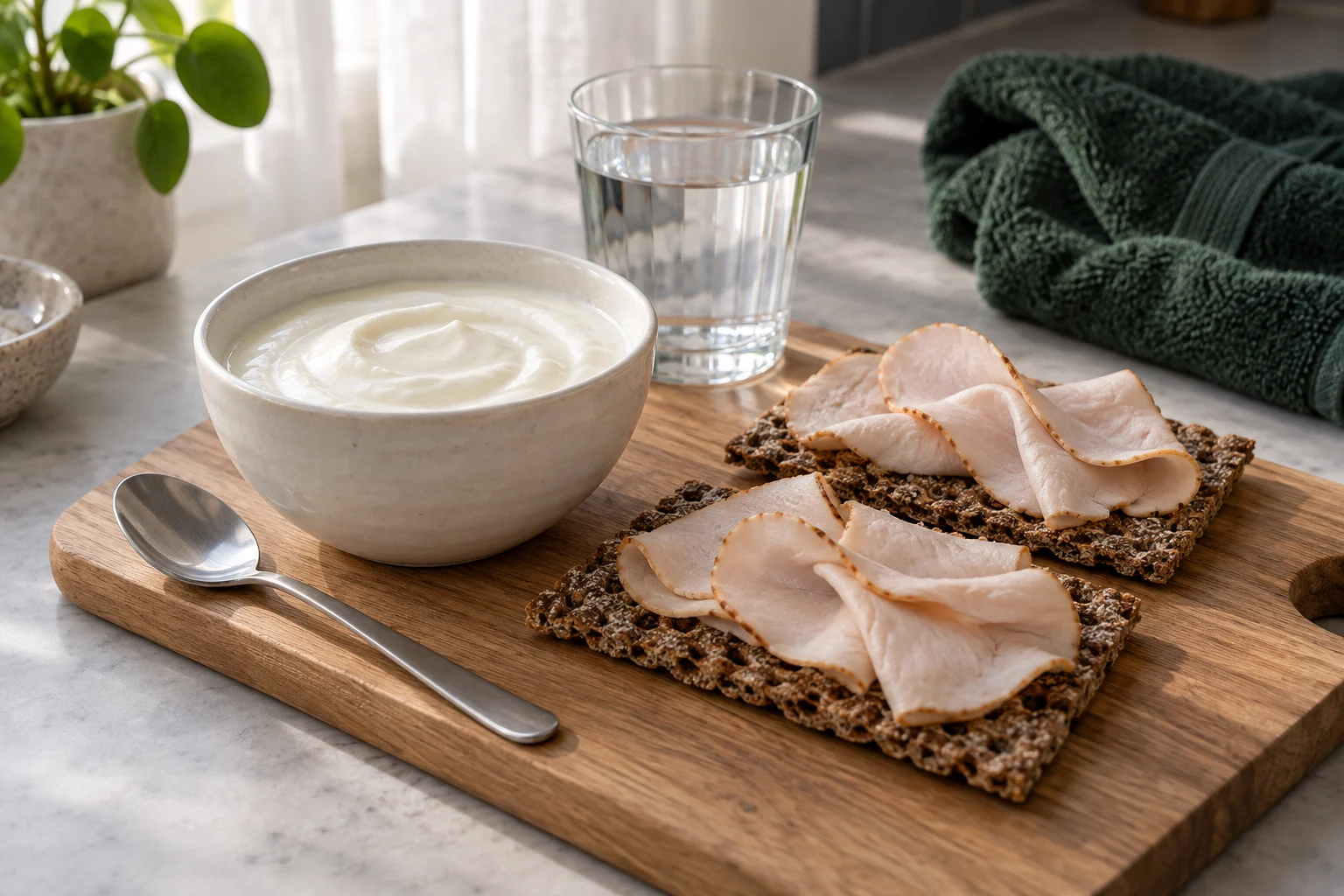
- 400 ml filmjölk (cultured milk) + crispbread + sliced meat (~30–35 g protein)
Filmjölk is also an affordable protein source frequently on promotion at Swedish grocery stores — solid protein without expensive supplements.
NNR 2023 and protein quality#
NNR 2023 recommends that Nordic diets include varied protein sources — both animal and plant-based — with environmental impact in mind. For muscle building this means you can combine legumes such as lentils and chickpeas with dairy and eggs to cover your amino acid profile without relying solely on meat.
A portion of red lentils (200 g cooked, ~18 g protein) + cottage cheese (200 g, ~20 g protein) + eggs (2 whole, ~12 g) delivers 50 g of complete protein with solid amino acid coverage.
Summary: three priorities in the right order#
- Total daily protein — 1.6–2.2 g/kg, non-negotiable
- Distribution — 3–4 meals, ~0.4–0.55 g/kg per occasion
- Timing — protein-rich breakfast + meal within 2–3 hours post-workout
All three matter, but in that order. No timing strategy compensates for eating a total of 100 g protein per day when you need 160 g.
Want help planning meals that hit your protein targets using foods from Scandinavian grocery stores? Smaklig can build your weekly meal plan based on your weight, goal, and preferred store.
FAQ#
How wide is the anabolic window — 30 minutes or longer?#
Current research suggests the anabolic window is considerably wider than 30 minutes — likely 3–5 hours post-training for most people. If you had a protein-rich meal 1–2 hours before training, waiting 60–90 minutes after your session is not a problem. Total daily protein intake matters more than precise timing.
How much protein should I have per meal?#
Research points to 0.4–0.55 g of protein per kg of body weight per meal as a solid guideline for maximizing muscle protein synthesis. For an 80 kg person that is roughly 32–44 g of protein per meal, spread across 3–4 eating occasions per day.
Is cottage cheese a good protein source for muscle building?#
Excellent choice. A 500 g tub of plain cottage cheese typically provides 50–60 g of protein and is rich in casein, a slower-digesting protein that keeps amino acid levels elevated for longer. Combined with oats at breakfast it delivers solid satiety and a complete amino acid profile.
Do I need protein shakes if I eat whole food?#
No — provided you consistently reach 1.6–2.2 g of protein per kg of body weight per day through whole food. Shakes are convenient but not required. Many people hit their targets with cottage cheese, eggs, chicken, salmon, and legumes without any supplements.
Sign up at Smaklig and get an AI-generated nutrition plan tailored to your muscle-building goals — with recipes that actually taste good.
Sources
- British Journal of Sports Medicine (2018). Morton et al., 2018 — A systematic review, meta-analysis and meta-regression of the effect of protein supplementation on resistance training-induced gains in muscle mass and strength
- Journal of the International Society of Sports Nutrition (2014). Helms et al., 2014 — Evidence-based recommendations for natural bodybuilding contest preparation: nutrition and supplementation
- American Journal of Clinical Nutrition (2015). Leidy et al., 2015 — The role of protein in weight loss and maintenance
- Nordic Council of Ministers (2023). NNR 2023 — Nordic Nutrition Recommendations
Frequently asked questions
How wide is the anabolic window — 30 minutes or longer?
Current research suggests the anabolic window is considerably wider than 30 minutes — likely 3–5 hours post-training for most people. If you had a protein-rich meal 1–2 hours before training, waiting 60–90 minutes after your session is not a problem. Total daily protein intake matters more than precise timing.
How much protein should I have per meal?
Research points to 0.4–0.55 g of protein per kg of body weight per meal as a solid guideline for maximizing muscle protein synthesis. For an 80 kg person that works out to roughly 32–44 g of protein per meal, spread across 3–4 eating occasions per day.
Is cottage cheese a good protein source for muscle building?
Excellent choice. A 500 g tub of plain cottage cheese typically provides 50–60 g of protein and is rich in casein, a slower-digesting protein that keeps amino acid levels elevated for longer. Combine it with oats at breakfast for solid satiety and a complete amino acid profile.
Do I need protein shakes if I eat whole food?
No — provided you consistently reach 1.6–2.2 g of protein per kg of body weight per day through whole food. Shakes are convenient but not required. Many people hit their targets with a combination of cottage cheese, eggs, chicken, salmon, and legumes without any supplements.
Want more meal planning tips?
More guides on food, health and saving money — and a sous-chef that plans your week for you.
Get started
Founder, Smaklig
Writer at Smaklig. We write about food, health, and how to eat better without breaking the bank.
Related articles
August 13, 2026 · 6 min
How Much Protein Do You Need Per Day? Full 2026 Guide
How much protein you need per day and per meal — plus a table of protein in common foods like eggs, chicken and quark. Source: the Swedish Food Agency.
Read moreMay 8, 2026 · 7 min
Bulk weekly menu for muscle gain on a budget
A complete bulking meal plan with TDEE + 300–500 kcal surplus, high protein, and affordable Swedish grocery staples — build muscle without breaking the bank.
Read moreMay 8, 2026 · 7 min
Progressive overload: complete guide
Learn how progressive overload works in practice — increase weight, volume and RPE step by step to build muscle and get stronger at any gym.
Read moreReady to plan smarter?
Smaklig creates your weekly menu with AI based on store campaigns. Tailored to your goals and allergies.
Get started free