Bulk weekly menu for muscle gain on a budget
A complete bulking meal plan with TDEE + 300–500 kcal surplus, high protein, and affordable Swedish grocery staples — build muscle without breaking the bank.
Download Smaklig – now on the App Store and Google Play The Smaklig app is now on the App Store (iPhone) and Google Play (Android). Download it free.
Download SmakligShort answer: An effective bulk requires a controlled calorie surplus of 300–500 kcal above your TDEE, paired with 1.6–2.2 g of protein per kg of body weight. It does not have to be expensive. Oats, cultured milk (filmjölk), pasta, chicken thighs, and eggs are calorie-dense foods regularly on sale at Swedish grocery stores — keeping protein high without draining your wallet.
The bulk phase is widely misunderstood. Many people interpret "eat more" as "eat anything" — and end up gaining far more fat than muscle. A structured bulk is about a controlled calorie surplus combined with adequate protein and consistent progressive-overload training. That combination is what drives muscle growth.
This weekly menu is designed for a lightly-to-moderately active adult (activity factor 1.55), weighing 75–85 kg, with an estimated TDEE of roughly 2,600–2,900 kcal. Adjust portion sizes based on your own TDEE.
Calculate your TDEE with Mifflin-St Jeor#
Before setting your bulk calories, you need a baseline. Mifflin-St Jeor is the equation nutrition physiologists and Livsmedelsverket (the Swedish Food Agency) most commonly reference:
Men: BMR = (10 × weight kg) + (6.25 × height cm) − (5 × age) + 5
Women: BMR = (10 × weight kg) + (6.25 × height cm) − (5 × age) − 161
Then multiply BMR by your activity factor:
- Sedentary (little/no exercise): × 1.2
- Lightly active (1–3 days/week): × 1.375
- Moderately active (3–5 days/week): × 1.55
- Very active (6–7 days/week): × 1.725
Add 300–500 kcal to your TDEE for a muscle-building surplus. According to Morton et al., 2018, protein availability is the strongest variable for muscle growth — calories provide the frame, protein provides the building blocks.
Weekly menu: Monday–Sunday#
Monday#
Breakfast: 120 g dry oats + 300 ml filmjölk (Swedish cultured milk) + 2 scrambled eggs + banana
Approx. 760 kcal, 42 g protein
Lunch: Pasta bake — 250 g dry pasta, 300 g ground beef (80/20), tomato passata, onion, garlic
Approx. 880 kcal, 52 g protein
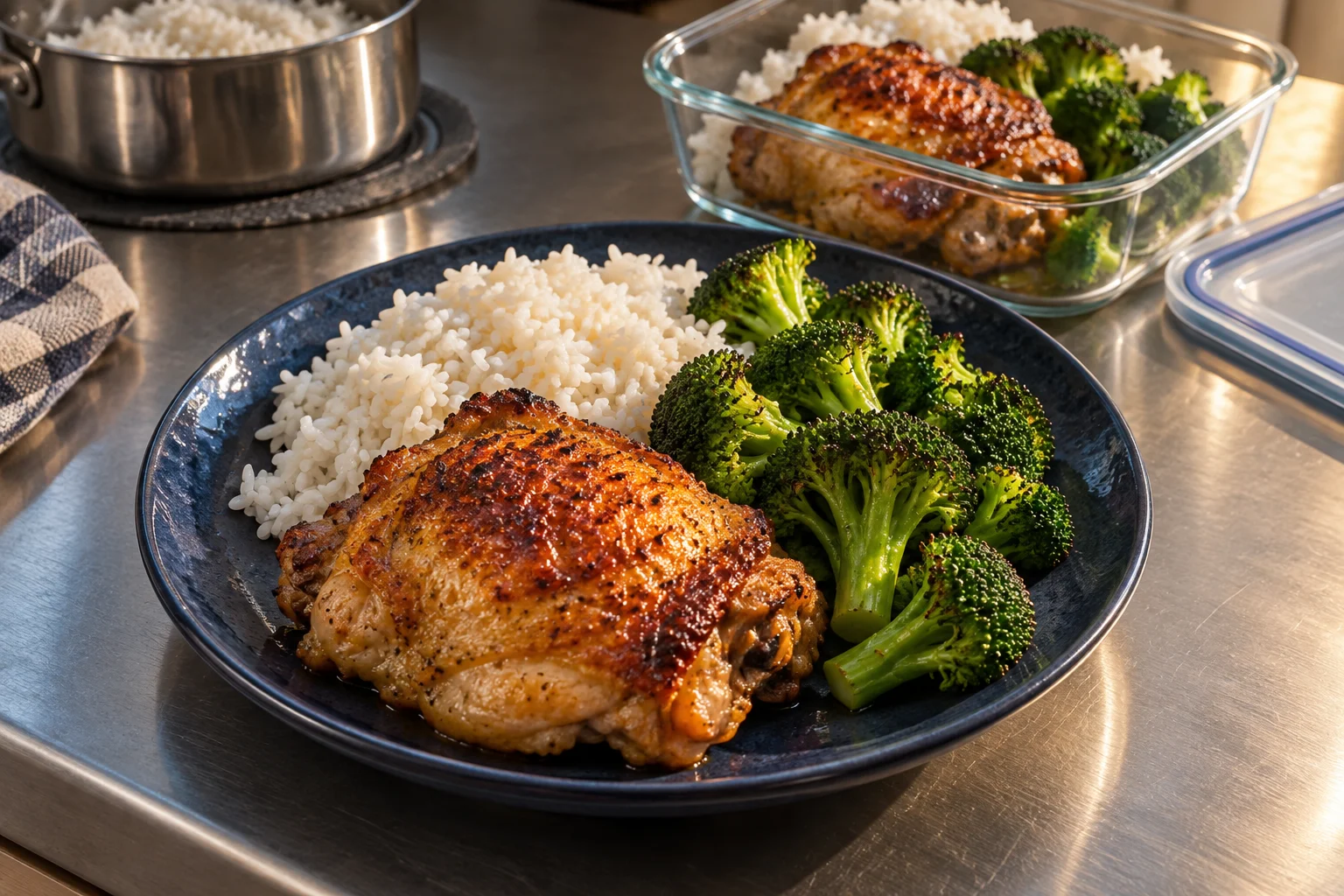
Dinner: 200 g chicken thighs (bone-in, skin-on, oven-roasted) + 300 g cooked rice + frozen broccoli mix
Approx. 750 kcal, 45 g protein
Evening snack: 250 g cottage cheese + 2 tbsp peanut butter + 100 ml dry oats
Approx. 480 kcal, 35 g protein
Day total: Approx. 2,870 kcal, 174 g protein
Tuesday#
Breakfast: 3 eggs + 150 g smoked salmon slices + 2 slices of rye bread
Approx. 620 kcal, 48 g protein
Lunch: Chicken rice soup with leftover chicken + 200 ml cooked rice + vegetable mix + chicken stock
Approx. 680 kcal, 40 g protein
Dinner: 250 g ground beef + bulgur (100 g dry) + feta + cucumber (köfte-style)
Approx. 870 kcal, 50 g protein
Evening snack: 400 ml filmjölk + banana + 3 crispbreads
Approx. 440 kcal, 22 g protein
Day total: Approx. 2,610 kcal, 160 g protein
Wednesday–Sunday (pattern to rotate)#
The same principle applies each day:
- Breakfast: Oats (100–120 g dry) + protein source (cottage cheese, eggs, filmjölk — 30–45 g protein) + fruit
- Lunch: Large portion of carbohydrates (pasta/rice/bulgur/potatoes) + protein-rich main (chicken/ground beef/legumes, 40–50 g protein) + vegetables
- Dinner: Protein-rich main (fish/meat/eggs) + carbohydrates + vegetables
- Evening snack: Cottage cheese or filmjölk + extra calories from nuts/peanut butter/oats
Budget focus: what does it actually cost?#
A proper bulk does not have to be expensive. Here are the most cost-effective options per macronutrient:
Protein (cost per 100 g of protein):
- Bone-in chicken thighs: ~low cost per 100 g protein
- Eggs (12-pack): one of the cheapest protein sources
- Filmjölk (cultured milk): solid protein per Swedish krona
- Cottage cheese (large pack): affordable casein source
- Chicken breast: more expensive but very lean
Carbohydrates (calories per currency unit):
- Oats (store brand): extremely calorie-dense per unit cost
- Pasta (store brand): near-equivalent to oats
- Rice (1 kg bag): excellent value
- Potatoes: good but less calorie-dense than grains
Swedish grocery stores ICA and Coop regularly run promotions on chicken thighs, ground beef, filmjölk, and eggs. Buying these when discounted and freezing them is an easy strategy for keeping food costs down across a longer bulk phase. Smaklig shows you current promotions at your preferred store and helps you plan your weekly menu around what is cheapest right now.
Classic Swedish bulk staples#
Filmjölk (Swedish cultured milk) is a comprehensive package: protein (~3.5 g/100 ml), carbohydrates, calcium, and beneficial bacteria. A litre of filmjölk per day provides approximately 35 g of protein and 550–600 kcal at minimal cost and maximum convenience. It is a staple in Swedish gym households for good reason.
Pasta is underrated in fitness circles. 100 g of dry pasta delivers around 350 kcal and 12 g of protein, forming the base of a pasta bake that costs under 30 SEK to prepare for 2 servings. Combined with ground beef and tomato passata it creates a complete muscle-building meal.
Chicken thighs are cheaper than breast fillets, more calorie-dense (more calories per kg = better for bulking), and taste better roasted in the oven. A 1 kg pack provides roughly 3–4 servings.
NNR 2023 perspective on bulking#
NNR 2023 emphasizes that diet during muscle-building phases should include varied foods — not exclusively animal protein sources. Including legumes, wholegrains, and vegetables in your bulk diet supports overall health and contributes fiber and micronutrients that are often neglected when the focus is on calories and protein.
Helms et al., 2014 note that micronutrient status affects recovery and hormonal function — which in turn affects muscle building. A bulk built entirely on fast food and shakes yields worse outcomes than one incorporating vegetables, wholegrains, and varied protein sources.
Practical tips for sticking to a bulk diet#
Batch prepare carbohydrates: Cook a large portion of rice (500 g dry → 1.5 kg cooked) and a big pasta bake at the start of the week. That is 30 minutes of preparation time ensuring you always have carbohydrates ready.
Use frozen vegetables: Frozen vegetable mixes (broccoli, green beans, peas) are cheaper than fresh and nearly equivalent nutritionally. They fill the plate and provide micronutrients without adding time to your cooking.
Avoid empty calories: Soft drinks and confectionery provide no building blocks — even during a bulk, most calories should come from whole foods. This is pragmatism, not asceticism.
Read more about how to distribute protein optimally through the day in our article on protein timing and muscle building.
FAQ#
How large a calorie surplus do I need to build muscle?#
300–500 kcal per day above your TDEE is a well-established guideline for maximizing muscle gain while minimizing fat gain. A larger surplus does not build more muscle — it adds more fat. Calculate your TDEE using the Mifflin-St Jeor equation and multiply by your activity factor.
Which foods are most cost-effective for bulking?#
Oats, pasta, rice, filmjölk, eggs, and chicken thighs are calorie-dense, affordable foods with solid protein profiles. Chicken thighs are cheaper than breast fillets and contain more calories per kg. Watch for promotions at ICA and Coop for temporary discounts.
How long should I bulk for best results?#
A typical bulk phase runs 12–20 weeks, followed by a cut phase of 8–16 weeks. Shorter bulk periods do not allow enough time for meaningful adaptation. Longer periods increase the risk of accumulating more fat than necessary, especially with a larger surplus.
Can I bulk on a vegetarian diet?#
Yes. Combine cottage cheese, eggs, dairy, soy products, and legumes to cover 1.6–2.2 g protein/kg. It requires more planning but is fully achievable with standard Scandinavian grocery store inventories.
Sign up at Smaklig and let the AI calculate your TDEE, set your calorie surplus, and build a bulk weekly menu tailored to your weight, preferences, and local grocery store.
Sources
- British Journal of Sports Medicine (2018). Morton et al., 2018 — A systematic review, meta-analysis and meta-regression of the effect of protein supplementation on resistance training-induced gains in muscle mass and strength
- Nordic Council of Ministers (2023). NNR 2023 — Nordic Nutrition Recommendations
- Livsmedelsverket (2024). Livsmedelsverket — Energy and macronutrients
- Journal of the International Society of Sports Nutrition (2014). Helms et al., 2014 — Evidence-based recommendations for natural bodybuilding contest preparation: nutrition and supplementation
Frequently asked questions
How large a calorie surplus do I need to build muscle?
300–500 kcal per day above your TDEE is a well-established guideline for maximizing muscle gain while minimizing fat gain. A larger surplus does not build more muscle — it adds more fat. Calculate your TDEE using the Mifflin-St Jeor equation and multiply by your activity factor (1.55 for most regular gym-goers).
Which foods are most cost-effective for bulking?
Oats, pasta, rice, cultured milk (filmjölk), eggs, and chicken thighs are calorie-dense, affordable foods with solid protein profiles. Chicken thighs are considerably cheaper than breast fillets and contain more calories per kg — ideal for bulking. Watch for promotions at your local grocery store for temporary discounts on meat and dairy.
How long should I bulk for best results?
A typical bulk phase runs 12–20 weeks, followed by a cut phase of 8–16 weeks. Shorter bulk periods (under 8 weeks) do not allow enough time for meaningful adaptation. Longer periods (over 6 months) increase the risk of accumulating more fat than necessary, especially with a larger surplus.
Can I bulk on a vegetarian diet?
Yes. Combine cottage cheese, eggs, dairy, soy products, and legumes to cover 1.6–2.2 g protein/kg. Plant milks and oat drinks provide the calories; lentils and chickpeas contribute protein. It requires more planning but is fully achievable with standard Scandinavian grocery store inventories.
Want more meal planning tips?
More guides on food, health and saving money — and a sous-chef that plans your week for you.
Get started
Founder, Smaklig
Writer at Smaklig. We write about food, health, and how to eat better without breaking the bank.
Related articles
May 8, 2026 · 7 min
Maintenance Weekly Menu: 5 Days at TDEE
A practical 5-day weekly menu at maintenance calories (TDEE) with no deficit. Swedish staples, supermarket promotion substitutions, and NNR 2023-aligned nutrition.
Read moreMay 8, 2026 · 7 min
Progressive overload: complete guide
Learn how progressive overload works in practice — increase weight, volume and RPE step by step to build muscle and get stronger at any gym.
Read moreMay 8, 2026 · 7 min
Protein timing for muscle building: the anabolic window myth
Do you really need a protein shake within 30 minutes of training? We debunk the anabolic window myth and show how protein distribution actually affects muscle growth.
Read moreReady to plan smarter?
Smaklig creates your weekly menu with AI based on store campaigns. Tailored to your goals and allergies.
Get started free