The Food Waste Costing You 5,000 SEK/Year (And How to Stop It)
Swedish households waste 8,100 SEK of food per year according to Naturvårdsverket. 10 concrete tips to cut food waste by 50% — save money and the planet.
Download Smaklig – now on the App Store and Google Play The Smaklig app is now on the App Store (iPhone) and Google Play (Android). Download it free.
Download SmakligQuick answer:
- Swedish households waste ~50 kg of food/year (Naturvårdsverket) — worth 5,000–8,100 SEK per household
- A quarter is completely edible food thrown away due to poor planning or misunderstood date labels
- Weekly meal planning reduces food waste by 30% — the single most effective action
- "Best before" ≠ "use by" — bread, cheese, milk are often edible long after the best-before date
- Halving your food waste saves 2,500–4,000 SEK/year for a family — without compromising on food quality
How much food do we actually waste?#
According to Naturvårdsverket's latest measurement (2023), Swedish households throw away roughly 50 kg of food waste per person per year. A quarter — just over 12 kg per person — is food that could have been eaten. The rest is "unavoidable waste" (peels, bones, pits).
For a two-child household of four, that's 200 kg of food in the trash per year. In money terms:
| Household type | Food waste/year | Value (low) | Value (high) |
|---|---|---|---|
| Single | 50 kg | 1,500 SEK | 2,000 SEK |
| Couple | 100 kg | 3,000 SEK | 4,000 SEK |
| Family (2+2) | 200 kg | 6,000 SEK | 8,100 SEK |
The math is simple. At an average 30–40 SEK/kg of purchased food (mixed fresh and dry goods), an average family's food waste costs between 6,000 and 8,100 SEK per year.
Beyond the money: Swedish food waste accounts for around 2 million tonnes of CO2 equivalents per year, according to Livsmedelsverket. That equals the emissions of 800,000 cars.
What gets wasted most?#
It's not banana peels dominating the trash bag. Naturvårdsverket's studies show the largest share of food waste comes from four categories:
| Category | Share of food waste | Most common cause |
|---|---|---|
| Fruits and vegetables | 23% | Wilts in fridge, forgotten |
| Cooked food (leftovers) | 19% | Forgotten, not eaten up |
| Bread | 18% | Goes stale, mold |
| Dairy (milk, yogurt, cheese) | 11% | Passes best-before, thrown out unnecessarily |
| Meat and fish | 8% | Passes use-by date |
| Other (ready meals, snacks) | 21% | Various causes |
Bread + fruit/veg = 41% of all food in the waste bin. Both categories can be cut drastically with better storage and correct purchase amounts.
Why we waste food#
Three main causes are behind almost all food waste in Swedish homes:
1. We buy too much#
Konsumentverket has shown that impulse purchases account for 20–30% of all shopping in households without a shopping list. A yogurt sale ("3 for 30 SEK") turns into waste if you can't eat it all before the best-before date.
2. Poor storage#
Right temperature, right spot in the fridge, and right packaging can extend the shelf life of fresh food by 50–100%. But many don't know tomatoes shouldn't go in the fridge, or that bread should be frozen before day 3.
3. "Best before" misunderstandings#
The single biggest reason fully edible food gets thrown out. According to a consumer study from Livsmedelsverket (2022), 42% of Swedes believe "best before" means the same as "use by". It doesn't — and the difference can be worth 1,500 SEK/year per household.
10 concrete tips to halve your food waste#
These are the tips with the largest documented effect. Ordered by savings potential.
- Plan your meals weekly. Households that plan weekly throw away 30% less food (Livsmedelsverket). Savings: 3,000 SEK/year.
- Shop with a list — only what's on it. Impulse buys halved. Savings: 1,500 SEK/year.
- Freeze surplus the same day. Bread, milk, meat, cooked food — everything tolerates the freezer. Savings: 1,000 SEK/year.
- Learn the difference between "best before" and "use by". This alone saves 800 SEK/year for most people.
- Store fruit and veg correctly. Tomatoes at room temp, bananas separate, herbs in a glass of water. Savings: 500 SEK/year.
- First in, first out (FIFO). Put new at the back, old at the front. Reduces forgetting.
- Plan a "leftover day" each week. Thursday or Sunday = everything in the fridge becomes soup, stir-fry, or hash.
- Buy less, more often. A small shop twice a week beats one big one. Less chance for veg to wilt.
- Label containers with dates. A piece of tape + a pen is enough. You'll eat them before they "disappear".
- Use the freezer as a pause button. When you can't eat it — freeze instead of throwing out.
Combined, these 10 tips save a family between 2,500 and 4,000 SEK/year, and cut the climate footprint from food by around 15%.
"Best before" vs "use by"#
This is the most important distinction to understand. Mixing them up means throwing out fully edible food multiple times a month.
| Label | Meaning | What do I do? |
|---|---|---|
| Best before | Guarantee of quality, not safety. Often fine for weeks or months after the date. | Smell, taste, feel. If it's good — eat it. |
| Use by | Safety. Applied to meat, fish, fresh fish, ground meat. | Respect strictly. Eat or freeze by that date. |
Typical "best before" items and real shelf life#
| Item | Best before | Actual shelf life |
|---|---|---|
| Dry goods (pasta, rice, oats) | 6–12 months | Years in unopened packaging |
| Eggs | 3 weeks | 2–4 extra weeks (glass test: sinks = good, floats = throw out) |
| Milk | 7 days | 3–5 extra days if it smells normal |
| Yogurt | 2 weeks | 1–2 extra weeks, often longer |
| Cheese (hard cheese) | 3 weeks after opening | Months extra — cut off mold with 2 cm margin |
| Bread | 5–7 days | Freeze on day 2 — lasts 3 months |
Use by (strict — always respect): raw meat, ground meat, raw chicken, fresh fish, shrimp, smoked salmon, paté, cold cuts.
Storage — right temperature, right location#
Small things that save big money. Here are the most common mistakes — and the right way.
The fridge: right temperature#
- Right temperature: 4°C (not 6°C as many have). Check with a thermometer.
- Bottom shelf = coldest — meat, fish
- Middle shelves — dairy, leftovers
- Top shelf = warmest — butter, cheese, other
- Fridge door — ketchup, mustard, jam (not milk — temperature fluctuates too much)
What does NOT belong in the fridge?#
| Item | Should be stored | Why |
|---|---|---|
| Tomatoes | Room temp | Loses flavor in cold |
| Bananas | Room temp, separate | Ripens other fruit |
| Potatoes, onions | Dark, cool | Sprouts in light/heat |
| Avocado (unripe) | Room temp | Won't ripen in cold |
| Bread | Freeze after 2 days | Dries out in fridge |
| Honey | Room temp | Crystallizes |
Vegetables — shelf life hacks#
- Carrots + root vegetables: Airtight in the fridge = 3–4 weeks
- Lettuce: Rinse + dry + paper towel in bag = 1 week instead of 3 days
- Herbs: Stand in glass with water (like flowers), plastic bag loose over top = 2 weeks
- Mushrooms: Paper bag (NOT plastic) = 1 week
- Onions, garlic: Dry, dark, not next to potatoes = months
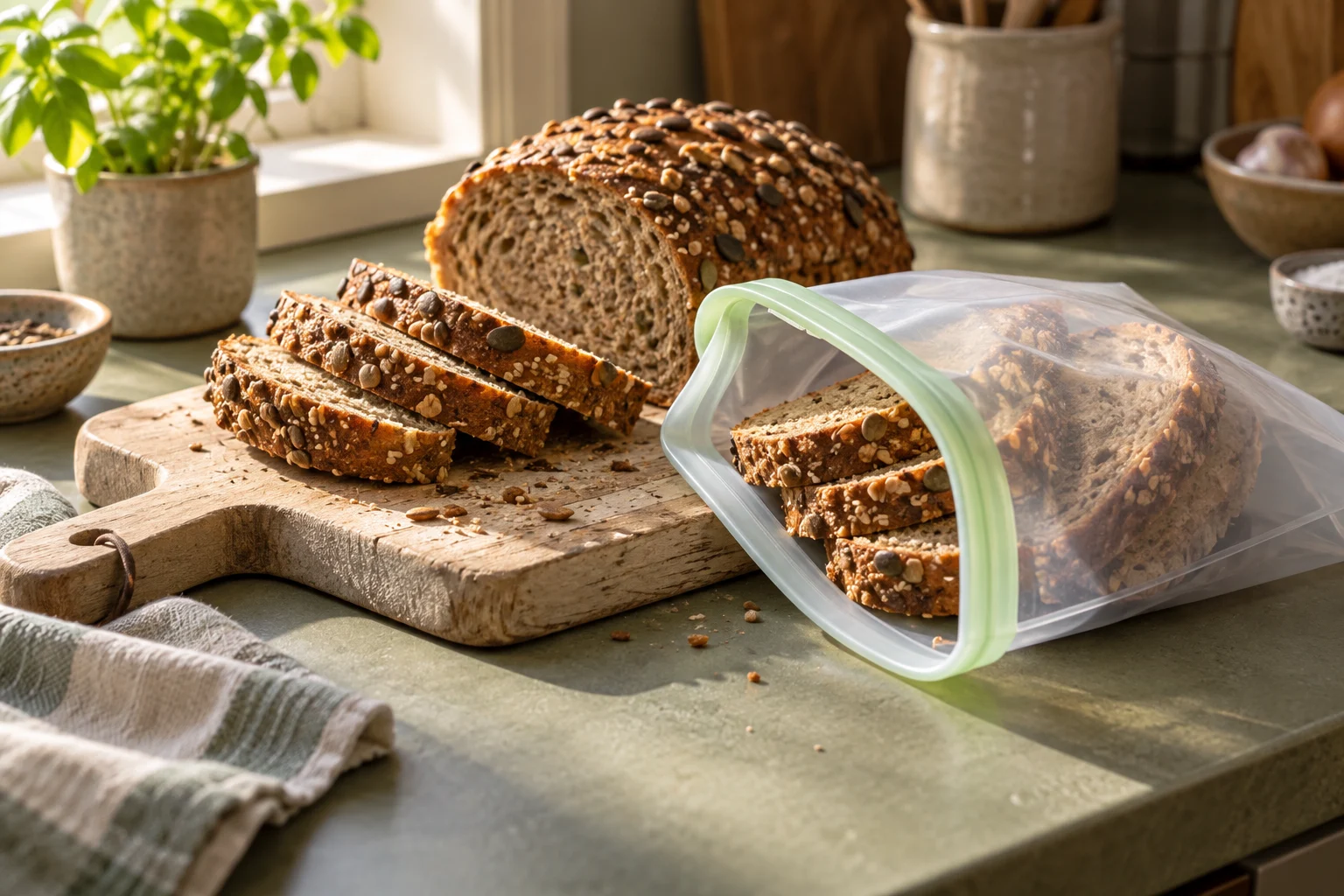
Bread: the freezer is your best friend#
- Slice before freezing
- Freeze on day 2 — NOT day 5 when it's already drying out
- Thaw in the toaster straight from the freezer (1–2 min)
- Freezer shelf life: 3 months
Leftover recipes — 7 ways to use surplus food#
One "leftover night" per week empties the fridge of everything otherwise thrown out. Here are seven guaranteed starting points:
- Roast chicken → chicken salad, wrap, or pasta sauce. Monday's dinner chicken becomes Wednesday's lunch salad.
- Leftover rice → fried rice. Egg, soy, garlic, any vegetable. Done in 10 min.
- Pasta with leftovers → pasta frittata or pasta salad. Mix with vinaigrette and eat cold.
- Boiled potatoes → pytt i panna (Swedish hash) with fried egg. A classic. Works with any leftover.
- Vegetable scraps → soup or stir-fry. Anything starting to wilt goes in soup.
- Stale bread → croutons, breadcrumbs, or French toast. Freeze dried bread heels — collect until you have 500 g.
- Bananas ripening fast → banana bread or frozen for smoothies. Peel, cut, freeze.
Leftovers in the fridge — rule of thumb for shelf life:
| Dish | Fridge shelf life |
|---|---|
| Chicken, fish, rice | 1–2 days |
| Meat, bolognese sauce | 2–3 days |
| Soups, stews, curry | 3–4 days |
| Fried potatoes, pasta | 2–3 days |
Label containers with the date when you cook. That way no containers "disappear" at the back of the fridge.
Weekly meal planning as a tool against food waste#
The single most effective tool. Households that plan their week throw away 30% less food according to Livsmedelsverket. Here's how it works:
- Sunday: First, look in the fridge — what must be eaten? Plan Monday around it.
- Check campaigns at your store (ICA Mon–Sun, Coop Tue–Sun). Build dinners around the sales.
- Write a weekly menu. 5 dinners (Fri/Sat tend to be spontaneous). Plan "leftover night" on Thursday.
- Write your shopping list from the menu. Only what you're missing. Double-check recipes so you don't overbuy.
- One big shop, one top-up shop. Fresh goods for the second half of the week bought on Wednesday.
Effect on food waste: studies show well-planned households throw out 6–10 kg/person/year — compared to 50 kg on average. That's a difference of 4,000 SEK/year for a family.
Want to skip all the manual planning? That's exactly why we built Smaklig — the AI does the weekly plan, counts ingredients, and adapts to your store's campaigns.
Economic savings — calculate your own food waste#
You can measure your own food waste in a week. Simple method:
- Keep a bowl in the fridge labeled "waste" (for a moment before tossing)
- Every time you throw out edible food — put it there first, weigh before tossing
- Record each entry for one week
- Multiply: (waste/week in kg) × 52 × 35 SEK = annual cost
Example: family of 4#
- Week 1: 2.5 kg waste
- Annual cost: 2.5 × 52 × 35 = 4,550 SEK/year
- After 1 month with correct storage + weekly planning: 1.0 kg/week
- New annual cost: 1,820 SEK
- Savings: 2,730 SEK/year
You don't have to be perfect. Halving your food waste is realistic and goes a long way.
Related reading#
- Cheap filling meals — 20 recipes under 30 SEK/serving — combine reduced waste with smart campaign shopping
- Weekly menu for weight loss — planning that gives both health and savings
- ICA campaigns: maximize savings — planned shopping instead of impulse buys
- Dinner ideas for the week — use leftovers as a base for quick dinners
- Glossary: Meal planning and nutrition — definitions of the terms we use
Let Smaklig plan food waste out of your life#
Food waste is 80% planning, 20% storage. Smaklig handles the planning:
- Weekly menu in 30 seconds — AI-generated, adapted to your ICA store's campaigns
- Smart shopping list — exact amount for the recipe, no surplus
- Leftover reminders — use yesterday's chicken in today's lunch
- Budget and waste calculation — so you see the difference in your wallet
You skip counting, hunting sales flyers, or staring into the fridge wondering "what should I do with this?". Smaklig does it for you.
Smaklig is an AI-based meal planning tool built for the Swedish market. Choose your ICA store, enter your goals, and get personalized food that fits your wallet, your nutrition needs — and stops filling the trash bag unnecessarily.
Sources: Naturvårdsverket (Food Waste in Sweden, 2023), Livsmedelsverket (Household Food Waste, 2022), SCB (Household Food Consumption, 2023), Konsumentverket (Reference Budget 2026).
Sources
- Naturvårdsverket. Matavfall i Sverige 2023
- Livsmedelsverket. Livsmedelsverket — Bäst före datum
Frequently asked questions
How much food do Swedish households waste?
The average Swedish household throws out around 50 kg of food waste per year according to Naturvårdsverket (2023). Value: 5,000-8,100 SEK per household per year. A quarter of that is still edible food.
Which foods are wasted the most?
Bread (18%), fruits and vegetables (23%), cooked meals (19%), and dairy (11%). Bread and vegetables account for nearly half — both easy to reduce with better storage and planning.
How can I reduce food waste at home?
Weekly meal planning (reduces waste by 30% immediately), store food correctly (temperature, location), eat best-before items first, freeze leftovers, plan reuse (Monday's chicken → Wednesday's salad).
Is 'best before' the same as 'use by'?
No! 'Best before' means quality may decline but the food is often fine for weeks or months after. 'Use by' is safety (meat, fish) — respect it strictly. Smell, taste, look — apply common sense to best-before dates.
How long can cooked food be kept in the fridge?
3-4 days for most cooked dishes. Chicken, fish, rice: 1-2 days. Soups, stews: 3-4 days. Tip: label containers with cook date. Freeze on day 2-3 if you won't eat it.
Which tips give the biggest savings?
1) Weekly meal planning (3,000+ SEK/year), 2) Shopping with a list (1,500+ SEK), 3) Freezing surplus (1,000+ SEK), 4) Storing fruit correctly (500+ SEK). Combined: 50% less food waste = 2,500-4,000 SEK/year for a family.
Want more meal planning tips?
More guides on food, health and saving money — and a sous-chef that plans your week for you.
Get started
Founder, Smaklig
Writer at Smaklig. We write about food, health, and how to eat better without breaking the bank.
Related articles
September 9, 2026 · 11 min
Alternative to Linas Matkasse – compared with Smaklig (2026)
Looking for an alternative to Linas Matkasse? Compare a delivered meal box with free weekly planning and a shopping list linked to every ICA store.
Read moreSeptember 4, 2026 · 13 min
Photograph Your Fridge — Get Dinner Ideas (2026)
Photograph your fridge and let AI identify ingredients and suggest recipes you can cook now. See how it works, what it can miss, and how it reduces food waste.
Read moreJuly 31, 2026 · 11 min
Meal Prep: Freezer-Friendly Meals for the Week (2026)
Meal prep for the week: choose recipes, scale portions, cool food safely and freeze practical meals. Plan grocery quantities so each ingredient has a clear use.
Read moreReady to plan smarter?
Smaklig creates your weekly menu with AI based on store campaigns. Tailored to your goals and allergies.
Get started free