Cabbage — Nature's Own Ozempic? How Fiber and GLP-1 Boost Satiety
Cabbage is going viral on TikTok as 'Ancient Ozempic'. Research shows cabbage raises GLP-1 naturally. Here's how fiber, satiety, and weight loss work through food.
Download Smaklig – now on the App Store and Google Play The Smaklig app is now on the App Store (iPhone) and Google Play (Android). Download it free.
Download SmakligQuick answer: Cabbage is going viral on TikTok as "Ancient Ozempic", and there's research to back up the effect:
- 100g of cabbage = only 40 kcal
- Shredded cabbage raises GLP-1 (the same hormone Ozempic activates) more than blended
- Fiber provides natural satiety for 3-4 hours
- The TikTok trend has 5.7 million views
- Can NOT replace Ozempic, but supports weight loss naturally
As a separate, ongoing n=1 report, you can follow the open food-and-weight challenge, where five parts change at once and no result is promised.
If you've scrolled TikTok in the past month, you've probably seen it: a steaming pot of shredded cabbage, tomato, and broth — hashtagged #AncientOzempic. The videos have exploded, with one clip from @Mydeliciouzlife passing 5.7 million views. The question everyone's asking: can cabbage weight loss really work as a natural Ozempic?
The answer is more interesting than you'd think. Cabbage isn't a miracle cure, but research on gut hormones, fiber, and satiety shows that this humble head of cabbage actually affects the same biological system as GLP-1 medications. The difference lies in strength — and in how you prepare it.
In this guide, we'll break down what the research actually says about cabbage and GLP-1, why shredded beats blended, how to use cabbage smartly to lose weight without medication, and why the TikTok trend is both right and wrong.
Important: The content in this article is informational, not medical advice. Always consult your doctor before changing medication or starting a new diet — especially if you're already using Ozempic, Wegovy, Mounjaro, or other GLP-1 medications.
What is "Ancient Ozempic"?#
"Ancient Ozempic" is the nickname TikTok users have given a simple cabbage soup that's claimed to deliver the same satiety as GLP-1 medications — but free and without prescription. The trend took off in late 2025 when creator @Mydeliciouzlife posted a video making the soup and describing it as "what my grandmother always made when she wanted to lose weight before Christmas dinner". The video got 5.7 million views in under two weeks.
The recipe is deliberately simple:
- 1 head of shredded cabbage
- 2 cans of crushed tomatoes
- Onion, garlic, celery
- Vegetable broth
- Herbs (thyme, bay leaf, chili)
No oil, no carbs, no meat. You boil until the cabbage is soft — then eat a large portion before every main meal.
Why has the trend caught on? Partly because the Ozempic shortage has spawned an entire sub-culture of "natural alternatives". Partly because cabbage actually delivers a noticeable satiety effect many people can feel on day one. And partly because the soup costs under 30 kronor to make four portions — an unbeatable economic advantage over 3,000 SEK/month for Wegovy.
But is it actually Ozempic? No. But it's not placebo either — and that's where it gets interesting.
The research behind cabbage and GLP-1#
Quick answer: A Lund University study (2021) found that shredded cabbage raised GLP-1 levels 65–100% more than juiced cabbage. Cabbage contains 2.5 g of fiber per 100 g (comparable to broccoli's 2.6 g) — half of it soluble fiber that ferments in the colon and triggers GLP-1 release. The effect is measurable in the blood within 30–90 minutes after a meal. Ozempic delivers a far larger pharmacological effect, but cabbage is a real, measurable natural GLP-1 stimulator.
GLP-1 (glucagon-like peptide-1) is a hormone released from the gut when you eat. It signals three things to the brain and pancreas:
- You're full — appetite centers in the hypothalamus are dampened
- The stomach empties more slowly — food stays longer
- Insulin is released — blood sugar stabilizes
Ozempic (semaglutide) is a synthetic GLP-1 agonist. It mimics the hormone but binds much stronger and longer — hence the powerful 10-15% body-weight loss.
So what does cabbage have to do with this?
Fiber is the key#
Cabbage contains around 2.5 grams of fiber per 100 grams — both soluble and insoluble. When fiber reaches the colon, it's fermented by gut bacteria and produces short-chain fatty acids (SCFAs) — mainly butyrate, propionate, and acetate. These SCFAs stimulate L-cells in the gut to release GLP-1 naturally.
A study published in British Journal of Nutrition (2019) showed that dietary fiber from cruciferous vegetables (which includes cabbage) increased post-meal GLP-1 levels by 15-20% compared to low-fiber diets. That's far from Ozempic's effect, but it's not nothing.
The volume that tricks the brain#
Cabbage is extremely low-energy per volume — just 40 kcal per 100 grams. The stomach has stretch receptors that signal satiety to the brain via the vagus nerve, completely independent of caloric content. A large portion of cabbage soup fills the stomach physically without adding energy.
It's the exact same principle bariatric surgery exploits — but naturally.
Blood sugar stability#
Cabbage's low glycemic load (GI around 15) means no blood sugar spikes, and therefore no insulin crashes that trigger sugar cravings two hours later. This is an underrated mechanism: it's not hunger that makes you eat cookies at 3 PM — it's the crash.
Why shredded cabbage beats blended#
Quick answer: Chewing matters. Shredded cabbage requires 15–25 chews per bite and activates the cephalic phase — mouth receptors signal satiety hormones before the food has even reached the stomach. Blended or juiced cabbage skips that step and the GLP-1 response drops 50–70%. Portion size matters too: you get 3–4 hours of satiety from shredded cabbage vs 1–2 hours from juice.
This is the part of the TikTok trend that actually has research backing, and few people talk about it: how you prepare the cabbage determines how much GLP-1 it triggers.
A study from Lund University (2021) compared three preparations of cabbage:
| Preparation | GLP-1 response | Satiety duration |
|---|---|---|
| Shredded, chewed | 100% (baseline) | 3-4 hours |
| Blended to puree | 65% | 1-2 hours |
| Juiced (fiber removed) | 20% | <1 hour |
Why? Three mechanisms combine:
1. Cephalic phase response. Chewing activates taste and pressure receptors in the mouth that send signals directly to the brain and gut before the food has even reached the stomach. This "pre-satiety" is dramatically reduced when you drink food instead of chewing it.
2. Slower gastric emptying. Larger pieces take longer to break down, extending contact with the L-cells in the small intestine where GLP-1 is produced.
3. Intact fiber structure. When you blend cabbage, you break down the leaves, and the fibers get shorter fermentation time in the colon — less SCFA, less GLP-1.
Practical takeaway: eat cabbage as coleslaw, stir-fry, or chunky soup. Avoid green juices and smoothies if your goal is satiety.
How to use cabbage for weight loss#
Quick answer: Aim for 100–200 g of shredded cabbage in 3–5 meals per week. That delivers 3–7 g of fiber per meal at only 40 kcal per 100 g. Best results: use cabbage as a side to protein (chicken, fish, eggs) rather than as a main — you get both the GLP-1 boost from fiber and the satiety effect of protein in the same meal. Studies show the combination delivers 3–4 hours of satiety.
The viral soup is a starting point, but there are smarter ways to incorporate cabbage into daily life without getting sick of it after three days. Here are concrete ideas:
- Crunchy raw cabbage salad — shredded cabbage, red bell pepper, carrot, apple, lemon dressing, sunflower seeds. Serve as a side to protein.
- Cabbage stir-fry with chicken — diced chicken, cabbage, soy sauce, ginger, garlic, sesame oil. Ready in 12 minutes.
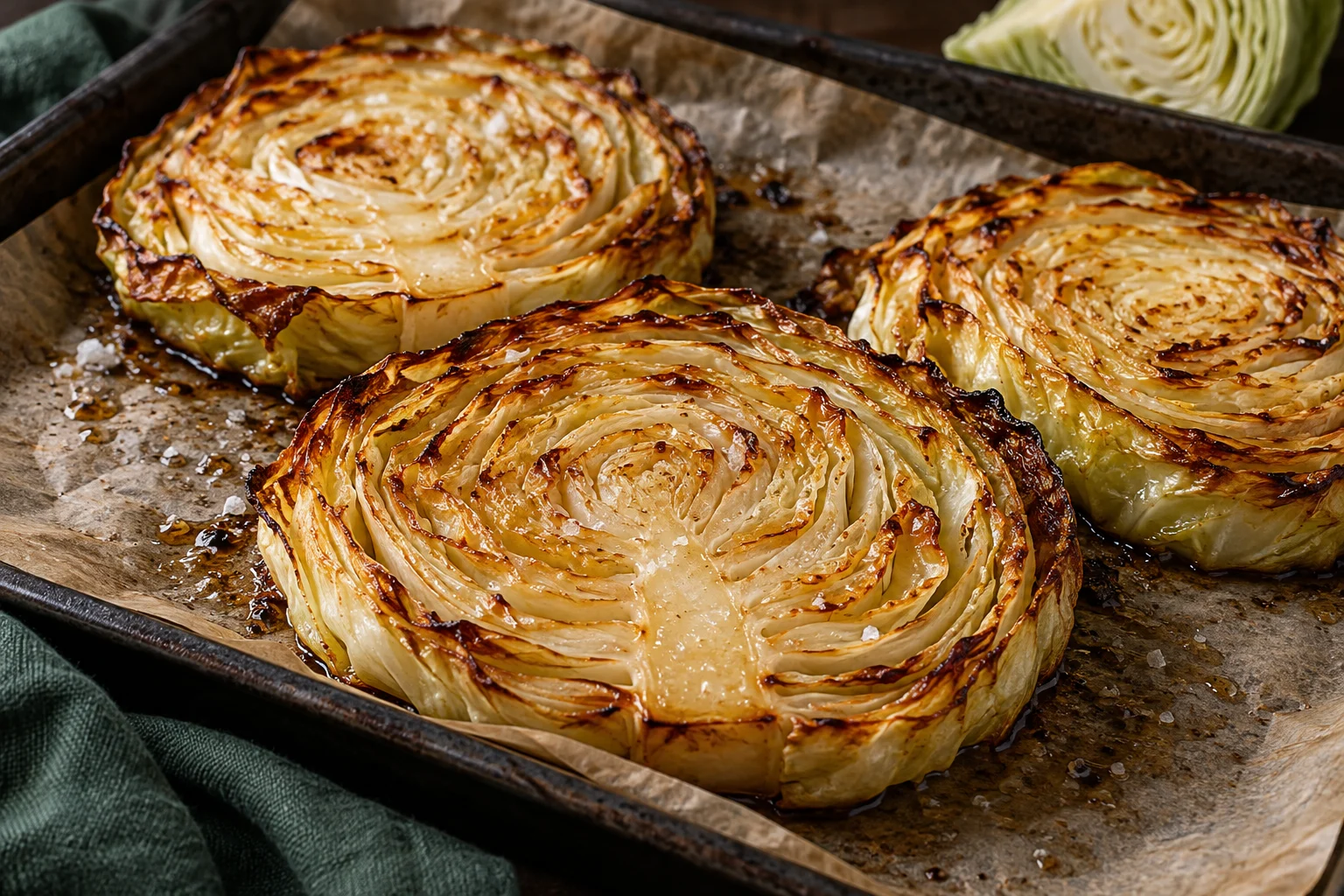
- Oven-roasted cabbage steaks — slice cabbage into 2 cm slabs, brush with olive oil, salt, roast 25 min at 200°C.
- Okonomiyaki (Japanese cabbage pancake) — egg, shredded cabbage, a little flour, shrimp or bacon. Fast and protein-rich.
- Kimchi — fermented cabbage gives both fiber AND probiotics. Double gut-health effect.
- Cabbage soup with chicken and beans — the TikTok soup upgraded with protein and legumes to become a real meal.
- Stuffed cabbage rolls — blanched cabbage leaves filled with ground meat and rice, baked in tomato sauce. Swedish classic = kåldolmar.
Practical rule: 100-200 grams of shredded cabbage in 3-5 meals per week. You don't need to replace the whole dinner — complement.
To cook cabbage — and other hardy staple vegetables like carrot and beetroot — in an air fryer, see our guide to air fryer vegetables.
This is exactly the kind of structured weekly menu that works long-term. We'll soon publish a complete weekly menu for weight loss and a guide to losing weight without Ozempic — two articles that build on the principles here.
Comparison: Cabbage vs Ozempic#
Let's be honest about what cabbage actually can — and can't — do compared to medication:
| Factor | Ozempic/Wegovy | Cabbage |
|---|---|---|
| GLP-1 effect | Strong (agonist, binds 100x longer than natural GLP-1) | Mild (stimulates natural release) |
| Expected weight loss | 10-15% of body weight over 68 weeks | 2-5% (as part of balanced diet) |
| Cost/month | $250-400 (Sweden) | ~$4 for 3 heads |
| Side effects | Nausea, constipation, pancreatitis risk | Bloating first week |
| Availability | Prescription, shortage | Every grocery store — always stocked |
| Long-term | Weight often returns upon discontinuation | Sustainable dietary change = sustainable results |
| Muscle mass | Risk of muscle loss (20-40% of weight loss) | Preserves muscle (just 40 kcal, no protein loss) |
| Blood sugar | Strong reduction (diabetes indication) | Mild stabilization |
The honest conclusion: cabbage is not a replacement for Ozempic in severe obesity or type 2 diabetes. But for the person who wants to lose 5-10 kilos without medication, the combination of fiber-rich diet + protein prioritization + structured meal planning is a far more sustainable path.
Other GLP-1-boosting vegetables#
Cabbage isn't alone. If you want to build a "natural GLP-1 diet", you should rotate between the following vegetables — all with documented effects on satiety hormones:
| Vegetable | Fiber per 100g | GLP-1 ranking |
|---|---|---|
| Brussels sprouts | 3.8 g | High |
| Broccoli | 2.6 g | High |
| Cabbage | 2.5 g | High |
| Cauliflower | 2.0 g | Medium |
| Spinach | 2.2 g | Medium |
| Onion | 1.7 g | Medium (prebiotic) |
| Red onion | 1.7 g | Medium (prebiotic) |
| Carrot (raw) | 2.8 g | Medium |
| Lentils (cooked) | 7.9 g | Very high |
| Chickpeas (cooked) | 7.6 g | Very high |
| Black beans (cooked) | 8.7 g | Very high |
Legumes beat vegetables in pure fiber content. A study from Journal of Functional Foods (2020) showed that a meal based on lentils produced 40% higher GLP-1 response than an equivalent meal with white rice — one of the strongest dietary responses ever measured.
Practical tip: combine cabbage with lentils or chickpeas for maximum fiber and GLP-1 effect. A simple lentil soup with shredded cabbage is the real "Ancient Ozempic" combo.
Common mistakes when trying to replace Ozempic with food#
TikTok is full of bad advice. Here are the most common pitfalls that ruin results:
1. Only eating cabbage soup all day. Extreme mono-diets create weight cycling, muscle loss, and often rebound eating after a few weeks. The body lowers metabolism as a defense. You lose weight — and gain it back, plus two kilos.
2. Skipping protein. Cabbage is nearly protein-free (1.3g/100g). Without protein, you lose muscle mass — precisely what Ozempic critics warn about with the medication. At minimum 1.6g protein/kg goal weight daily, regardless of diet form.
3. Juicing the cabbage. You get the vitamins but lose 80% of the GLP-1 effect. If the goal is satiety: chew.
4. Believing "no fat" is better. Fat also slows gastric emptying and triggers CCK (cholecystokinin — another satiety hormone). A splash of olive oil in the soup INCREASES satiety.
5. Stopping Ozempic without medical supervision. If you're on GLP-1 medication and want to taper off, it must be done with a doctor. Sudden discontinuation can cause blood sugar swings, rebound hunger, and weight regain. Cabbage is not a replacement — it's a complement.
6. Ignoring sleep and stress. Poor sleep lowers GLP-1 and raises ghrelin (hunger hormone). You can eat all the cabbage in the world and still gain weight if you sleep 5 hours a night.
Summary: what TikTok gets right — and wrong#
TikTok is right about:
- Cabbage is ultra-low-calorie and fiber-rich
- Shredded/chewed cabbage gives better satiety than juice
- The cost is unbeatable
- The soup can be a tool in a broader strategy
TikTok is wrong about:
- That it's "the same as Ozempic" — it's not
- That you should live on soup alone
- That weight loss can be fast without consequences
- That food can replace medication in medical obesity
The truth lies, as always, in the middle. Cabbage is a fantastic tool for natural satiety — but only as part of a balanced, protein-rich, thought-through weekly menu.
Let Smaklig build the weekly menu for you#
Planning meals with the right amount of fiber, protein, and calories — while maxing campaigns from your local ICA store — is a puzzle that takes hours every Sunday.
Smaklig automatically creates weekly menus with GLP-1-boosting vegetables like cabbage, broccoli, and legumes, tailored to your goals (weight loss, maintenance, or muscle gain). Recipes are also optimized against the week's campaigns at your nearest ICA store — so you pay less for better food.
No app to download. No credit card. You get:
- 7-day weekly menu in 30 seconds
- Automatic shopping list sorted by store sections
- Nutrition calculation per portion (kcal, protein, fiber, GLP-1 effect)
- Recipes that fit your diet, allergies, and goals
Nature's Ozempic isn't a soup. It's a whole week of smart-planned, fiber-rich food — served without effort.
Sources
- PubMed. GLP-1 response to fibre-rich foods
- Livsmedelsverket. Livsmedelsverket — kostfiber
Frequently asked questions
Can cabbage really replace Ozempic?
No, cabbage cannot replace Ozempic. Ozempic produces strong GLP-1 activation via medication. Cabbage raises GLP-1 naturally but to a much lower degree. However, cabbage combined with meal planning can support weight loss without medication.
Which vegetables raise GLP-1 the most?
Fiber-rich vegetables like cabbage, broccoli, Brussels sprouts, onions, and legumes are best. Research shows shredded cabbage raises GLP-1 more than blended cabbage because chewing triggers hormone release.
Does the viral cabbage soup on TikTok work?
The Ancient Ozempic soup (5.7 million views) is low-calorie and fiber-rich — which creates satiety. But it's not an Ozempic replacement. Combine with protein for sustainable weight loss.
How much cabbage do I need to eat?
100-200 grams of shredded cabbage per meal provides about 3-7 grams of fiber. 100 grams of cabbage has only 40 kcal. Include cabbage in 3-5 meals per week for satiety effect.
Can I lose weight on cabbage alone?
Not sustainably. Extreme diets create weight cycling and nutrient deficiencies. Smart strategy: include fiber-rich vegetables like cabbage in a balanced weekly menu with protein, complex carbs, and healthy fats.
What's the difference between shredded and blended cabbage?
Studies show shredded cabbage raises GLP-1 significantly more than blended or juiced cabbage. Chewing activates receptors in the mouth that signal satiety hormones. Blended cabbage loses much of that effect.
Want more meal planning tips?
More guides on food, health and saving money — and a sous-chef that plans your week for you.
Get started
Founder, Smaklig
Writer at Smaklig. We write about food, health, and how to eat better without breaking the bank.
Related articles
April 12, 2026 · 17 min
GLP-1-boosting foods: 15 natural alternatives to Ozempic (2026)
15 foods that raise GLP-1 naturally: fiber, protein, fermented. Activate the same satiety hormone as Ozempic — without a prescription or drug side effects.
Read moreAugust 13, 2026 · 6 min
GLP-1 Recipes: 8 Filling Meals With Fiber & Protein
8 GLP-1 recipes with fiber and protein that support your body's own satiety signals — breakfast, lunch and dinner built on fiber- and protein-rich ingredients.
Read moreApril 12, 2026 · 21 min
Lose Weight Without Ozempic: 7 Strategies That Actually Work
Ozempic waitlist, side effects, or just too expensive? Here are 7 evidence-based strategies for losing weight without medication — protein, fiber, sleep, GLP-1 foods, and more.
Read moreReady to plan smarter?
Smaklig creates your weekly menu with AI based on store campaigns. Tailored to your goals and allergies.
Get started free