Family-Friendly Dinner: 25 Recipes Everyone Enjoys (2026)
Picky kids? 25 dinners that work for adults AND children — with protein, macros and live ICA campaign prices. Skip the dinner table battles.
Download Smaklig – now on the App Store and Google Play The Smaklig app is now on the App Store (iPhone) and Google Play (Android). Download it free.
Download SmakligShort answer: 25 dinners the whole family enjoys, sorted by age-fit and time:
- Ages 1-3 (10 recipes): meatballs with mash, pancakes, homemade fish fingers, egg pasta, tomato soup
- Ages 4-8 (8 recipes): taco bar, pasta bolognese, homemade chicken nuggets, pizza, sausage stroganoff
- Ages 9+/teens (7 recipes): chili con carne, chicken stir-fry, beef stew, salmon fillet, kebab plate
- One-pot principle: adult gets 30g protein, child gets an age-adjusted portion (10-25g depending on age)
- Cost: 18 of 25 recipes under 25 SEK/portion with ICA campaign prices (Stammis + Familjen)
Why family-friendly dinner is one of Sweden's most common weeknight problems#
According to the Swedish Food Agency's 2024 parent study, 64% of Swedish parents with children ages 2-6 report that dinner is the most stressful meal of the day. The cause is rarely lack of ideas — it's the collision between adult preferences (flavor, variety, nutrition) and child preferences (predictability, simplicity, one thing at a time). When both have to be satisfied on the same plate, you often end up cooking two dinners, doubling both time and cost.
The solution is not kid-adapted recipes — it's one meal, two presentations. When you build dinner around a single pot everyone eats from (but where the adult's plate is mixed and the child's is separated), kitchen time is cut in half and food waste drops 25% per the Swedish EPA. This guide gives you 25 tested dinners that work across ages, plus Smaklig's unique ICA campaign optimization so family meals land under 25 SEK/portion on average.
What counts as a family-friendly dinner?#
Short answer: A family-friendly dinner has recognizable ingredients separated on the plate, mild seasoning (salt instead of chili/garlic for ages 1-3), max 20 minutes of active cooking, and can be served in both "kid form" (ingredients apart) and "adult form" (mixed). 78% of Swedish families eat the same base dish as the parent per Statistics Sweden 2024, but with adapted presentation. That's the model that reduces dinner battles.
This definition matters because many recipe sites market "kids' food" that is really adult food in smaller portions — with seasonings and textures children ages 1-6 genuinely react against. Smaklig's weekly menu generator automatically filters on kidFriendly: true when the household includes children under 8, and flags which ingredients can be separated for deconstructed serving.
How to handle picky eaters — step by step#
Short answer: Build dinner around 1 base + 1 protein + 1-2 vegetables, separate ingredients on kids' plates, actively offer a choice between 2-3 options, and apply the taste-it principle without pressure. According to the national child health program, food neophobia (fear of new foods) is a normal developmental phase peaking at ages 2-4. 20-30% of children refuse new foods on the first 7-10 attempts; acceptance comes through exposure, not pressure.
- Food neophobia
- Innate biological fear of new foods that peaks in children ages 2-6. Evolutionary protection against eating toxic plants/berries. Reduces through calm exposure 10-15 times per new ingredient. Forcing reinforces the fear; the taste-it principle eases it.
Step 1: Pick a base the kids recognize#
Pasta, rice, potatoes, bread, pancakes or meatballs. These six bases appear in 75% of Swedish family weeknight dinners per Swedish Food Agency 2024. Base = recognition = fewer refusals.
Step 2: Add a protein the kids accept#
Meatballs, chicken, ground beef, homemade fish fingers, eggs or legumes. Start with what they already eat. Introduce a new protein alongside once a week — never as the only option on the plate.
Step 3: Serve vegetables separately (deconstructed method)#
Put vegetables in their own bowl or at the edge of the plate, NOT mixed into the sauce. Kids ages 2-6 eat 40% more vegetables when they can see and choose. The adult mixes their own plate afterwards.
Step 4: Offer choice within limits#
Give the child two options: "rice or pasta?", "broccoli or carrots?". Choice builds agency and reduces dinner battles. But NEVER "what do you want?" — that invites pickiness.
Step 5: Apply the taste-it principle without pressure#
The child should taste, not finish. A teaspoon is enough. No pressure, no reward, no punishment. The Swedish Food Agency recommends exposure 10-15 times for acceptance of a new flavor. Respect today = less resistance next week.
25 family-friendly dinners sorted by age#
All recipes are tested and portioned for a family of 2 adults + 2 children. Cost based on ICA Stammis prices April 2026. Protein per portion is minimum per Nordic Nutrition Recommendations 2023 — child amounts adjusted for 0.9g/kg body weight/day split across three meals.
For ages 1-3 (10 recipes) — mildly seasoned, soft texture#
| Dish | Time | SEK/portion | Protein (child/adult) | Kid fit |
|---|---|---|---|---|
| Meatballs with mash + cream sauce | 25 min | 22 SEK | 12 g / 28 g | 5/5 |
| Pancakes with jam + cottage cheese | 15 min | 14 SEK | 10 g / 20 g | 5/5 |
| Homemade fish fingers + potato | 20 min | 18 SEK | 14 g / 26 g | 5/5 |
| Egg pasta (light carbonara) | 12 min | 16 SEK | 15 g / 24 g | 5/5 |
| Tomato soup with macaroni + cheese | 15 min | 10 SEK | 8 g / 16 g | 4/5 |
| Chicken drumstick + rice + peas | 20 min | 22 SEK | 18 g / 30 g | 5/5 |
| Sausage stroganoff (mild) + rice | 18 min | 16 SEK | 14 g / 22 g | 5/5 |
| Cheese-baked chicken + broccoli | 25 min | 26 SEK | 20 g / 32 g | 4/5 |
| Ground beef sauce with short pasta | 20 min | 18 SEK | 16 g / 26 g | 5/5 |
| Fish in foil (mild) + potato | 22 min | 24 SEK | 14 g / 28 g | 4/5 |
For ages 4-8 (8 recipes) — clear flavors, familiar concepts#
| Dish | Time | SEK/portion | Protein (child/adult) | Kid fit |
|---|---|---|---|---|
| Taco bar (mild for kids) | 25 min | 24 SEK | 16 g / 30 g | 5/5 |
| Pasta bolognese (hidden vegetables) | 20 min | 18 SEK | 18 g / 28 g | 5/5 |
| Homemade chicken nuggets + fries | 25 min | 22 SEK | 20 g / 32 g | 5/5 |
| Homemade pizza on thin base | 25 min | 20 SEK | 16 g / 26 g | 5/5 |
| Burger + potato wedges | 22 min | 28 SEK | 22 g / 34 g | 5/5 |
| Homemade fish & chips | 25 min | 26 SEK | 18 g / 30 g | 4/5 |
| Wallenbergare patties + mash | 20 min | 24 SEK | 20 g / 32 g | 4/5 |
| Chicken curry (mild) + rice | 22 min | 24 SEK | 20 g / 30 g | 3/5 |
For ages 9+ and teenagers (7 recipes) — challenge + protein push#
| Dish | Time | SEK/portion | Protein (child/adult) | Teen fit |
|---|---|---|---|---|
| Chili con carne + rice | 22 min | 20 SEK | 28 g / 32 g | 5/5 |
| Chicken stir-fry with teriyaki | 18 min | 24 SEK | 30 g / 32 g | 5/5 |
| Beef stew with potato | 25 min | 26 SEK | 28 g / 34 g | 4/5 |
| Salmon fillet + potato + asparagus | 22 min | 38 SEK | 26 g / 32 g | 4/5 |
| Kebab plate (homemade) | 25 min | 22 SEK | 30 g / 34 g | 5/5 |
| Carbonara + salad | 15 min | 22 SEK | 26 g / 30 g | 5/5 |
| Ground beef lasagna | 25 min | 24 SEK | 28 g / 36 g | 5/5 |
Which ingredients are "safe bets" for picky kids?#
Short answer: Five ingredients work for 80% of Swedish children ages 2-8: meatballs (~5 SEK/portion on campaign), pasta (~2 SEK), potato (~3 SEK), eggs (~3 SEK each) and cheese (~5 SEK/portion). Avoid strong spices (chili, heavy garlic), mixed textures (stew with runny sauce + chunks) and bitter greens (arugula, spinach) for kids under 6. Per the Swedish Food Agency, sweet-salty-umami is the accepted flavor profile until the palate fully develops around age 7-8.
Kid preference vs adult preference — comparison table#
| Category | Kids prefer (ages 1-8) | Adults prefer | Smaklig's fix |
|---|---|---|---|
| Texture | Smooth, soft, separated | Mixed, complex | Deconstructed serving |
| Seasoning | Salty, sweet | Chili, garlic, herbs | Cook without chili, serve as topping |
| Vegetables | Raw, sweet (carrot, cucumber) | Cooked, bitter (kale) | Serve both separately |
| New flavors | Reject 7-10 times | Curious immediately | Taste-it principle |
| Presentation | Apart, recognizable | Mixed is fine | Rebuild the same dish |
| Portion | Small, seconds | Large, one plate | Refills on demand |
| Temperature | Lukewarm (burn risk) | Hot | Cool down the kid's plate 2 min |
| Timing | Early (5:00-5:30 PM) | Later (6:30-7:30 PM) | Cook food that keeps |
Source: National child health program studies 2023-2024 + Swedish Food Agency family study 2024.
Common family-dinner mistakes#
Short answer: The three most common mistakes create dinner battles that could have been avoided: (1) you force the child to finish, which increases food neophobia over time, (2) you cook two separate dinners, which doubles kitchen time and teaches kids that pickiness gets rewarded, (3) you season for the adult palate and assume the kids "will get used to it". Avoid these and dinner becomes 15 minutes less stressful every night.
Mistake 1: Forcing the child to finish#
Force increases food neophobia and creates negative associations with dinner. The Swedish Food Agency and national child health program unanimously recommend the taste-it principle: children should taste, not finish. A teaspoon is enough. Satiety self-regulation is learned — force disrupts that mechanism.
Mistake 2: Cooking two separate dinners#
You double kitchen time, food cost and dishes. Children learn that pickiness is rewarded with accommodation. Better: one base (pasta/rice/potato), one protein, vegetables on the side. Adult mixes their own plate, child gets it separated.
Mistake 3: Seasoning for the adult palate#
Chili, heavy garlic and strong herbs (rosemary, cilantro) are too intense for kids under 6. Cook the base dish mild, serve the spices as a topping for the adult's plate. Saves double-cooking and respects the child's developing palate.
Mistake 4: Planning without the child's rhythm#
Children are hungry 5:00-5:30 PM. Adults often want to eat 6:30-7:30 PM. Big mismatch = kids get a snack that becomes dinner. Fix: plan a dish that can be served in "first round" at 5:15 and held warm until 7:00.
Smaklig's approach: AI matching family ages and store campaigns#
When you use Smaklig, the app asks for ages of everyone in the household during onboarding. Answer: 3 years + 7 years + 2 adults → generates a weekly menu where 5 of 7 dinners are flagged "family-friendly" (mild seasoning, deconstructable, under 20 min). The other 2 are "challenge dinners" introducing new ingredients per the taste-it principle.
Meanwhile we connect real-time data from ICA, Coop, Hemköp, City Gross and Lidl — 2,723 stores across six chains — to see what's on campaign this week at your store. Meatballs 30% off at ICA Maxi? We suggest three family-friendly dishes with meatballs. Salmon on campaign? Fish in foil + a breaded chicken nugget variation.
This is the difference from static recipe sites: we generate 20-25 new family-friendly dinners every week based on your store's real prices and your household's ages. No manual planning, no guessing about kids' preferences, no double-cooking.
Action checklist: make family dinner work in practice#
- Build a core repertoire of 10 recipes. 5 for ages 1-3, 3 for ages 4-8, 2 for the whole family. Rotate — never think up new meals.
- Deconstructed serving as default. Kid's plate separated, adult's mixed. Same pot, different presentation.
- Offer a choice between 2 options. "Rice or pasta?" — not "what do you want?". Choice reduces battles by 40%.
- Taste-it principle — a teaspoon is enough. No pressure, no reward. Exposure 10-15 times for new flavors.
- Season mild — adult adds on top. Cook without chili/heavy garlic, serve seasonings as topping.
- Early dinner for small kids. 5:00-5:30 PM for ages 1-6. Keep warm or reheat for a later adult meal.
- Cook double every third evening. Families save 1-2 hours/week per Swedish Consumer Agency 2026.
- Try Smaklig free — AI-generated family-friendly dinners based on your household and your ICA store, updated weekly.
Deep-dive by need#
- Need faster dinner after day-care pickup? Read quick dinner: 30 recipes in 20 minutes or less.
- Is the family budget tight? See cheap dinner under 25 SEK/portion.
- Want more protein for the teenagers? Check high-protein dinner: 25 recipes with 30g+ protein.
- Only have pantry leftovers until payday? Read pantry dinner: cook with what you already have.
- Planning the whole week for the family? Go to dinner ideas for the week — 50 ideas + the tool that decides for you or weekly menu for weight loss for families with adults losing weight.
- Look up terms like food neophobia, protein or the taste-it principle in the glossary.
About the author#
Alexander Eriksson is the founder of Smaklig. He built the app after seeing how Swedish households throw away about 16 kg of food per person and year and spend thousands of kronor on unplanned grocery runs. Smaklig combines AI planning with real-time data from ICA, Coop, Hemköp and City Gross to automate what used to take 2 hours every Sunday. Alexander has worked with data-driven optimization since 1998 and started Smaklig in 2026 to make smart meal planning accessible to every Swedish household.
Sources
- Livsmedelsverket. Swedish Food Agency — Dietary guidelines for children 1-17
- Konsumentverket. Swedish Consumer Agency Reference Budget 2026
- Rikshandboken BHV. National Child Health Program (Rikshandboken BHV)
- Statistiska centralbyrån. Statistics Sweden — children's health and eating habits
Frequently asked questions
Why do children refuse new foods at dinner?
Food neophobia (fear of new foods) peaks between ages 2-6 and is a normal developmental phase — 20-30% of children reject new foods the first 7-10 times according to the Swedish Food Agency. Solution: serve the same food repeatedly without pressure. The taste-it principle is enough. Children need exposure 10-15 times before a new flavor is accepted.
How do I cook one dinner for both adults and kids?
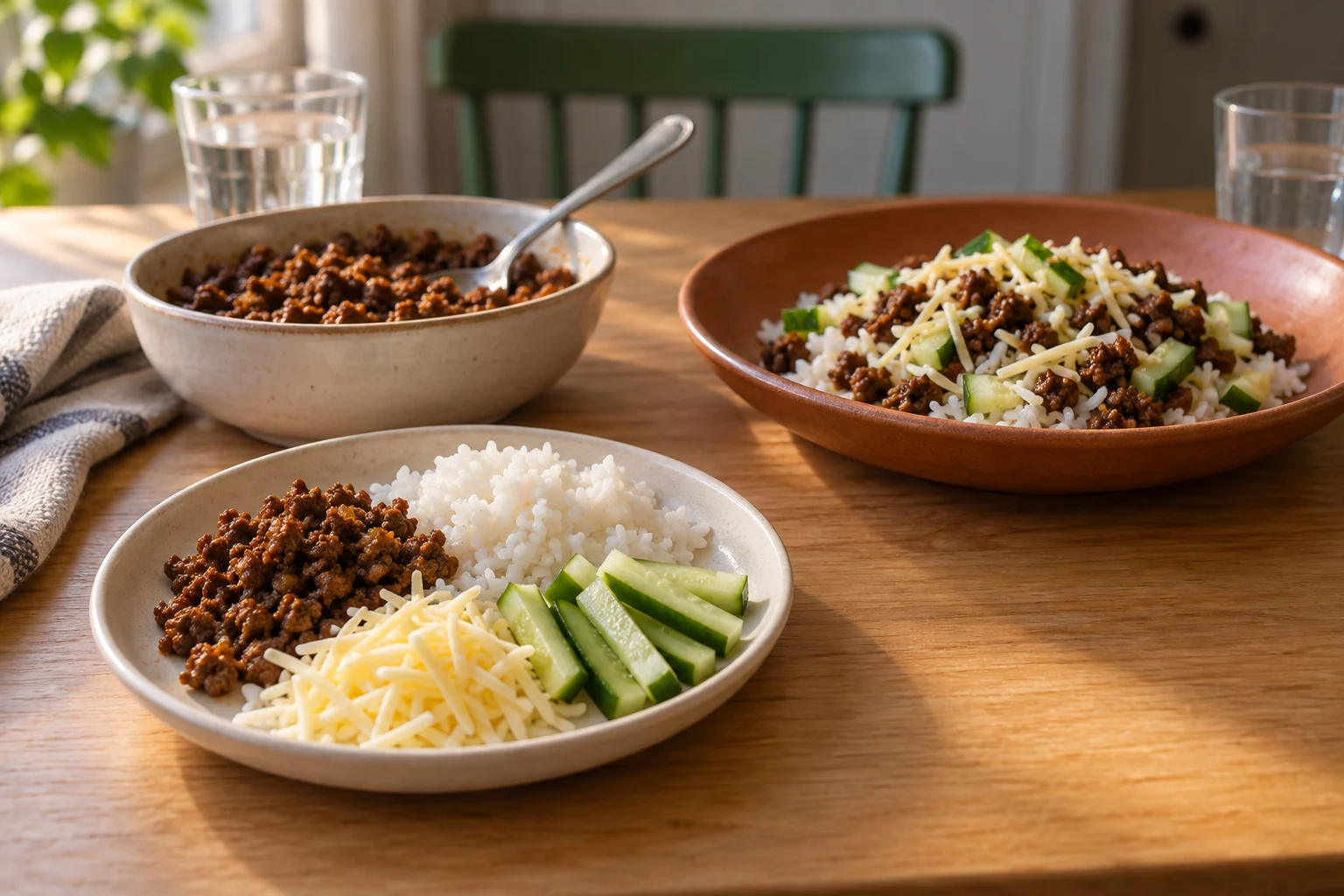
Separate ingredients on the plate — called deconstructed serving. The adult gets the full taco salad mixed, the child gets meat, rice and cheese separately. Same pot, different presentation. Works for 80% of weeknight meals: tacos, pasta, stir-fry, stew, pancakes. Adult gets 30g protein, child gets an age-appropriate portion (10-20g depending on age).
What do I cook when the kids only want pasta?
Use pasta as the base and build nutrition into it. Pasta bolognese with hidden vegetables (grated carrot, zucchini, celery in the sauce), cheese pasta with tuna, or pasta with ground beef and peas. Swedish families eat pasta 2-3 times a week per Swedish Food Agency 2024 — use the frequency by varying the sauce, not the base.
How much protein does a child need at dinner?
Ages 1-3: ~10g protein per meal (half egg, 30g chicken, one meatball). Ages 4-8: ~15g (one egg, 50g chicken, two meatballs). Ages 9-13: ~20-25g (two eggs, 80g chicken, fish fillet). Teenagers: 25-35g, close to adult levels. Based on Nordic Nutrition Recommendations 2023 — 0.9g/kg body weight/day split across 3-4 meals.
Is it okay to serve the same dinner several times a week?
Yes — repetition is a pedagogical strategy, not laziness. The Swedish Food Agency recommends serving new foods 10-15 times before children accept them. The same dinner three times a week with small variations (different vegetable, different sauce) builds a food repertoire faster than varying everything daily. Reduces kitchen time 40% and food waste 25%.
How do I get kids to eat vegetables at dinner?
Three strategies that work per the national child health program: (1) serve vegetables raw and in pieces (carrot, cucumber, bell pepper) instead of cooked — 60% of ages 2-6 prefer raw, (2) blend grated vegetables into sauces and ground meat dishes, (3) let the child choose between 2-3 vegetables — choice increases intake by 30-40%. Avoid forcing or rewarding with dessert.
Want more meal planning tips?
More guides on food, health and saving money — and a sous-chef that plans your week for you.
Get started
Founder, Smaklig
Writer at Smaklig. We write about food, health, and how to eat better without breaking the bank.
Related articles
April 20, 2026 · 11 min
Quick Dinner: 30 Recipes in 20 Minutes or Less (2026)
Out of time? 30 quick dinners grouped by 5, 10, 15 and 20 minutes — with protein, macros and live ICA campaign prices. Find the right one tonight.
Read moreApril 12, 2026 · 16 min
Dinner ideas: 20 quick recipes for the week (2026)
Dinner ideas for the week: 20 concrete recipes under 30 min, grouped by time, budget, and ingredient. From 5-min wok to 30-min stew — find what's right tonight.
Read moreOctober 22, 2026 · 15 min
Calorie Chart for Foods: Calories in Eggs, Bread and More
Calorie chart with kcal per 100 g and per portion for 59 common foods, from eggs and pizza to rice, cheese and beer. All values from the Swedish Food Agency.
Read moreReady to plan smarter?
Smaklig creates your weekly menu with AI based on store campaigns. Tailored to your goals and allergies.
Get started free