High-Protein Dinner: 25 Recipes With 30g+ Protein Per Serving (2026)
High-protein dinner: 25 recipes with 30g+ protein per serving, including quick dinners under 30 min. Macros, cook time and cost — preserve muscle mass.
Download Smaklig – now on the App Store and Google Play The Smaklig app is now on the App Store (iPhone) and Google Play (Android). Download it free.
Download SmakligShort answer: 25 dinners with 30 g+ protein per serving, sorted by protein amount:
- 30-35 g protein: chicken stir-fry, salmon bowl, oven-baked cod with beans, chickpea curry with feta, halloumi bowl
- 35-45 g protein: grilled chicken breast with quinoa, ground-beef pasta, tuna pasta, lamb stew, steak with mushroom sauce
- 45 g+ protein: steak with lingonberries, chicken stew with lentils, salmon patties with quark, entrecôte with beans, grilled skewers with yogurt sauce
- Cost: 12 of 25 recipes land under $2.50/serving with campaign items from ICA, Coop or City Gross
- Vegetarian: 6 recipes with 30 g+ protein without meat or fish
Why high-protein dinner matters#
Dinner is often the day's largest meal — but for many people it's also the most protein-deficient. A classic "pasta with Bolognese" typically contains 18-22 g protein per serving, which is 30-40% below the recommendation for an adult aiming to preserve muscle mass in a caloric deficit or build strength.
This guide shows you 25 dinners that consistently deliver 30 g+ protein per serving — with exact numbers, ICA campaign prices, and cook time per recipe. Protein intake is the single variable that matters most when you're trying to lose weight without losing muscle mass (Helms et al., 2014, JISSN). Smaklig's TDEE calculator computes protein needs dynamically per user based on goals, and this list is paired with those calculations.
Important: This article is general information based on research — not medical advice. For caloric deficits below 1200 kcal/day, a history of eating disorders, pregnancy, diabetes, or other medical conditions — always consult a licensed doctor or dietitian before following a diet plan.
How much protein do you need per dinner?#
Short answer: Typically 30-45 g protein per dinner for an adult. For weight loss and muscle preservation, research recommends 1.8-2.2 g protein per kg target weight per day (Morton et al., 2018, Br J Sports Med), distributed across 3-4 meals. That gives ~30-45 g per main meal, with a slightly higher share for dinner if it's the day's largest.
- Protein synthesis
- The process by which the body builds new proteins from amino acids. After a protein intake of 25-40 g, muscle protein synthesis is stimulated for 3-5 hours. Distributing protein evenly across the day (3-4 meals) yields roughly 25% higher total synthesis than eating all of it at one meal, according to studies summarized in NNR 2023.
Protein needs per goal (Smaklig's nutrition module)#
Smaklig's lib/nutrition.ts calculates protein needs dynamically based on the user's goal. Values come from NNR 2023 + Morton et al. 2018 + Helms et al. 2014:
| Goal | g protein/kg target weight | Daily need (65 kg target) | Per dinner (25-30% of day) |
|---|---|---|---|
| Weight loss | 2.0 g/kg | 130 g | 33-40 g |
| Muscle building | 1.8 g/kg | 117 g | 30-36 g |
| Maintenance / health | 1.6 g/kg | 104 g | 26-32 g |
| General recommendation (NNR 2023, sedentary) | 0.83 g/kg | 54 g | 14-16 g |
The difference between NNR's "general" recommendation (0.83 g/kg) and recommendations for active individuals (1.6-2.2 g/kg) is important: the lower number prevents deficiency but does not optimize for muscle preservation in a caloric deficit or during strength training (Helms et al., 2014).
25 high-protein dinners sorted by protein amount#
All recipes calculated for 2 adult servings. Prices from ICA Stammis April 2026; may be 20-30% higher without campaign. Protein figures from Livsmedelsverket's food database (2024).
30-35 g protein per serving (10 recipes)#
| Dish | Protein | Time | $/serving | Type |
|---|---|---|---|---|
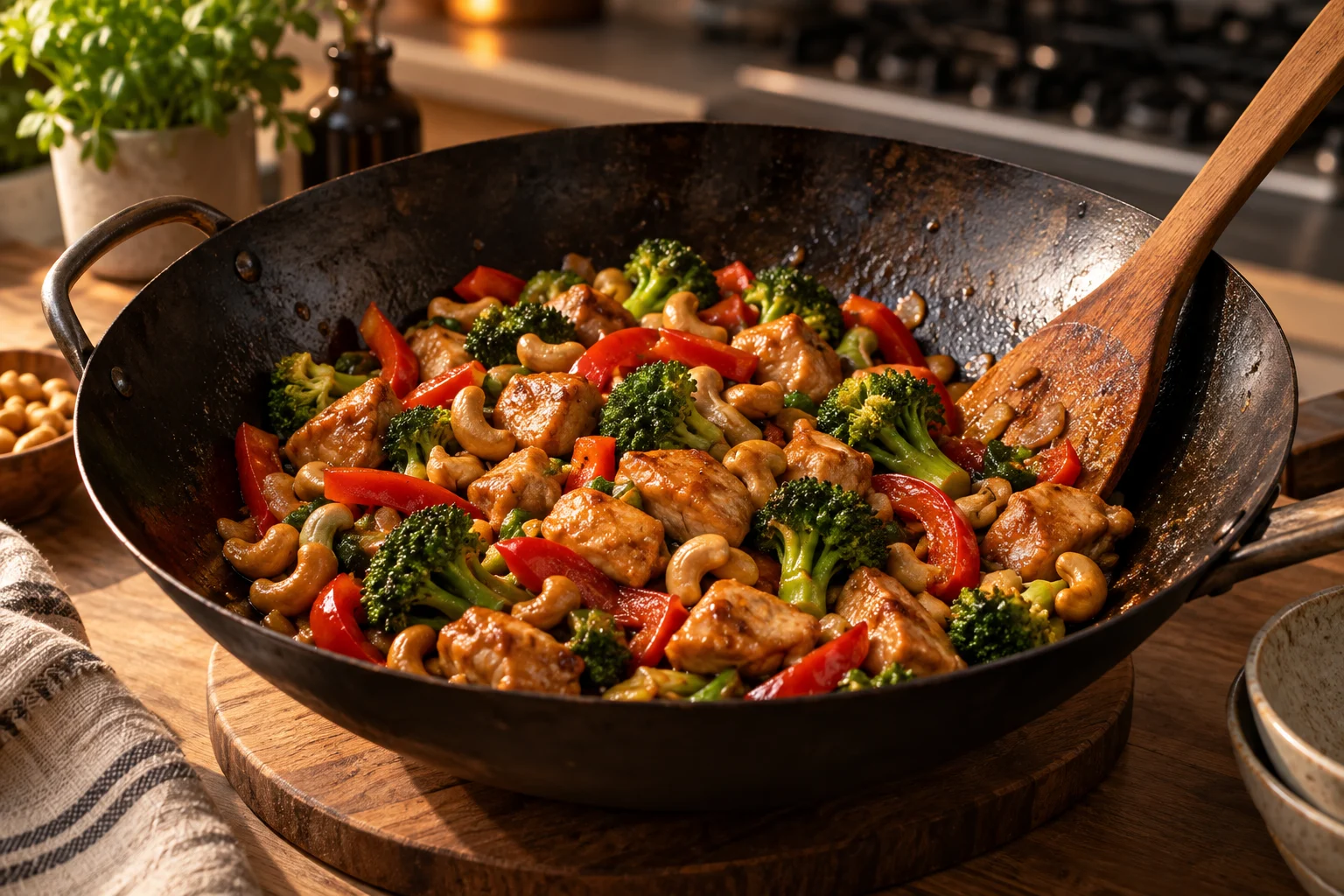
| Chicken stir-fry with cashews | 32 g | 15 min | $2.60 | Meat |
| Salmon bowl with quinoa and edamame | 34 g | 20 min | $4.20 | Fish |
| Oven-baked cod with white beans | 30 g | 25 min | $3.60 | Fish |
| Chickpea curry with feta | 32 g | 20 min | $1.80 | Vegetarian |
| Halloumi bowl with chickpeas | 34 g | 15 min | $2.40 | Vegetarian |
| Tuna pasta with yogurt-lemon | 33 g | 12 min | $2.20 | Fish |
| Chicken stew with bell pepper | 31 g | 25 min | $2.40 | Meat |
| Lentil stew with feta and spinach | 30 g | 20 min | $1.60 | Vegetarian |
| Tofu stir-fry with edamame and rice | 30 g | 15 min | $2.20 | Vegetarian |
| Egg frittata with feta and broccoli | 32 g | 15 min | $1.80 | Vegetarian |
35-45 g protein per serving (9 recipes)#
| Dish | Protein | Time | $/serving | Type |
|---|---|---|---|---|
| Grilled chicken breast with quinoa | 42 g | 20 min | $2.20 | Meat |
| Bolognese with high-meat ratio on pasta | 38 g | 20 min | $2.80 | Meat |
| Tuna pasta with egg and parmesan | 40 g | 12 min | $2.00 | Fish |
| Lamb stew with beans and tomato | 44 g | 35 min | $4.80 | Meat |
| Steak with mushroom sauce and potato wedges | 42 g | 25 min | $5.20 | Meat |
| Pan-seared chicken breast with white beans | 45 g | 18 min | $2.40 | Meat |
| Shrimp pasta with quark and garlic | 36 g | 15 min | $3.20 | Fish |
| Burrito bowl with ground beef + beans | 40 g | 20 min | $2.60 | Meat |
| Oven-baked salmon with quark-dill | 38 g | 25 min | $4.60 | Fish |
45 g+ protein per serving (6 recipes)#
| Dish | Protein | Time | $/serving | Type |
|---|---|---|---|---|
| Entrecôte with pan-fried beans | 52 g | 15 min | $6.80 | Meat |
| Pan-seared filet with lingonberry and quark | 48 g | 20 min | $5.80 | Meat |
| Chicken stew with lentils and spinach | 46 g | 30 min | $2.80 | Meat |
| Salmon patties with quark-dill sauce | 47 g | 20 min | $3.80 | Fish |
| Grilled skewers with yogurt sauce + bulgur | 50 g | 25 min | $3.40 | Meat |
| Chicken parmigiana with mozzarella | 56 g | 25 min | $3.20 | Meat |
Which ingredients give the most protein per dollar?#
Short answer: Legumes (lentils, chickpeas) give $0.03-0.04 per gram of protein, eggs $0.05/g, chicken breast on campaign $0.04/g, quark $0.06/g. Fish is most expensive: salmon ~$0.12/g, cod ~$0.09/g. For budget-optimized protein: 60% legumes + eggs, 30% chicken/quark, 10% fish according to Smaklig's pattern for cost-efficient weight loss.
Protein per dollar — comparison table#
| Ingredient | Protein/100 g | $/100 g | $/g protein |
|---|---|---|---|
| Lentils (dry) | 23 g | $1.20 | $0.05 |
| Chickpeas (canned) | 8 g | $0.80 | $0.10 |
| Beans (canned) | 8 g | $0.70 | $0.09 |
| Eggs | 13 g | $0.40/egg (~$6/kg) | $0.05 |
| Quark 1.5% | 12 g | $1.80 (500 g = $3.60) | $0.06 |
| Chicken breast (sale) | 31 g | $8.90/kg | $0.03 |
| Chicken breast (regular) | 31 g | $14/kg | $0.05 |
| Ground beef 10% fat | 20 g | $9.50/kg | $0.05 |
| Salmon | 20 g | $24/kg | $0.12 |
| Cod | 18 g | $16.50/kg | $0.09 |
| Halloumi | 24 g | $9/kg | $0.04 |
| Tuna (canned) | 26 g | ~$4/kg | $0.02 |
Source: Livsmedelsverket food database (2024) + ICA Stammis prices April 2026.
Insight: Canned tuna on campaign is the cheapest protein source per gram of protein — under $0.02/g. Chicken breast on campaign is second cheapest and offers more variety.
Vegetarian high-protein dinners — 6 recipes with 30 g+#
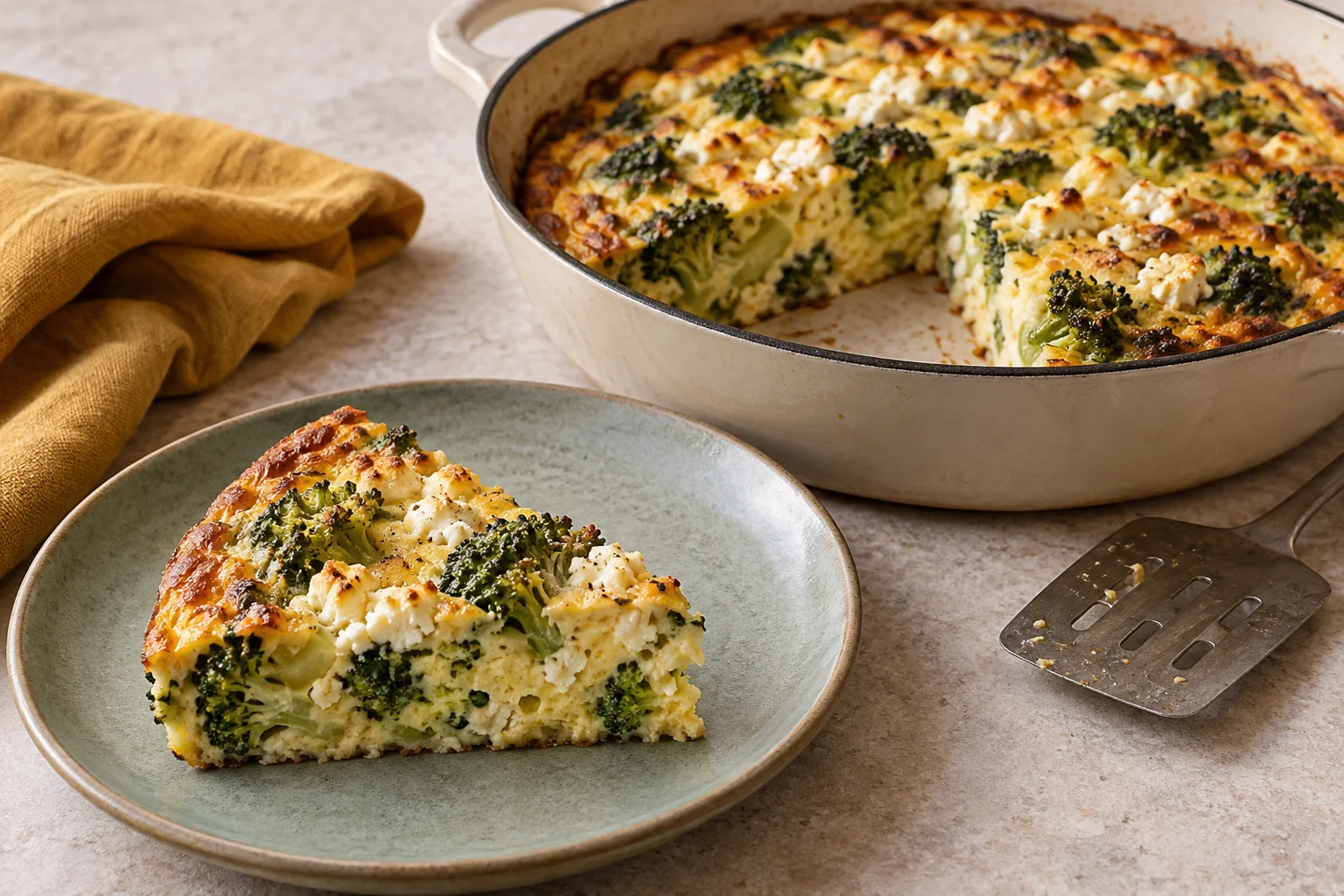
Short answer: As a vegetarian you can hit 30 g protein per dinner by combining legumes with dairy or eggs. Typical winners: halloumi bowl (34 g), lentil stew with feta (30 g), tofu stir-fry (30 g), frittata with feta (32 g), chickpea curry with yogurt (32 g), quinoa bowl with beans and halloumi (33 g). Plant protein has slightly lower biological value, so aim for ~10% higher total intake across the day (NNR 2023).
Important considerations for vegetarian protein:
- Combine legumes with dairy/eggs for complete amino acid profile
- Quantity: Plant proteins have lower density — 300 g lentils gives 27 g protein vs 150 g chicken gives 47 g
- Variety: Rotate between soy products (tofu, edamame), legumes (lentils, chickpeas, beans), dairy (quark, halloumi, feta), and eggs
- Vegan: Without dairy/eggs, larger portions or soy protein additions (edamame, tofu) are required to reach 30 g
How to calculate your protein per dinner — step by step#
Short answer: Calculate target weight × 1.8-2.2 g = daily need → divide across 3-4 meals → pick recipe that fills the gap for the specific meal. Smaklig's nutrition module does this automatically based on your goal (weight loss/maintenance/muscle building) and activity level.
Step 1: Determine your goal#
Pick one of three scenarios:
- Weight loss (caloric deficit): 1.8-2.2 g protein per kg target weight — preserves muscle mass (Helms et al., 2014)
- Muscle building (caloric surplus or maintenance + strength training): 1.6-2.2 g/kg body weight (Morton et al., 2018)
- Maintenance / health: 1.6 g/kg for active, 0.83 g/kg for sedentary (NNR 2023)
Step 2: Calculate daily need#
Example 1: 65 kg target weight × 2.0 g/kg = 130 g protein/day (weight loss)
Example 2: 80 kg body weight × 1.8 g/kg = 144 g protein/day (muscle building)
Example 3: 70 kg × 1.6 g/kg = 112 g protein/day (maintenance, active)
Step 3: Distribute evenly across the day#
Divide total protein across 3-4 meals. Even distribution yields ~25% higher total muscle protein synthesis than "all at dinner" according to research.
- 4 meals: 130 g / 4 = 32-33 g per meal
- 3 meals: 130 g / 3 = 43-44 g per meal (more ambitious)
Step 4: Choose recipe based on gap#
If you ate 22 g breakfast + 40 g lunch + 8 g snack = 70 g before dinner. Daily goal 130 g → dinner needs to deliver 60 g protein. Pick from the 45g+ list or increase portion size of a 35-45g recipe.
Step 5: Verify the first month#
Weigh protein 2-3 times per week during the first month — eyeballing is often off by 20-30%. After calibration, estimation is enough. Smaklig's app logs protein per recipe automatically.
Common mistakes with high-protein dinners#
Short answer: The three most common mistakes halve the effect of a high-protein dinner: (1) you calculate on current weight instead of target weight when overweight, (2) you skip protein at breakfast and lunch and try to "catch up" at dinner (yields worse total synthesis), (3) you rely on eyeballing without calibrating with a scale for a month.
Mistake 1: Calculating on current weight when overweight#
A person weighing 95 kg with target weight 75 kg should calculate protein on 75 kg, not 95 kg. Otherwise you get 170 g protein/day instead of 135 g — unnecessarily high and can crowd out other nutrients. Exception: during strength training, the lower of body weight and target weight + 10% may be reasonable.
Mistake 2: Stacking all protein at dinner#
Eating 20 g breakfast + 20 g lunch + 80 g dinner = 120 g may look OK, but total muscle protein synthesis ends up 20-25% lower than even distribution. Muscle cannot "store" a large protein surplus at a single meal — the excess is oxidized for energy or converted to glucose.
Mistake 3: Eyeballing without calibration#
"A normal portion of chicken" looks different depending on plate and person. Typical error: undervaluation by 25-40% in people who haven't weighed before. Weigh the first month to calibrate — then your hand works as reference (palm of chicken = ~30 g protein).
Mistake 4: Forgetting vegetarian protein sources#
Even if you eat meat, include 2-3 vegetarian protein meals per week. Legumes provide fiber that supports satiety (30% fewer kcal at the next meal according to studies). Cost advantage is 60-70% cheaper than meat per gram protein.
Mistake 5: Thinking whey is required#
Studies show no difference in muscle-building between whole-food protein (chicken, quark, eggs) and whey at matched total intake (Morton et al., 2018). Whey is convenience — not necessity. Use it if you struggle to hit the target, skip it if you manage with food.
Smaklig's approach: dynamic protein per user#
When you onboard Smaklig, you set a goal (weight loss / maintenance / muscle building) and activity level. Our lib/nutrition.ts module calculates:
- BMR via the Mifflin-St Jeor formula (most accurate for Swedish population according to comparison studies)
- TDEE by multiplying BMR × activity factor (1.2-1.9)
- Calorie budget for your goal (maintenance, -500 kcal for weight loss, +200 kcal for bulk)
- Protein grams/day dynamically per goal (2.0 g/kg target weight for weight loss, 1.8 g/kg for maintenance-active, 1.8 g/kg for muscle building)
- Protein per meal through distribution across 3-4 meals
The AI then matches each recipe suggestion to your gap — if you're 35 g protein short of the daily goal at 5 PM, Smaklig suggests a 35 g+ dinner from the list above that also matches budget, time, campaign items at your ICA store, and any allergies.
That's the difference compared to static template meal plans: we generate new dinners every week based on your real protein gap, not a generic template for "adult 70 kg".
Action checklist: get started with high-protein dinner#
- Calculate your daily need — target weight × 1.8-2.2 g (weight loss) or 1.6-1.8 g (maintenance)
- Split across 3-4 meals — aim for even distribution, not all at dinner
- Stock the pantry with cheap protein staples — eggs, quark, lentils, chickpeas, canned tuna, chicken breast (freeze on sale)
- Learn 5 recipes by heart from the 30-45g list — starter pack for rotation
- Weigh protein the first month — eyeballing is 20-40% off before calibration
- Include 2-3 vegetarian dinners/week — fiber + 60% cheaper per gram protein
- Skip whey if you hit goals with food — no proven advantage at matched total intake
- Try Smaklig free — AI calculates your protein gap dynamically and suggests dinners every week
Dive deeper based on your need#
- Need a general dinner guide? Read dinner ideas for the week — 50 ideas + tools that decide for you.
- Want to lose weight? Read lose weight without Ozempic for the complete strategy.
- Looking for quick dinners? See quick dinner — 30 recipes in 20 minutes.
- Want protein at breakfast too? Read high-protein breakfast for weight loss.
- Dive deeper into TDEE and macros with TDEE calculator + macros guide.
- Look up terms in the glossary.
About the author#
Alexander Eriksson is the founder of Smaklig. He built the app after seeing Swedish households throw away about 16 kg of food per person annually and spend thousands unnecessarily on unplanned shopping. Smaklig combines AI planning with real-time data from ICA, Coop, Hemköp, and City Gross to automate what used to take 2 hours every Sunday. Alexander has worked with data-driven optimization since 1998 and started Smaklig in 2026 to make smart meal planning accessible to all Swedish households.
Sources
- Livsmedelsverket. Swedish Food Agency (Livsmedelsverket) — dietary guidelines
- Nordic Council of Ministers. Nordic Nutrition Recommendations 2023
- British Journal of Sports Medicine, 2018. Morton et al., A systematic review, meta-analysis and meta-regression of the effect of protein supplementation on resistance training-induced gains in muscle mass and strength
- Journal of the International Society of Sports Nutrition, 2014. Helms et al., Evidence-based recommendations for natural bodybuilding contest preparation: nutrition and supplementation
- Livsmedelsverket. Livsmedelsverket food database
Frequently asked questions
How much protein do I need per dinner?
Typically 30-45 g protein per dinner for an adult. For a 70 kg person with target weight 65 kg doing strength training, that equals ~30-35 g per main meal, based on a daily need of 1.6-2.2 g/kg target weight ([Morton et al., 2018](https://pubmed.ncbi.nlm.nih.gov/28698222/)). Individual variation applies.
Which ingredients give the most protein per dollar?
Eggs (~$0.30/egg, 6 g protein = $0.05/g), chicken breast on sale (~$1.30/serving, 31 g = $0.04/g), and quark/skyr (~$1.10/serving, 20 g = $0.06/g). Legumes like lentils and chickpeas deliver $0.03-0.04 per gram of protein and are the cheapest option per Livsmedelsverket price data.
Can I get 30 g protein per dinner as a vegetarian?
Yes. Combine legumes (lentils, beans, chickpeas) with dairy or eggs. Examples: lentil stew with feta (32 g), halloumi bowl with chickpeas (34 g), tofu stir-fry with edamame (30 g). Plant proteins typically have slightly lower biological value, so a slightly higher total intake may be appropriate ([NNR 2023](https://www.nnr2023.no)).
What counts as a high-protein dinner?
A dinner where at least 25% of calories come from protein, or at least 30 g protein per serving for an adult. A 600 kcal dinner with 35 g protein equals 23% of calories from protein — satiety is typically 20-30% better than a carb-heavy dinner according to satiety hormone research.
Do I need whey protein or supplements at dinner?
Not if you eat whole foods. Whole foods like chicken, fish, eggs, quark, and legumes cover protein needs for most people. Supplements are convenience — not necessity. Studies show no difference in muscle-building between whole-food protein and whey at matched total intake ([Morton et al., 2018](https://pubmed.ncbi.nlm.nih.gov/28698222/)).
How do I calculate my protein needs for weight loss?
In a caloric deficit: 1.8-2.2 g protein per kg target weight to preserve muscle mass. A person with target weight 65 kg needs 117-143 g/day ([Helms et al., 2014](https://pubmed.ncbi.nlm.nih.gov/24864135/)). Split across 3-4 meals = 30-45 g per meal. Smaklig's TDEE calculator computes this dynamically based on your specific goal.
Want more meal planning tips?
More guides on food, health and saving money — and a sous-chef that plans your week for you.
Get started
Founder, Smaklig
Writer at Smaklig. We write about food, health, and how to eat better without breaking the bank.
Related articles
August 3, 2026 · 10 min
High-Protein Dinner for Weight Loss: 7 Recipes (2026)
High-protein dinner for weight loss: 7 recipes with about 30–40 g protein, 25–35 minute cooking times and clear cost ranges. Build a meal-kit shop in Smaklig.
Read moreOctober 22, 2026 · 15 min
Intermittent Fasting for Women: What the Research Shows
In trials, intermittent fasting gives similar weight loss to an ordinary calorie deficit. On 16:8, menopause, PCOS, pregnancy and who should avoid fasting.
Read moreSeptember 30, 2026 · 9 min
Stress, cortisol and a body that no longer responds as usual
How stress, cortisol, insulin, 'cortisol belly' and muscle fit together, what supplements are good for and when to see a doctor.
Read moreReady to plan smarter?
Smaklig creates your weekly menu with AI based on store campaigns. Tailored to your goals and allergies.
Get started free