High-Protein Breakfast: 10 Recipes <10 Min (2026)
High-protein breakfast for weight loss: how to get 30 grams of protein, with and without protein powder, plus 10 quick, filling recipes under 10 min.
Download Smaklig – now on the App Store and Google Play The Smaklig app is now on the App Store (iPhone) and Google Play (Android). Download it free.
Download SmakligQuick answer: 10 high-protein breakfasts under 10 minutes for weight loss:
- Target: 25–40 g protein per serving for 3–4 hours of satiety
- Cheapest: 9 SEK/serving (boiled egg + oats + banana)
- Fastest: 2 min (chia pudding prepared the night before)
- Effect: 30 g protein breakfast cuts hungry episodes by 60% during the day (Leidy 2015)
- Cuts total calorie intake: 12–15% per day through increased satiety (Westerterp-Plantenga 2009)
A current personal example appears in the documented challenge about weight loss, where breakfast is not isolated as a cause and no result is promised.
Why breakfast protein is critical for weight loss#
Breakfast is the meal that affects the rest of the day most. The wrong breakfast (sugar, low protein) gives a blood-sugar spike → crash 90–120 min later → craving for sweet snacks at 10–11 AM → 300–500 extra calories without noticing.
The right breakfast (25–40 g protein) delivers:
- Increased TEF — 20–30% of calories are burned just in digestion (vs 5–10% for carbs, 0–3% for fat)
- Longer satiety — 3–4 hours vs 1–2 for sugar-based breakfast
- More stable blood sugar — protein slows carb absorption
- Preserved muscle mass during calorie deficit (1.6–2.2 g/kg target weight, see TDEE calculator)
- Lower total calorie intake — drops 12–15% per day per Westerterp-Plantenga (2009)
The 5 best protein sources for breakfast#
| Source | Protein per serving | Price | Time | Good for |
|---|---|---|---|---|
| Eggs (2 st) | 12 g | 6 SEK | 6 min | Classic, omnivore |
| Kvarg (150 g) | 18 g | 10–14 SEK | 1 min | Quick, lactose-friendly |
| Skyr (150 g) | 17 g | 12–16 SEK | 1 min | Icelandic, slightly tart |
| Cottage cheese (150 g) | 16 g | 8–12 SEK | 1 min | Mildest flavor, high calcium |
| Oats (1 dl) + milk | 10 g | 4 SEK | 5 min | Cheapest, high fiber |
Pro-tip: Check this week's ICA campaigns — eggs and kvarg are often on 30–50% sale.
10 breakfasts with 25–40 g protein#
Quick answer: Here are 10 concrete recipes sorted by time. All hit at least 25 g protein. 4 are under 10 SEK/serving. 3 can be prepped the night before for "open the fridge and eat" mornings.
1. Classic omelet with cheese and spinach (6 min, 32 g protein, 14 SEK)#
- 3 eggs + 50 g grated cheese + handful spinach + butter
- Whisk eggs, fry in butter, sprinkle cheese + spinach, fold. Serve with toasted rye.
- Protein: 18 g eggs + 12 g cheese + 3 g bread = 33 g
2. Kvarg + oats + berries (2 min, 28 g protein, 16 SEK)#
- 200 g kvarg + 1 dl oats + 100 g frozen berries + 1 tbsp honey
- Mix everything directly from package.
- Protein: 24 g kvarg + 4 g oats = 28 g
3. Chia pudding (2 min in morning, 26 g protein, 18 SEK)#
- Night before: 3 tbsp chia seeds + 2.5 dl milk + 1 tbsp protein powder + 1 tsp vanilla
- Mix in jar, seal, chill overnight.
- Morning: top with berries, raspberries, or banana.
- Protein: 6 g chia + 8 g milk + 12 g powder = 26 g
4. Skyr bowl with nuts and fruit (2 min, 30 g protein, 18 SEK)#
- 200 g Skyr + 1 tbsp walnuts + 1 tbsp hazelnuts + 1 sliced banana
- Combine in bowl.
- Protein: 22 g Skyr + 5 g nuts + 3 g banana = 30 g
5. Oatmeal with egg + almond butter (8 min, 27 g protein, 11 SEK)#
- 1 dl oats + 2.5 dl milk → boil 4 min. Stir in 1 tbsp almond butter.
- Boil 1 egg in parallel (4 min hard-boiled).
- Serve together.
- Protein: 10 g oats+milk + 7 g almond butter + 6 g egg = 23 g (add 1 tbsp hemp seeds for +5 g)
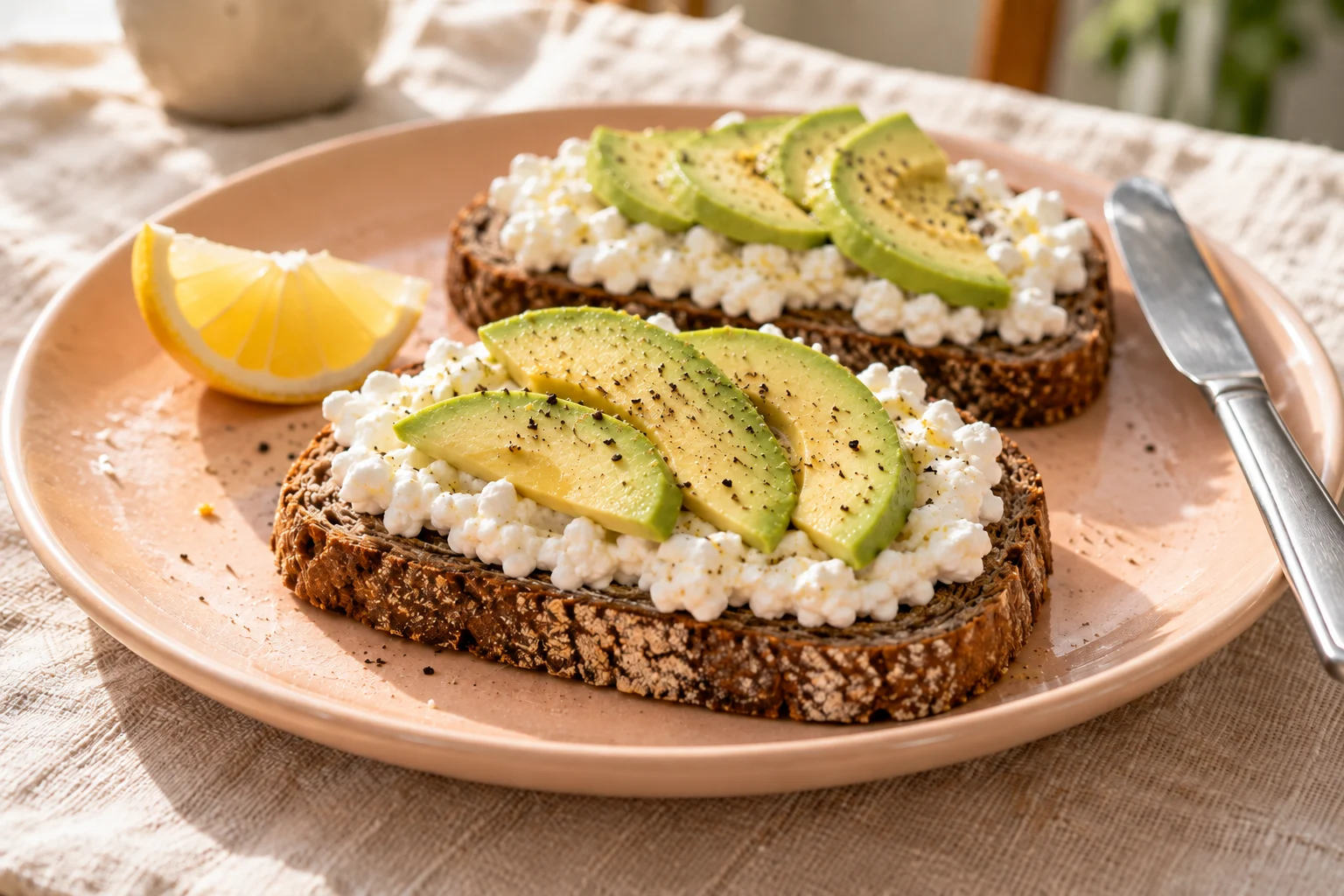
6. Cottage cheese on rye with avocado (3 min, 26 g protein, 13 SEK)#
- 2 slices rye + 150 g cottage cheese + 1/4 avocado + salt, pepper, lemon
- Spread cottage cheese on bread, slice avocado on top.
- Protein: 16 g cottage cheese + 6 g bread + 2 g avocado = 24 g
7. Protein shake + banana + oats (3 min, 38 g protein, 15 SEK)#
- 3 dl milk + 30 g protein powder + 1 banana + 1/2 dl oats
- Blend everything.
- Protein: 10 g milk + 25 g powder + 3 g banana + 3 g oats = 41 g
8. Greek yogurt with granola (2 min, 25 g protein, 17 SEK)#
- 200 g Greek yogurt 10% + 50 g granola (check protein label, pick >10 g/100g) + 1 tbsp honey
- Bowl, layer, eat.
- Protein: 20 g yogurt + 5 g granola = 25 g
9. Avocado-egg toast (7 min, 28 g protein, 18 SEK)#
- 2 slices sourdough + 1/2 avocado + 2 poached or fried eggs + chili/pepper
- Toast bread, mash avocado on top, add eggs.
- Protein: 12 g eggs + 10 g bread + 2 g avocado (+ 4 g add 50 g smoked salmon) = 28–32 g
10. Cheapest: boiled egg + oatmeal (9 min, 25 g protein, 9 SEK)#
- 2 boiled eggs (6 min) + 1 dl oats boiled in water (4 min) + 1 dl milk + cinnamon
- Serve with 1/2 banana if you have.
- Protein: 12 g eggs + 8 g oats+milk + 3 g banana = 23 g (push to 35 g with extra egg for +6 g)
How to get exactly 30 grams of protein at breakfast#
Short answer: 30 grams of protein at breakfast is a practical benchmark — not a universal physiological threshold. The point is to spread protein evenly across the day's meals rather than piling almost all of it onto dinner. A small study of eight healthy adults found about 25% higher 24-hour muscle protein synthesis when protein was evenly distributed (roughly 30 g per meal) versus skewed (Mamerow et al., 2014, J Nutr). Here's how to combine your way to 30 grams without doing math in your head:
| Food (typical serving) | Protein |
|---|---|
| 1 egg | ~7 g |
| Kvarg / quark, plain (100 g) | ~11 g |
| Cottage cheese (100 g) | ~13 g |
| Skyr, plain (100 g) | ~11 g |
| Greek yoghurt (100 g) | ~9 g |
| Oats, dry (40 g) | ~5 g |
| Protein powder (30 g) | ~24 g |
Source: Swedish Food Composition Database. Values are approximate and vary between products — check the nutrition label on your packaging, especially for yoghurt and protein powder.
Four combinations that land around 30 grams (rounded to the values above):
- 2 eggs (~14 g) + 150 g quark (~16 g) ≈ 30 g
- 200 g skyr (~22 g) + 40 g oats (~5 g) + a handful of almonds ≈ 30 g
- 200 g cottage cheese (~26 g) + a slice of rye bread ≈ 30 g
- Protein shake (30 g powder, ~24 g) + 2 dl milk (~7 g) ≈ 30 g
The reason 30 grams comes up so often is that it's a reasonable amount most people can manage at breakfast and enough for noticeable satiety — not because the body "caps" protein above an exact line. Whether you need more or less depends on your body weight and goals (see the daily-needs section below).
Can you eat a high-protein breakfast without protein powder?#
Quick answer: Yes. Protein powder is a convenience food, not a requirement for a high-protein breakfast. Eggs, dairy, cereals, legumes, nuts, and seeds are protein sources according to NNR 2023. Build breakfast around one clear main source plus oats or rye bread, and check the nutrition label if you are following a gram target.
Three simple combinations without powder are kvarg or Skyr with oats and seeds, eggs with cottage cheese and rye bread, and oatmeal cooked with milk and served with an egg. For a plant-based breakfast, combine legumes with cereals; NNR describes that combination as a way to obtain a good distribution of essential amino acids.
How much protein do you need at breakfast?#
Quick answer: There is no separate Nordic recommendation for breakfast. NNR 2023 instead sets an adult reference intake of 0.83 grams per kilogram of body weight per day, within 10–20% of energy. Divide your daily need across meals and treat this article's 25–40 grams as practical examples, not a universal requirement.
For example, an adult weighing 70 kg has a reference intake of about 58 g protein per day at the NNR baseline. Needs and goals can differ with high training volume, older age, illness, or intentional weight loss. NNR notes that protein's share of energy may need to rise when energy intake is low so the daily requirement is still met.
What is a quick and easy high-protein breakfast?#
Quick answer: Pick a protein source that needs no cooking and add a high-fibre side. Kvarg or Skyr with oats takes about two minutes; cottage cheese on rye takes roughly three. With five minutes, make oatmeal with milk and add a pre-boiled egg. Check the nutrition label for the actual amount of protein in your products.
Make mornings easier by preparing a jar of oats and seeds the night before, boiling several eggs at once, or portioning cottage cheese. The same model works whether you prefer a cold bowl, a sandwich, or hot oatmeal: one clear protein source, something high in fibre, and fruit, berries, or vegetables.
Comparison table — pick the right breakfast for the day#
| # | Breakfast | Time | Protein | Price | Carbs |
|---|---|---|---|---|---|
| 1 | Omelet + cheese + spinach | 6 min | 33 g | 14 SEK | Low |
| 2 | Kvarg + oats + berries | 2 min | 28 g | 16 SEK | Medium |
| 3 | Chia pudding | 2 min | 26 g | 18 SEK | Low |
| 4 | Skyr + nuts + banana | 2 min | 30 g | 18 SEK | Medium |
| 5 | Oatmeal + egg | 8 min | 27 g | 11 SEK | High |
| 6 | Cottage cheese + rye + avocado | 3 min | 26 g | 13 SEK | Medium |
| 7 | Protein shake + banana | 3 min | 38 g | 15 SEK | Medium |
| 8 | Greek yogurt + granola | 2 min | 25 g | 17 SEK | Medium |
| 9 | Avocado-egg toast | 7 min | 28 g | 18 SEK | Medium |
| 10 | Boiled egg + oatmeal | 9 min | 25 g | 9 SEK | High |
How to prep 5 breakfasts in 15 min Sunday evening#
Quick answer: "Batch-cook" 5 breakfasts Sunday so you just open the fridge on weekdays. Chia pudding, hard-boiled eggs, oatmeal in jars, kvarg portions, sliced fruit — everything ready when you wake up.
15-minute Sunday prep#
- Boil 5 eggs (10 min passive — you can multitask) → fridge storage 5 days
- 5 chia jars (5 min) → 3 tbsp chia + 2.5 dl milk each jar → fridge 5 days
- 5 kvarg portions (3 min) → 200 g kvarg + 1 dl oats each jar, top in the morning
- Oven oatmeal (5 min prep, 30 min passive) → 5 dl oats + 7.5 dl milk + cinnamon in oven dish 30 min at 180 °C → 5 portions
- Sliced fruit (2 min) → banana + apples in sealed container → 2 days
Total time: 15 min active + 40 min passive. Result: 5 ready high-protein breakfasts for the week. Total cost ~50 SEK = 10 SEK/serving average.
Avoid these breakfast mistakes#
- "Health flakes" without protein — 8 g protein vs 30 g target. You'll be hungry again at 10 AM.
- Juice instead of fruit — 120 kcal of sugar, no fiber, no satiety.
- Coffee drinks as breakfast — 250–400 kcal sugar + milk. Doesn't count as breakfast.
- Skipping breakfast to "save calories" — leads to overeating 3–8 PM. Studies do NOT show intermittent fasting is more effective than steady calorie budgets.
- Protein bars — 30 SEK/serving, 8–12 g protein, high sugar. More expensive per gram of protein than eggs × 5.
Related reading#
- TDEE calculator and macros — calculate your daily protein need
- Weekly menu for weight loss — build breakfasts into weekly planning
- Lose weight without Ozempic — 7 strategies for natural weight loss
- Cheap filling meals — 20 recipes under 30 SEK/serving
- Dinner ideas for the week — quick dinners under 30 min
- Glossary — TDEE, macros, GLP-1, and more
Let Smaklig plan breakfasts for you#
Smaklig builds breakfast schedules based on:
- Your protein target (1.6–2.2 g/kg target weight)
- This week's ICA campaigns (eggs, kvarg, oats often 30–50% off)
- Time you have in the morning
- Allergies and preferences
You get 7 days of high-protein breakfasts + shopping list in 30 seconds.
Smaklig is an AI-based meal planning tool for the Swedish market. Pick your ICA store, set your goals, and get personalized meal plans that support weight loss.
Medical disclaimer: This article is general information based on research — not medical advice. For eating disorders, diabetes, kidney disease, or pregnancy: always consult a licensed healthcare professional before changing your breakfast or protein intake.
Sources
- PubMed / Obesity. Leidy et al. — Protein breakfast and appetite (2015)
- PubMed / J Nutr 144(6):876-880. Mamerow et al. — Dietary protein distribution and 24-h muscle protein synthesis (2014)
- PubMed / Obes Rev. Westerterp-Plantenga — Protein TEF and satiety (2009)
- Livsmedelsverket. Livsmedelsverket — nutrition recommendations
- Nordic Council of Ministers. Nordic Nutrition Recommendations 2023 — Protein
Frequently asked questions
How much protein do I need at breakfast for weight loss?
At least 25-40 grams of protein at breakfast. Research shows 30 g protein at breakfast cuts hungry episodes by 60% during the day (Leidy et al., 2015). Example: 2 eggs + 150 g kvarg = 34 g protein.
Why is high-protein breakfast important for weight loss?
Protein has the highest TEF (thermic effect of food) — 20-30% of calories are burned in digestion alone. Plus: satiety 3-4 hours vs carbs 1-2 hours. Cuts total calorie intake 12-15% (Westerterp-Plantenga, 2009).
What are the best protein sources for breakfast?
Top 5: eggs (6g/egg, 420 kcal for an omelet), kvarg (12g/100g), cottage cheese (11g/100g), oats with milk (8g total), Skyr/Greek yogurt (10g/100g). All under 15 SEK per serving at campaign prices.
How much time do you need for a high-protein breakfast?
5-10 minutes. Omelet: 6 min. Chia pudding (prepared the night before): 2 min in the morning. Oatmeal: 5 min. Kvarg + berries + oats: 2 min. Most are faster than driving to the café.
Can I make high-protein breakfast cheap?
Yes. Eggs (3 SEK/each), oats (2 SEK/serving), kvarg (8 SEK/100g on sale) — breakfast for 9-15 SEK/serving with 25-35 g protein. Compare with store-bought muesli: 25-35 SEK/serving with only 10-15 g protein.
Does high-protein breakfast work if I don't like eggs?
Absolutely. Skyr/Greek yogurt + oats + berries + nuts = 30 g protein. Kvarg + chia + fruit = 28 g. Protein shake + oats + banana = 35 g. Cottage cheese on rye = 25 g. Plenty of egg-free options.
Want more meal planning tips?
More guides on food, health and saving money — and a sous-chef that plans your week for you.
Get started
Founder, Smaklig
Writer at Smaklig. We write about food, health, and how to eat better without breaking the bank.
Related articles
August 3, 2026 · 9 min
High-Protein Lunch for Weight Loss: 8 Recipes (2026)
High-protein lunch for weight loss: 8 recipes with about 29–46 g protein, 12–25 minute prep and estimated costs from 15 SEK. Plan the full shop in Smaklig.
Read moreSeptember 30, 2026 · 9 min
Stress, cortisol and a body that no longer responds as usual
How stress, cortisol, insulin, 'cortisol belly' and muscle fit together, what supplements are good for and when to see a doctor.
Read moreAugust 13, 2026 · 6 min
GLP-1 Recipes: 8 Filling Meals With Fiber & Protein
8 GLP-1 recipes with fiber and protein that support your body's own satiety signals — breakfast, lunch and dinner built on fiber- and protein-rich ingredients.
Read moreReady to plan smarter?
Smaklig creates your weekly menu with AI based on store campaigns. Tailored to your goals and allergies.
Get started free