Calorie Deficit: How Much Do You Actually Need? (2026)
Calorie deficit — how big does it need to be, how do you calculate it, and why doesn't it always work? Research-based guide with female-specific factors.
Download Smaklig – now on the App Store and Google Play The Smaklig app is now on the App Store (iPhone) and Google Play (Android). Download it free.
Download SmakligQuick answer: A calorie deficit of 300-500 kcal/day (15-25% below TDEE) produces sustainable weight loss of 0.3-0.5 kg/week for most adults.
- 300-500 kcal/day is the evidence-based sweet spot (NNR 2023 — Nordic Nutrition Recommendations)
- Women: lowest safe intake = fat-free mass × 30 kcal (Loucks 2003)
- Müller 2015: Up to ~108 kcal/day adaptive thermogenesis within 3 days (metabolic ward study on men under severe restriction) — expect body resistance at moderate deficits too, though smaller in magnitude
- Bray 2012 (JAMA): Calories drive fat, protein drives muscle — NOT macro distribution
- Measurement accuracy: TDEE calculators have ±10-15% margin of error — use as a benchmark, not absolute truth
If you have a difficult relationship with food, you don't have to handle it alone: Reach out to National Alliance for Eating Disorders helpline (US, 1-866-662-1235), Beat's helpline (UK, 0808 801 0677), or your country's national eating disorder service.
This article provides general guidelines based on current nutrition research. Individual factors — health status, medications, hormones, and life situation — affect how the body responds to a calorie deficit. The advice does not replace counseling from a doctor or dietitian. A calorie deficit is intake below expenditure over a day — it is how weight loss is built in biology, but how big the deficit needs to be, how to calculate it safely, and why the scale sometimes won't move are questions that research actually answers. This guide covers the mechanism, the math, female-specific factors, and the real boundaries.
The campaign's own measurement is reported in the weight-loss challenge with an open protocol; it is not a reader instruction and does not isolate one component as the cause.
What is a calorie deficit — and why does it work?#
Quick answer: A calorie deficit means intake is lower than expenditure. Bray 2012 (JAMA 307:47) showed in a controlled overfeeding RCT that calorie balance — not which macronutrients are eaten — drives how much fat is stored under energy surplus. The reverse principle — under deficit, stored energy is mobilized and weight falls — relies on the same thermodynamic model but is not directly tested in Bray 2012; deficit RCTs do support the same conclusion.
The body has a baseline expenditure (BMR — basal metabolic rate) that covers what it needs to keep heart, breathing, brain, and basal metabolism running at rest. On top of this comes physical activity and the thermic effect of food (TEF). The total is called TDEE — Total Daily Energy Expenditure.
Hall 2017 (EJCN 71:323) reviewed the carbohydrate-insulin model of obesity and found that several central assumptions — that high insulin response automatically directs energy toward fat storage — have been "experimentally falsified." The conclusion stands: calorie balance is the foundation. What you eat affects satiety, muscle mass, and energy — but the number of calories drives fat accumulation.
In practice: if TDEE is 2,200 kcal/day and you eat 1,800 kcal/day → 400 kcal deficit × 7 days ≈ 0.4 kg fat loss (1 kg of fat ≈ 7,700 kcal theoretically).
How to calculate your calorie deficit — step by step#
Quick answer: Calculate BMR with Mifflin-St Jeor, multiply by your activity factor (PAL) → TDEE, subtract 15-25% for a moderate deficit. For women: check against the energy availability threshold. Measure for 2 weeks and adjust.
Use Smak's TDEE calculator or follow the steps manually:
Step 1 — BMR (Mifflin-St Jeor): (10 × weight in kg) + (6.25 × height in cm) − (5 × age) + 5 (men) or −161 (women). A 35-year-old woman, 65 kg, 168 cm: BMR ≈ 1,360 kcal/day.
Step 2 — PAL → TDEE: Multiply BMR by PAL. NNR 2023 lists: sedentary 1.3-1.5, lightly active (3-4 workouts/week) 1.6-1.7, moderate 1.8-1.9, very active 2.0-2.4. Our example woman with PAL 1.5: TDEE ≈ 2,040 kcal/day.
Step 3 — Deficit 15-25%: Multiply TDEE × 0.75-0.85. Our example: 1,530-1,730 kcal/day as intake target. That gives 310-510 kcal deficit — within the evidence zone.
Step 4 (women) — energy availability threshold: Calculate fat-free mass: FFM ≈ weight × (1 − body fat%). 65 kg × (1 − 0.25) = 48.75 kg FFM. Loucks 2003 showed LH pulsatility is disrupted below 30 kcal/kg FFM/day. Energy availability (EA) = (intake − exercise expenditure) ÷ FFM. For a sedentary woman: 48.75 × 30 = 1,463 kcal/day as lowest safe intake. For women who train: subtract exercise expenditure — if you burn 400 kcal/session you need to eat intake + 400 to stay above the threshold on training days.
Step 5 — measure and adjust after 2 weeks: Weigh yourself 3 mornings/week, take the average. If the weight is dropping 0.3-0.5 kg/week — continue. If the scale won't move for 2+ weeks — see the next H2.
Measurement accuracy: TDEE calculators (including ours) have ±10-15% margin of error. Treat the number as a benchmark, not the final word. Adjust based on how your body actually responds.
How big a deficit is optimal — what does the research say?#
Quick answer: Research points to 300-500 kcal/day deficit (15-25% below TDEE) as the sustainable sweet spot. NNR 2023 states that a negative balance of ~500 kcal/day produces approximately 500 g/week initial weight loss. Larger deficits trigger metabolic adaptation faster and hit hormones — which is ineffective in the long run.
Müller et al. 2015 (AJCN 102:807) followed 32 normal-weight men through severe caloric restriction and refeeding. Key findings:
- Adaptive thermogenesis (AT) — REE reduction independent of muscle loss — appeared within ≤3 days of deficit
- AT accounted for up to 108 kcal/day or 48% of total REE reduction
- Strong correlation with reduced insulin secretion (r = 0.92)
- Participants regained 3.5 of 6 kg of weight loss during refeeding
Note on protocol context: The study used −50% energy restriction (severe) over 3 weeks in a metabolic ward setting on men only — not 15-25% as recommended in this guide, and not free-living conditions. The 108 kcal/day adaptation is therefore an upper-bound under severe restriction. At moderate deficits in free-living conditions the effect is typically smaller, and the study is not directly extrapolable to women.
Conclusion: larger deficits don't capture more fat loss — they just activate the body's energy-conservation protocol faster. 300-500 kcal/day is the range where the deficit is substantial enough for weight loss but not aggressive enough to activate forceful adaptation.
NNR 2023 reference values: women 18-24 years old at PAL 1.6 need 1,984-2,536 kcal/day for maintenance. A 400 kcal deficit then lands at 1,584-2,136 kcal/day — well above the Loucks threshold for most.
Calorie deficit for women — hormonal factors you need to know#
Quick answer: Women's deficits must account for energy availability and menstrual-cycle variation. Loucks 2003 showed LH pulse frequency is disrupted below 30 kcal/kg fat-free mass/day. Mountjoy 2014 (IOC RED-S consensus) lists T3, estrogen, leptin, and cortisol as hormones at risk. It is NOT about women needing to eat less — it is about the deficit needing to respect hormonal threshold values.
Hormonal variations across the menstrual cycle affect both appetite and energy expenditure. That means a "perfect" calorie deficit looks different depending on where in the cycle you are — and that an overly aggressive deficit can disrupt hormonal balance. The goal is a sustainable deficit, not a maximum one.
Loucks and Thuma 2003 (JCEM 88:297) studied 29 sedentary, regularly menstruating women of normal body composition under different levels of energy availability (calories minus exercise expenditure, normalized per kg fat-free mass). At ≥30 kcal/kg FFM/day: LH pulsatility unaffected. Below 30 kcal/kg FFM/day: LH pulse frequency decreased significantly. The threshold is individually variable — some individuals are affected at higher levels.
Mountjoy et al. 2014 (IOC RED-S consensus, Br J Sports Med 48:491) broadens the picture: under relative energy deficiency, T3, estrogen, leptin, ghrelin, cortisol, and growth hormone are disrupted. Effects include metabolic downregulation, disrupted menstruation, reduced bone health, immune impact, and protein-synthesis downregulation. These are hormonal consequences of chronic underfeeding — NOT of a moderate 300-500 kcal/day deficit at normal weight.
Practical floor (sedentary baseline): A 65 kg woman with 25% body fat has 48.75 kg FFM → 30 × 48.75 = 1,463 kcal/day as lowest safe intake. For women who train: subtract exercise expenditure from intake before the EA calculation — a woman eating 1,800 kcal but burning 400 kcal/session has EA = (1,800 − 400) ÷ 48.75 = 28.7 kcal/kg/day, below the threshold despite a "safe" intake number. More than ~580 kcal/day deficit (sedentary baseline) or uncompensated training without extra calorie intake = hormonal risk zone.
NOTE: The Loucks threshold applies to fat-free mass, not total body weight. Misciting is common in fitness content — always verify against the FFM calculation.
Is there a specific calorie deficit for women?#
Quick answer: No single calorie number applies to all women. NNR 2023 estimates energy references using factors including age, body size, and physical activity, with separate references for pregnancy and lactation. Start from your own maintenance need. During pregnancy or breastfeeding, plan any intentional deficit with a midwife, doctor, or registered dietitian.
NNR's tables are group references, not personal calorie targets. They distinguish between age groups and activity levels but do not prescribe a standard deficit for different phases of the menstrual cycle. It is therefore more useful to follow energy, hunger, menstruation, and the weight trend over several weeks than to cut intake after a single week.
During pregnancy, energy needs include growth, and during lactation they include milk production, according to NNR 2023. General deficit rules cannot simply be carried into these periods unchanged. If menstruation becomes irregular or stops during a deficit, or if you are pregnant or breastfeeding and want to change your weight, contact healthcare for an individual assessment.
Why you're not losing weight despite a calorie deficit#
Quick answer: Two primary causes. (1) Measurement error — studies show most people underestimate intake by 20-40% and overestimate expenditure. (2) Metabolic adaptation — Müller 2015 showed the body lowers REE by up to 108 kcal/day within 3 days of deficit. This is the body's defense, not a sign you need to eat less.
The frustration that arises when the scale won't move despite careful counting is the consequence of two well-documented phenomena — not personal failure:
Measurement error is universal. Studies that have compared self-reported caloric intake against doubly-labeled water (gold standard for expenditure) have consistently shown 20-40% underestimation of intake. Recipe variation, unweighed portions, invisible oils in the pan, alcohol, weekends — sources of error are many. Combine this with TDEE calculators having ±10-15% margin of error and you have a realistic estimate where "1,700 kcal/day intake, 2,100 kcal expenditure" can in reality be closer to "1,950 intake, 1,950 expenditure" = zero deficit.
Adaptation is biology, not personal weakness. Müller 2015 documented that the body lowers REE by up to 108 kcal/day — before any muscle loss has occurred — as a direct response to caloric deficit. Within 3 days. And adaptation persists until the body gets signals that energy availability is safe again. That means your TDEE in week 4 of deficit is lower than TDEE in week 1.
What you do when the scale won't move 2+ weeks is not to cut more. That only reinforces adaptation. Instead: pause counting for 1-2 weeks, eat at maintenance (TDEE-level without deficit), let the body restore hormones and measurable markers, and then restart from a slightly lower TDEE. Chasing the scale through more restriction is the path to disordered-eating tendencies and dropout — not to sustainable weight loss.
Risks — and when you should NOT count calories#
Quick answer: Calorie counting is a tool, not a lifestyle. It is not the right tool during pregnancy, BMI <18.5, chronic illness, eating disorder history, or under 18. For many people — especially those with prior ED tendencies — intentional deficit is directly harmful.
Help if you need it: Do you have a difficult relationship with food or your body? You're not alone. Reach out to National Alliance for Eating Disorders (US, 1-866-662-1235), Beat (UK, 0808 801 0677), or your country's national support service.
Always consult a doctor or registered dietitian before intentionally creating a calorie deficit if any of the following apply to you:
- You are pregnant or breastfeeding
- You have a chronic illness (diabetes, thyroid disease, cardiovascular disease)
- You have or have had an eating disorder (anorexia, bulimia, orthorexia, BED — binge eating disorder)
- Your BMI is below 18.5
- You are under 18 years old
For people with eating disorder history, calorie counting can activate thought patterns and behaviors that have been in remission. Mountjoy 2014 (RED-S) lists downregulation of reproductive hormones, reduced bone health, and immune dysfunction as risks during prolonged underfeeding in athletes. RED-S syndrome is well-documented in athletic populations; for non-athletic populations doing aggressive diets the evidence base is more limited — but the underlying hormonal mechanisms are the same and warning signs should be taken seriously.
General warning signs that the calorie deficit has gone too far: fatigue that doesn't resolve with sleep, declining training performance 2+ weeks running, cold hands/feet, low mood/anxiety, disrupted menstruation, sleep disturbances, food preoccupation. With any of these — pause, eat at maintenance, seek guidance.
Practical: build a weekly menu with the right calorie deficit#
Quick answer: Set the protein target first (1.6-2.2 g/kg target weight — increased protein intake supports lean-mass preservation under deficit in deficit studies on athletes), then build meals around that number, factor in dietary fiber (25-35 g/day per Livsmedelsverket — the Swedish Food Agency), and let vegetables fill the volume.
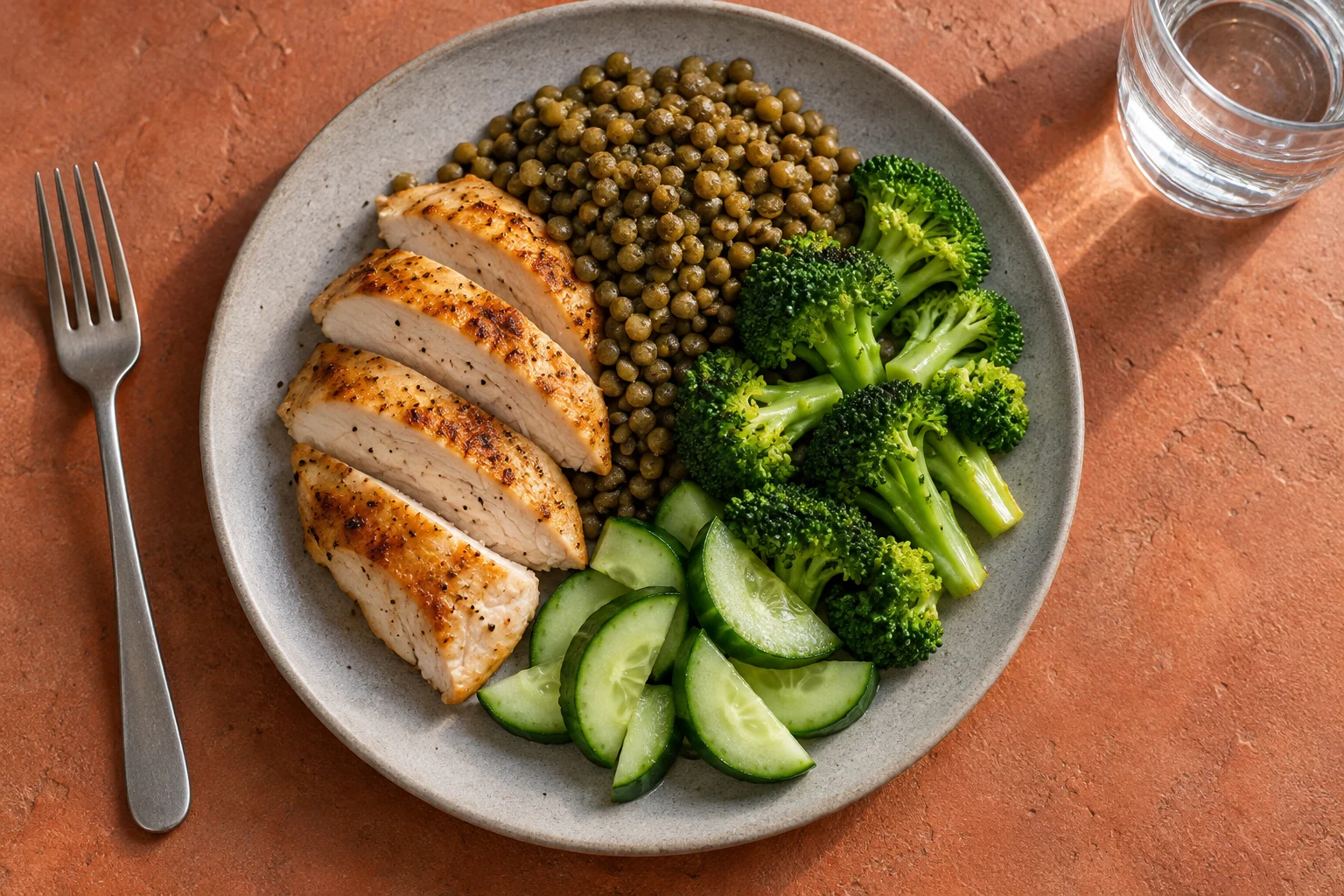
Protein first — like this: A 65 kg woman in deficit needs ~110-130 g protein/day. The split: breakfast 30-35 g (quark + oats), lunch 35-40 g (chicken/salmon + lentils), dinner 35-40 g (meat/fish/legumes + vegetables), evening snack 10-15 g (cottage cheese/Skyr).
High-volume food fills the stomach without calorie pressure: Cabbage (29 kcal/100 g), broccoli (34 kcal), spinach (23 kcal), cucumber (16 kcal). 200-300 g of vegetables at every main meal provides satiety without eating into the deficit.
Smak's AI weekly menu takes your TDEE input + your goals + the ICA store's weekly campaigns and builds a menu that lands within your calorie target (compensating across seven days), optimizes protein-per-krona from campaign products, and suggests dinner ideas for the week that fit Swedish weekday logistics. The app automatically calibrates based on your measurements (step 5 of the HowTo above).
For deeper protein strategy: high-protein dinner — 25 recipes with 30 g+ protein or weekly menu for weight loss. For GLP-1 effect without medication: GLP-1-boosting foods — 15 natural alternatives.
How Smak calculates the calorie deficit for you — with ICA campaigns and protein-per-krona optimization#
Smaklig combines AI-personalized calorie deficits with ICA campaigns and protein-per-krona optimization (cost per gram of protein) — so your daily calorie target is met with the cheapest possible protein from this week's active campaigns, without manual counting. Counting every gram yourself is a full-time job when TDEE varies across the menstrual cycle, campaign prices change every week, and the body's adaptation requires adjustment every 2 weeks. Smaklig automates the math:
- AI-personalized TDEE input — you enter weight/height/activity, we calculate BMR + PAL → daily calorie target with protein priority
- Weekly menu on ICA campaigns — 7 days of dinners, breakfasts, lunches, evening snacks within your numbers
- Protein-per-krona optimization — we prioritize cheap protein from this week's campaigns
- Calibration based on measurements — you log your weight trend, the app adjusts the calorie target every 2 weeks to compensate for adaptation
Tell Smaklig: "I'm 35 years old, 65 kg, want to lose 0.3-0.5 kg/week, allergic to shellfish, budget 25 SEK/portion" — and get personalized dinner suggestions that match your calorie targets, allergies, and budget from this week's ICA campaigns.
Smaklig is an AI-based meal planning tool for the Swedish market. Pick your ICA store, set your goals, and get personalized dinner suggestions every week.
About the author#
Alexander Eriksson is the founder of Smaklig. He built the app after seeing Swedish households throw away about 16 kg of food per person each year and spend thousands of kronor unnecessarily on unplanned purchases. Smaklig combines AI planning with real-time data from ICA, Coop, Hemköp and City Gross to automate what previously took 2 hours every Sunday. Alexander has worked with data-driven optimization since 1998 and started Smaklig in 2026 to make smart meal planning accessible to all Swedish households.
Sources
- European Journal of Clinical Nutrition 71(3):323-326. Hall KD — A review of the carbohydrate-insulin model of obesity (2017)
- JAMA 307(1):47-55. Bray GA et al. — Effect of dietary protein content on weight gain (2012)
- American Journal of Clinical Nutrition 102(4):807-819. Müller MJ et al. — Metabolic adaptation to caloric restriction (2015)
- Journal of Clinical Endocrinology & Metabolism 88(1):297-311. Loucks AB, Thuma JR — Luteinizing hormone pulsatility disrupted at energy availability threshold (2003)
- British Journal of Sports Medicine 48(7):491-497. Mountjoy M et al. — IOC consensus statement: Beyond the Female Athlete Triad — Relative Energy Deficiency in Sport (RED-S, 2014)
- Nordic Council of Ministers. Nordic Nutrition Recommendations 2023 — Energy
- Nordic Council of Ministers. Nordic Nutrition Recommendations 2023 — Energy overview
Frequently asked questions
How big a calorie deficit do I need to lose weight?
Research points to 15-25% below your TDEE — typically 300-500 kcal/day — for sustainable weight loss of 0.3-0.5 kg/week. Larger deficits trigger adaptive thermogenesis (Müller 2015) within 3 days and can hit hormones. Calculate your TDEE first, subtract 300-500 kcal — that's the foundation.
What is a calorie deficit, exactly?
A calorie deficit means you consume fewer calories than your body burns over a day. Bray 2012 (JAMA, overfeeding RCT) showed at caloric surplus that calorie balance — not which macronutrients you eat — drives fat accumulation; the principle extrapolates analogously to deficit. A 300-500 kcal/day deficit ≈ 0.3-0.5 kg weight loss/week theoretically. In practice, sleep, stress, hormones, and measurement accuracy all affect results.
Why am I not losing weight despite a calorie deficit?
Two primary reasons. (1) Measurement error: studies show most people underestimate intake by 20-40% and overestimate expenditure. (2) Metabolic adaptation: Müller 2015 showed the body lowers REE by up to 108 kcal/day within 3 days of deficit. If the scale won't move for 2+ weeks — pause counting, normalize intake for a few weeks, restart rather than cutting more.
How do I calculate a calorie deficit for women?
Calculate BMR via Mifflin-St Jeor, multiply by PAL → TDEE. Subtract 15-25%. Important: women shouldn't fall below 30 kcal/kg fat-free mass per day (Loucks 2003) — below that you risk LH pulse frequency and menstruation. For a 65 kg woman with 25% body fat: lowest safe intake ~1,460 kcal/day. Track monthly, not weekly — TDEE varies across the menstrual cycle.
When is a calorie deficit NOT the right tool?
During pregnancy, breastfeeding, BMI <18.5, chronic illness (diabetes, thyroid disease), eating disorder history (anorexia, bulimia, BED, orthorexia), or under 18. Consult a doctor or registered dietitian before intentional deficit. If you have a difficult relationship with food — seek help via the National Alliance for Eating Disorders (US), Beat (UK), or your local national support service.
Want more meal planning tips?
More guides on food, health and saving money — and a sous-chef that plans your week for you.
Get started
Founder, Smaklig
Writer at Smaklig. We write about food, health, and how to eat better without breaking the bank.
Related articles
May 8, 2026 · 7 min
Maintenance Calories: Calculate Your TDEE
How to calculate your maintenance calories after weight loss. Learn TDEE, Mifflin-St Jeor, and why manual calculations carry a 5–10% margin of error.
Read moreApril 12, 2026 · 15 min
TDEE Calculator and Macros: Complete Guide (2026)
How to calculate TDEE (calories), BMR and macros using the Mifflin-St Jeor formula. Worked examples for 5 profiles, activity table and how to adjust by goal.
Read moreSeptember 30, 2026 · 9 min
Stress, cortisol and a body that no longer responds as usual
How stress, cortisol, insulin, 'cortisol belly' and muscle fit together, what supplements are good for and when to see a doctor.
Read moreReady to plan smarter?
Smaklig creates your weekly menu with AI based on store campaigns. Tailored to your goals and allergies.
Get started free