GLP-1-boosting foods: 15 natural alternatives to Ozempic (2026)
15 foods that raise GLP-1 naturally: fiber, protein, fermented. Activate the same satiety hormone as Ozempic — without a prescription or drug side effects.
Download Smaklig – now on the App Store and Google Play The Smaklig app is now on the App Store (iPhone) and Google Play (Android). Download it free.
Download SmakligQuick answer: 15 foods that raise GLP-1 naturally:
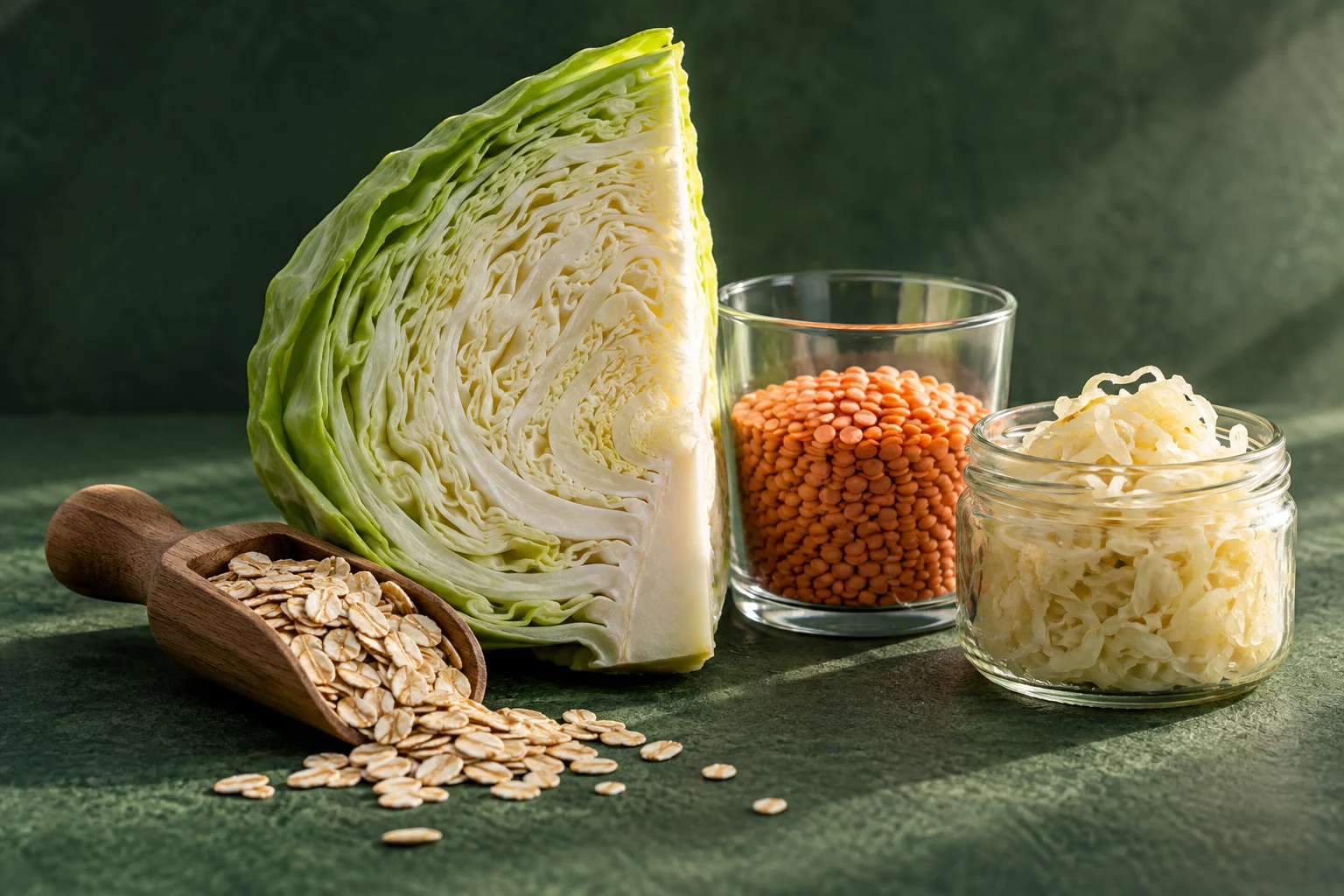
- Fiber-rich vegetables: cabbage (shredded), Brussels sprouts, broccoli, cauliflower, spinach
- Legumes: red lentils, chickpeas, black beans
- Oats (beta-glucan — 3 g/day = +15% GLP-1)
- Fermented: sauerkraut, kimchi, unpasteurized yogurt
- Lean protein: eggs, chicken, fish (also activates PYY hormone)
- Effect: 15–25% GLP-1 increase over baseline (vs Ozempic ~60–80%)
For a current n=1 example, follow the weight journey with published measurements; it documents several simultaneous changes without crediting GLP-1 foods or the app alone for the outcome.
What is GLP-1 and why do we want to raise it?#
GLP-1 (glucagon-like peptide-1) is a hormone released from the gut when food reaches the small intestine. It signals three things:
- Satiety — appetite centers in the hypothalamus are dampened
- Slower stomach emptying — you feel full longer
- Increased insulin response — better blood sugar control
Ozempic (semaglutide) is a GLP-1 receptor agonist that pharmacologically mimics the hormone's effect. The effect is strong — the STEP-trial (2021) showed 12–15% weight loss over 68 weeks.
But you can also raise GLP-1 naturally through food. The effect is significantly smaller — 15–25% over baseline vs Ozempic's pharmacological peak of 60–80% — but it's measurable, free, no prescription, and without the drug-related side effects associated with prescription GLP-1 medications (nausea, gastroparesis, thyroid risks).
Qualification: The randomized breakfast study below included eight healthy adults and found higher GLP-1 after the high-protein meal but no lower energy intake at the next meal. That study therefore does not support fixed percentage comparisons with medication or a promised rate of weight loss for an individual (van der Klaauw et al., 2013).
How can you increase GLP-1 naturally with food?#
Quick answer: Food does not contain semaglutide, but meals can affect the body's own GLP-1 release. In a randomized crossover study of eight healthy adults, a high-protein breakfast produced higher GLP-1 levels than calorie-, volume- and appearance-matched high-fat or high-carbohydrate breakfasts, without lower energy intake at the next meal (van der Klaauw et al., 2013). This was a short-lived hormone response, not a medication effect.
15 best-documented GLP-1-boosting foods#
Quick answer: The ranking is based on clinical studies of GLP-1 response after intake. The best are fiber-rich vegetables + fermented foods + lean protein in combination. Fiber ferments in the colon → short-chain fatty acids → GLP-1 release.
Fiber-rich vegetables (raise GLP-1 15–25%)#
1. Cabbage (shredded)
- GLP-1 effect: 65–100% higher than juiced (Lund University, 2021)
- Qualification: The identifiable randomized cabbage study included 19 healthy young men and compared chewed, shredded cabbage with pureed cabbage. GLP-1 was higher at 45, 60 and 90 minutes, but the study does not establish a general percentage effect (Kamemoto et al., 2024).
- Fiber: 2.5 g per 100 g (half soluble)
- Calories: 40 kcal per 100 g
- How: 100–200 g shredded per meal. Raw salads > cooked. Chewing triggers the cephalic phase (15–25 chews per bite).
2. Brussels sprouts
- Fiber: 3.8 g per 100 g
- Beta-glucan: 0.5 g per 100 g
- How: Halved and oven-roasted 20 min with olive oil + salt.
3. Broccoli
- Fiber: 2.6 g per 100 g
- Sulforaphane: activates Nrf2 gene expression (anti-inflammatory)
- How: Steamed 5 min, not boiled 15 min (preserve nutrition).
4. Cauliflower
- Fiber: 2 g per 100 g
- Volume-filling: 1 head = 100 kcal, 300 g of food
- How: Cauliflower rice (riced + lightly fried) replaces regular rice for 70% fewer calories.
5. Spinach
- Fiber: 2.2 g per 100 g (high nutrition density)
- Magnesium: 79 mg per 100 g
- How: Raw in salads or wilted 30 seconds.
Legumes (highest fiber per krona)#
6. Red lentils
- Fiber: 8 g per 100 g (cooked)
- Protein: 9 g per 100 g
- Price: ~2 SEK/serving (pantry staple)
- How: Lentil stew, dahl, in soups.
7. Chickpeas
- Fiber: 7.6 g per 100 g (cooked)
- Protein: 8.9 g per 100 g
- How: Curry, hummus, roasted as snacks.
8. Black beans
- Fiber: 8.7 g per 100 g
- Protein: 8.9 g per 100 g
- How: In quesadillas, tacos, salsas.
Oats + whole grains#
9. Oatmeal
- Beta-glucan: 3 g per serving = measurable GLP-1 increase + cholesterol reduction
- Total fiber: 10 g per 100 g dry weight
- How: Oatmeal with berries and nuts — classic GLP-1 breakfast.
10. Barley
- Fiber: 15 g per 100 g dry weight (more than oats)
- How: As rice replacement (cook 25 min) or in salads.
Fermented (gut flora boost)#
11. Sauerkraut
- Probiotics: Live lactic acid bacteria
- Short-chain fatty acids: Indirectly stimulate GLP-1 via gut flora
- How: 2 tbsp with dinner 3–4 days/week.
12. Kimchi
- Probiotics: Lactic acid bacteria + capsaicin (chili → extra metabolic boost)
- How: As a side with meat/fish, or in soups.
13. Unpasteurized yogurt
- Probiotics: Lactobacillus + Bifidobacterium
- Protein: 10 g per 100 g (Swedish kvarg: 12 g)
- How: Breakfast with berries + oats + yogurt = triple GLP-1 boost.
Lean protein (synergy with PYY)#
14. Eggs
- Protein: 6 g per egg
- Leucine: 500 mg per egg (stimulates mTOR + satiety signal)
- How: 2 eggs for breakfast = 420 kcal with 12 g protein + 4 hours of satiety.
15. Fish (fatty)
- Protein: 20 g per 100 g
- Omega-3 EPA/DHA: Anti-inflammatory + satiety-preserving
- How: Salmon 2x/week (even frozen). Mackerel, herring, sardines are cheaper.
Why chewing is key#
Quick answer: The GLP-1 response starts in the mouth, not the stomach. Chewing receptors signal satiety hormones before food even reaches the gut. This is called the cephalic phase. Shredded cabbage requires 15–25 chews per bite and strongly activates the cephalic phase. Juiced cabbage doesn't at all — which is why the GLP-1 response is 50–70% weaker on juice.
Qualification: The same randomized study found no difference in plasma glucose between the trials. Its result therefore does not support a prescribed number of chews, a minimum meal duration or a promised satiety effect (Kamemoto et al., 2024).
Practical consequences#
- Eat slower (15–20 min per meal minimum)
- Avoid daily smoothies — you miss the cephalic phase
- Pick raw vegetables when possible (cooked loses structure)
- Protein at the end of the meal to extend satiety effect
7-day GLP-1-maximized menu#
Quick answer: Every meal contains at least 2 GLP-1-boosting foods + protein. Total fiber: 30–40 g/day (above Livsmedelsverket's recommendation of 25–35 g). Calories: 1,800–2,000/day (maintenance for an active person).
| Day | Breakfast | Lunch | Dinner |
|---|---|---|---|
| Mon | Oats + berries + yogurt | Chickpea curry + rice | Chicken wok + cabbage |
| Tue | Omelet + spinach + avocado | Lentil stew + sauerkraut | Salmon + Brussels sprouts + potato |
| Wed | Kvarg + oats + nuts | Beans + quinoa + broccoli | Cauliflower rice + chicken |
| Thu | Eggs + oat pancake | Halloumi + lentils + salad | Pasta + tuna + kimchi |
| Fri | Yogurt + oats + cinnamon | Chickpea hummus + veg | Taco buffet + black beans |
| Sat | Oatmeal + blueberries | Herring + potato + dill | Oven salmon + Brussels sprouts |
| Sun | Kvarg + chia + berries | Soup: lentils + cabbage | Chicken fillet + root vegetables |
Which GLP-1 recipes work for everyday meals?#
Quick answer: A GLP-1 recipe is not a special medical recipe category. Use familiar meal templates from the seven-day menu: oatmeal with yogurt and berries, lentil stew with whole grains, or fish with potatoes and cabbage. Each combines a protein source, fiber-rich ingredients and vegetables. Adjust the portion to your own energy and nutritional needs; the food should not be described as semaglutide or treatment.
Three simple templates to vary:
- Breakfast: oats or whole grains + yogurt, quark or eggs + berries or fruit
- Lunch: lentils, chickpeas or beans + whole grains + at least one vegetable
- Dinner: fish, chicken, eggs or legumes + potatoes or whole grains + cabbage, broccoli or other vegetables
Want ready recipes with ingredients and steps? See the full collection in GLP-1 recipes: 8 filling meals.
Does semaglutide occur naturally in food?#
Quick answer: No. Semaglutide is the active substance in Ozempic and a GLP-1 receptor agonist according to the EMA product information. Food does not contain semaglutide. When a meal affects the body's own short-lived GLP-1 release, that is a different process from using a prescription medicine. The query “semaglutide naturally” therefore needs to distinguish the drug substance from the GLP-1 hormone made by the body.
This article does not compare doses or medicines and gives no advice to start, switch or stop treatment.
What research says about Mounjaro + GLP-1 activation#
This section summarizes published research, not medical recommendations. Consult a doctor for individual advice.
Mounjaro (tirzepatide) and Ozempic (semaglutide) are both prescription medications acting through the incretin system — the body's own satiety-hormone axis where GLP-1 is central. The difference: tirzepatide activates two receptors simultaneously (GIP + GLP-1), while semaglutide only activates GLP-1.
The SURMOUNT-1 trial (Jastreboff et al., NEJM 387:205, 2022) followed 2,539 adults without type 2 diabetes for 72 weeks. Average weight loss (intention-to-treat): 15.0% at the 5 mg dose, 19.5% at 10 mg, and 20.9% at 15 mg — compared with 3.1% in the placebo group.
The STEP-1 trial (Wilding et al., NEJM 384:989, 2021) tested semaglutide 2.4 mg/week for 68 weeks in 1,961 adults with overweight. Result: 14.9% weight loss (semaglutide) vs 2.4% (placebo). 86% of participants reached at least 5% weight loss — a clinically meaningful threshold.
STEP UP 2026: high-dose semaglutide (7.2 mg) — what the new trial shows#
The STEP UP trial (Wharton et al., Lancet Diabetes Endocrinol 2025 Nov;13(11):949-963; NCT05646706) tested high-dose semaglutide 7.2 mg against standard-dose 2.4 mg and placebo over 72 weeks in 1,407 adults without type 2 diabetes. Results: 7.2 mg produced 20.7% weight loss (trial-product estimand — outcome for participants who follow the protocol). The treatment-policy estimand, which includes drop-outs and adherence issues, gave 18.7% per FDA data at the CNPV (Commissioner's National Priority Voucher) accelerated approval in March 2026. The 2.4 mg arm gave 17.5%, placebo 2.4%. 33% of participants on 7.2 mg reached at least 25% weight loss — a result band previously seen only after bariatric surgery.
A post-hoc analysis presented at ECO 2026 (Dicker et al., May 2026, Istanbul; preliminary poster, not peer-reviewed) showed that ~28% of the 7.2 mg arm were "early responders" (≥15% weight loss already at 24 weeks). When early responders were excluded from the analysis, the gap between 7.2 mg and 2.4 mg narrowed considerably: 15.4% vs 13.2% over 72 weeks. This suggests that a substantial portion of the dose-extra benefit is driven by a subgroup rather than the entire population.
Important: all three arms — including placebo — received the same structured lifestyle intervention (dietary counseling + physical activity). The placebo arm's 2.4% weight loss represents the lifestyle effect without medication. That's competitive with unstructured diet programs but markedly lower than the 7.2 mg arm's 20.7%.
The difference in effect size (20.9% at 15 mg vs 14.9% at 2.4 mg) is partly attributed to tirzepatide's dual-receptor mechanism — the GIP component amplifies the GLP-1 response. Both medications, however, work far beyond what diet alone can achieve: food-induced GLP-1 responses are expressed as a percent increase over baseline (15-100%), not as pharmacological steady-state levels.
Foods that activate the same signaling pathways — naturally#
The mechanism both medications exploit — receptor activation on the gut's L-cells — can be stimulated by specific foods. Bowen et al., 2007 (Int J Obes 31:1696) demonstrated in isolated beverage-only studies that whey protein in overweight men produced significantly elevated postprandial GLP-1 levels (P=0.002) and 2-4 hours of prolonged ghrelin suppression. The effect was attenuated when fructose/glucose was consumed simultaneously — meaning the result does not directly extrapolate to mixed meals.
Tolhurst et al., 2012 (Diabetes 61:364) illuminates the fiber pathway: short-chain fatty acids (SCFAs — propionate, butyrate, acetate) are produced when gut microbiota ferment soluble dietary fibers (β-glucan in oats, inulin, legume fiber). SCFAs activate the FFAR2 receptor on L-cells → GLP-1 is released. This explains why fiber-rich diets produce measurable satiety 30-90 minutes after a meal.
The Swedish Food Agency (Livsmedelsverket) recommends 25-35 g fiber/day and 0.83 g protein/kg body weight/day (NNR 2023). The average Swede consumes ~16 g fiber/day (Riksmaten) — below the recommendation. Reaching 30 g/day (about 10 g per main meal) through oats, legumes, and fiber-rich vegetables is the dietary strategy for natural GLP-1 support.
Reminder: the section above summarizes published research. It does not constitute medical advice. Consult a doctor or dietitian for individual guidance on weight loss or medications.
Summary: Mounjaro and Ozempic provide pharmacological leverage on a biological axis that food activates on a smaller scale. Prescription medications are not replaced by food — but for those seeking a non-pharmacological first line, or as part of a healthy lifestyle, fiber + protein-dense food is the natural counterpart. The 15 foods listed above sit at the intersection of both mechanisms.
Body composition — why fat mass vs muscle mass matters#
This section summarizes preliminary ECO 2026 data + Eur Heart J 2025 research. Consult a physician for individual interpretation.
Weight loss is not uniform — it splits between fat mass, muscle mass, and water. An MRI sub-study within STEP UP (n=55, Hjelmesæth et al., ECO 2026 poster, preliminary) showed that the composition of weight loss in the 7.2 mg arm — based on these 55 participants, not the full 1,407 arm — broke down roughly as:
- 84% fat tissue (ECO 2026 poster, preliminary, n=55 — the desirable part of weight loss)
- 30% reduction in visceral abdominal fat (visceral fat is a stronger cardiovascular risk factor than BMI per Souza et al., Eur Heart J 46:1112-1123, 2025)
- 10% reduction in muscle mass (nuanced — the reduction is accompanied by improved muscle quality through less intramuscular fat)
Souza et al. 2025 documented that intramuscular fat (skeletal muscle adiposity) correlates with coronary microvascular dysfunction and a higher cardiovascular event rate, independent of total muscle mass. Measurable muscle quality is therefore more important than muscle quantity alone.
Practical implication for you: Regardless of whether you take GLP-1 medication, muscle preservation is a core question during weight loss. Two evidence-based levers:
- Protein target: 1.6–2.2 g protein/kg target weight/day preserves muscle mass under caloric deficit (Morton et al., Br J Sports Med 52(6):376-384, 2018).
- Resistance training: 2–3 times/week, compound movements (Phillips & Van Loon, J Sports Sci 29(Suppl 1):S29-S38, 2011) signal muscle protein synthesis and protect against catabolism.
The GLP-1 food strategy in this article covers lever 1. Protein-focused diet is the starting point — see high-protein breakfast for weight loss for concrete templates.
How should you eat when taking Ozempic?#
Quick answer: An article cannot provide one meal plan for everyone taking Ozempic. The EMA product information says that the medicine is used with diet and exercise for type 2 diabetes and directs patients to the package leaflet, doctor or pharmacist for practical advice. Follow your prescribed treatment and ask the responsible healthcare professional for individual food guidance based on your health and nutritional needs.
This guide stops at meal planning. It does not recommend a dose, medicine, switch or discontinuation and should not be used to change prescribed treatment.
Complement, not alternative — for those who take (or are considering) GLP-1#
GLP-1 medication (semaglutide, tirzepatide) and GLP-1-boosting food activate the same biological axis — receptors on the gut's L-cells — at different scales. Food provides 15–25% increase over baseline; medication gives 60–80% steady-state. They are not competitors. They are complements.
For those already taking GLP-1 medication: Fiber + protein + resistance training reinforce results and preserve muscle mass during weight loss. Lifestyle intervention was baseline in all STEP UP arms — not an optional add-on. Diet focus doesn't reduce the medication's effect; it strengthens body composition.
For those considering GLP-1 medication: A lifestyle-first approach is a legitimate path. The STEP UP placebo arm (lifestyle only) produced 2.4% weight loss over 72 weeks — modest but not zero. For people with BMI <30 without comorbidity, or where medication cost (Wegovy: ~USD 1,350/month in the US, ~SEK 4,000–5,000/month in Sweden) weighs heavy, diet + exercise can be the first step before medication is considered.
For those who don't qualify or opt out of medication: The 15-food list above covers the mechanisms food can activate. Don't expect 20% weight loss — expect 0.3–0.5 kg/week with structured caloric deficit + protein targets.
What GLP-1 food CAN'T do#
Be honest with yourself:
- Doesn't replace prescription weight medication for obesity + diabetes. Pharmacological GLP-1 is measurably stronger.
- Magic food doesn't exist. Calorie deficit is still central — fiber just makes it easier to follow.
- Same amount = less effect over time. The body adapts. Vary foods every month.
- Does NOT work alone for eating disorders. Consult healthcare professionals — National Alliance for Eating Disorders (phone: 1-866-662-1235) in the US or another licensed mental-health resource.
Can food be used instead of Ozempic?#
Quick answer: No, food cannot be used as an equivalent substitute for Ozempic. The EMA describes Ozempic as a prescription medicine with semaglutide as its active substance; ordinary foods do not provide that substance. Fiber- and protein-rich meals can still be part of your meal plan, but do not start, switch or stop prescribed treatment because of a food guide. Make treatment decisions with the responsible healthcare professional.
If you do not use medication, the same ingredients can still be ordinary parts of a varied weekly menu. That does not make them “natural Ozempic”; their value should be assessed as food and meal structure, not as replacement treatment.
How GLP-1 food fits into weekly planning#
Quick answer: Build 2–3 GLP-1-boosting foods into every meal, use this week's ICA campaigns to pick the cheapest, and combine with 1.6–2.2 g protein per kg target weight. See Weekly menu for weight loss for the full planning structure.
Concretely: When cabbage is on sale (often 8–12 SEK/kg), buy 2 heads, shred, and freeze in 200 g portions. Perfect as a side for every dinner that week. Combined with campaign chicken (69–89 SEK/kg), that's the cheapest possible GLP-1-maximized diet.
Related reading#
This article is about food that supports the body's own GLP-1 signals naturally. If you're already being treated with a prescription GLP-1 or GIP medicine and want practical food help during treatment — protein for muscle mass, food for nausea — see instead eating on Mounjaro: nutrition during tirzepatide.
- Cabbage — nature's own Ozempic? — deep dive on cabbage + the TikTok trend
- Lose weight without Ozempic — 7 strategies including GLP-1 food
- TDEE and macros — complete guide — protein targets and calorie budget
- Weekly menu for weight loss — how to build GLP-1 food into weekly planning
- Glossary — definitions of GLP-1, beta-glucan, cephalic phase
Let Smaklig build a GLP-1-optimized week for you#
Smaklig automatically adds GLP-1-boosting foods to your weekly menus based on your goals + allergies + this week's ICA campaigns. You get:
- At least 2 GLP-1-boosting foods per dinner
- Right protein quantity for your body weight
- Calorie deficit at the right pace (0.3–0.5 kg/week)
- Shopping list in 30 seconds
Smaklig is an AI-based meal planning tool for the Swedish market. Pick your ICA store, set your goals, and get personal dinners that support natural weight loss.
Medical disclaimer: This article is general information based on research — not medical advice. For obesity, diabetes, thyroid disease, pregnancy, or other conditions: always consult a licensed healthcare professional before changing your diet or stopping medication.
Sources
- Lund University. Lund University — GLP-1 response to shredded cabbage (2021)
- NEJM 384(11):989-1002. Wilding JPH et al. — Once-Weekly Semaglutide in Adults with Overweight or Obesity (STEP-1, 2021)
- NEJM 387(3):205-216. Jastreboff AM et al. — Tirzepatide Once Weekly for the Treatment of Obesity (SURMOUNT-1, 2022)
- Int J Obes (Lond) 31(11):1696-1703. Bowen J et al. — Whey protein → postprandial GLP-1 elevation (2007)
- Diabetes 61(2):364-371. Tolhurst G et al. — SCFA → GLP-1 secretion via FFAR2 (2012)
- Livsmedelsverket. Livsmedelsverket — Dietary fiber
- Livsmedelsverket. Livsmedelsverket — Protein
- Lancet Diabetes Endocrinol 2025 Nov;13(11):949-963 (DOI: 10.1016/S2213-8587(25)00226-8). Wharton S et al. — Once-weekly semaglutide 7.2 mg in adults with obesity (STEP UP, 2025)
- Eur Heart J 46:1112-1123. Souza A et al. — Skeletal muscle adiposity, coronary microvascular dysfunction, and adverse cardiovascular outcomes (2025)
- ECO 2026 Istanbul. Dicker D et al. — Responders to semaglutide 7.2 mg: post hoc analysis of STEP UP (ECO 2026 poster, preliminary)
- ECO 2026 Istanbul. Hjelmesæth J et al. — Effect of semaglutide on body composition and proximal muscle strength: STEP UP MRI sub-study (ECO 2026 poster, preliminary)
- Novo Nordisk Investor Relations, 2026-05-12. Novo Nordisk — Higher dose Wegovy demonstrates nearly 28% weight loss in early responders (press release)
- Br J Sports Med 52(6):376-384. Morton RW et al. — Protein supplementation augments resistance training muscle gain (2018)
- J Sports Sci 29(Suppl 1):S29-S38. Phillips SM, Van Loon LJC — Dietary protein for athletes: from requirements to optimum adaptation (2011)
- Obesity (Silver Spring) 21(8):1602-1607. van der Klaauw AA et al. — High protein intake stimulates postprandial GLP-1 and PYY release (2013)
- Scientific Reports 14:7557. Kamemoto K et al. — Effect of vegetable consumption with chewing on postprandial glucose metabolism (2024)
- European Medicines Agency. European Medicines Agency — Ozempic EPAR
Frequently asked questions
Which foods raise GLP-1 most naturally?
Top 5: shredded cabbage (65-100% increase per Lund 2021), Brussels sprouts, oats (beta-glucan), legumes (lentils, chickpeas), fermented foods (sauerkraut, kimchi). Fiber + chewing activate the cephalic phase in the mouth.
Can food really replace Ozempic?
No — Ozempic provides pharmacological GLP-1 activation that's significantly stronger (12-15% weight loss over 68 weeks per STEP-trial). Food raises GLP-1 15-25% over baseline. But combined with weekly planning + protein, the effect is measurable.
How much fiber do I need for GLP-1 effect?
At least 25-35 g fiber/day. Swedish average intake: ~16 g. Increase gradually to avoid gas issues. Spread across the day — 10 g breakfast (oats+berries), 10 g lunch (lentils+greens), 10 g dinner (cabbage+legumes).
Which fermented foods are most effective?
Sauerkraut, kimchi, and unpasteurized yogurt contain live probiotics + short-chain fatty acids that stimulate GLP-1 via gut flora. 2-3 servings/week is enough for measurable effect on gut health and satiety.
Does GLP-1 food work for type 2 diabetes?
Yes — fiber and fermented foods have clinical effects on blood sugar control. But always consult a doctor before changing diet with diabetes. Combine with medication, don't replace it without healthcare guidance.
How fast will I notice the GLP-1 effect?
GLP-1 response: 30-90 min after a meal (direct satiety). Weight-loss effect: 2-4 weeks of consistent intake. Combined with protein (1.6-2.2 g/kg target weight) and calorie deficit yields 0.3-0.5 kg/week weight loss.
What does research say about natural GLP-1-activating foods?
Bowen et al. 2007 (Int J Obes) showed that whey protein significantly elevated postprandial GLP-1 levels (P=0.002) in overweight men. Tolhurst et al. 2012 (Diabetes) describes the fiber pathway: soluble dietary fibers are fermented by gut microbiota into short-chain fatty acids (SCFAs), which activate the FFAR2 receptor on the gut's L-cells and trigger GLP-1 release. Livsmedelsverket recommends 25-35 g fiber/day — Swedish average is ~16 g.
How do tirzepatide trials (SURMOUNT) compare with semaglutide trials (STEP)?
SURMOUNT-1 (Jastreboff et al. 2022, NEJM 387:205) followed 2,539 adults without type 2 diabetes for 72 weeks on tirzepatide. Average weight loss 20.9% at 15 mg (intention-to-treat) vs 3.1% placebo. STEP-1 (Wilding et al. 2021, NEJM 384:989) followed 1,961 adults for 68 weeks on semaglutide 2.4 mg/week. Average 14.9% weight loss vs 2.4% placebo. The difference (20.9% vs 14.9%) is partly attributed to tirzepatide's dual GIP+GLP-1 receptor activation.
What is the STEP UP trial and how does it differ from STEP-1?
STEP UP (Wharton et al. 2025, Lancet Diabetes Endocrinol 13:949) tested high-dose semaglutide 7.2 mg over 72 weeks in 1,407 adults. Result: 20.7% weight loss on 7.2 mg vs 17.5% on 2.4 mg vs 2.4% placebo. STEP-1 (Wilding 2021) tested 2.4 mg in 1,961 adults over 68 weeks and produced 14.9% — the gap vs STEP UP's 17.5% is partly explained by 4 additional weeks of treatment.
How do I preserve muscle mass when losing weight — with or without GLP-1?
Two evidence-based levers: (1) protein 1.6–2.2 g/kg target weight/day (Morton et al. 2018) preserves muscle mass during caloric deficit; (2) resistance training 2–3 times/week protects against catabolism. The STEP UP MRI sub-study (n=55, Hjelmesæth ECO 2026 poster) showed that ~10% of weight loss at 7.2 mg is muscle mass — but muscle quality improves (less intramuscular fat). Protein + resistance training applies regardless of GLP-1 medication.
When is high-dose Wegovy 7.2 mg the right choice, when is food-first right?
This is a doctor-discussion, not a food-question. Relevant factors: BMI (≥30, or ≥27 with comorbidity, meets US medical indication), contraindications (thyroid cancer history, pancreatitis), cost (~USD 1,350/month for Wegovy in the US, ~SEK 4,000–5,000/month in Sweden), and side effects (GI events typically decline over time). For BMI <30 without comorbidity, diet + exercise is a legitimate first step — STEP UP's placebo arm with lifestyle coaching produced 2.4% weight loss over 72 weeks. Consult a licensed physician for individual assessment.
Want more meal planning tips?
More guides on food, health and saving money — and a sous-chef that plans your week for you.
Get started
Founder, Smaklig
Writer at Smaklig. We write about food, health, and how to eat better without breaking the bank.
Related articles
April 12, 2026 · 12 min
Cabbage — Nature's Own Ozempic? How Fiber and GLP-1 Boost Satiety
Cabbage is going viral on TikTok as 'Ancient Ozempic'. Research shows cabbage raises GLP-1 naturally. Here's how fiber, satiety, and weight loss work through food.
Read moreAugust 13, 2026 · 6 min
GLP-1 Recipes: 8 Filling Meals With Fiber & Protein
8 GLP-1 recipes with fiber and protein that support your body's own satiety signals — breakfast, lunch and dinner built on fiber- and protein-rich ingredients.
Read moreJuly 2, 2026 · 13 min
Eating on Mounjaro: Nutrition During Tirzepatide (2026)
What should you eat on Mounjaro? A practical food guide: 7-day meal plan, food noise, protein for muscle mass, and advice for nausea and reduced appetite.
Read moreReady to plan smarter?
Smaklig creates your weekly menu with AI based on store campaigns. Tailored to your goals and allergies.
Get started free