How to Keep Your Weight Stable on Vacation (2026)
Keep your weight stable on vacation? Studies show +0.32 kg per trip — weight that rarely disappears on its own. Protein-first, smart grilling, flexible control.
Download Smaklig – now on the App Store and Google Play The Smaklig app is now on the App Store (iPhone) and Google Play (Android). Download it free.
Download SmakligQuick answer: Vacation adds on average 0.32 kg — and research shows that this kind of weight rarely disappears on its own. But the solution is not restriction; it's structure and flexible control.
- 0.32 kg — average gain during a 1–3 week vacation (Cooper & Tokar, 2016)
- 0.48 kg — net gain after holiday periods that was not reversed during spring or summer (Yanovski, 2000, NEJM)
- Protein first — higher-protein meals increase perceived fullness and satiety hormones (Leidy, 2015)
- Flexible control beats rigid bans for weight outcomes (Westenhoefer, 2013)
- 7 kcal/gram — the energy content of alcohol; a 33 cl strong beer holds 149 kcal (Systembolaget)
Keeping your weight stable on vacation is not about counting calories on the beach. It's about understanding what actually happens during a few weeks off — and having a plan for the return home, which matters more than the vacation weeks themselves.
This guide covers what the research says about vacation weight gain, why rigid bans backfire, and how to enjoy barbecue nights, ice cream and buffets without paying for them with months of progress.
How much weight do people gain on vacation?#
On average 0.32 kg during a one-to-three-week vacation. That was the finding of a prospective study that weighed 122 adults before and after their trip (Cooper & Tokar, 2016, Physiology & Behavior). Comparable research on holiday periods shows 0.37 kg (Yanovski et al., 2000, NEJM). The gain is less dramatic than most people fear — the problem is what happens afterwards.
These are averages: some participants gained considerably more, others nothing at all. But the most important lesson from the research is not the size of the gain — it's the stubbornness of it.
The weight does not disappear on its own#
Yanovski and colleagues followed their participants long after the holiday period. At the follow-up in late February–March, a net gain of 0.48 kg remained — and the study's conclusion is blunt: since the gain is not reversed during the spring or summer months, it probably contributes to the gradual weight increase that frequently occurs during adulthood (Yanovski et al., 2000).
Half a kilo per year sounds harmless. Ten years later it's five kilos. That's why vacation deserves a strategy — not panic, but a plan for the return.
Flexible control beats rigid bans#
Here comes the counterintuitive part: people who try to manage their weight with strict bans do worse than those who allow themselves flexibility. Research on eating behaviour distinguishes between rigid control (all-or-nothing rules: "no ice cream the entire trip") and flexible control (deliberate choices: "ice cream sometimes, not every day"). Flexible control was associated with more weight lost and better weight maintenance, while rigid control was associated with poorer results (Westenhoefer et al., 2013, Eating Behaviors).
The popular "80/20 rule" — eat deliberately 80% of the time, enjoy freely 20% — is a simplified rule of thumb rather than a research figure. But the principle behind it has evidence: flexibility is more sustainable than prohibition, and someone who forbids nothing has nothing to "fall off."
In vacation practice this means: choose what's worth it. The ice cream on the beach with the kids? Worth it. The third cinnamon bun at fika just because it was there? Maybe not. The difference is awareness, not morality.
Help if you need it: Do you have a difficult relationship with food or your body? You're not alone. Reach out to National Alliance for Eating Disorders (US, 1-866-662-1235), Beat (UK, 0808 801 0677), or your country's national support service.
Protein first — even on vacation#
Higher-protein meals produce greater perceived fullness and elevated satiety hormones compared to lower-protein alternatives — an effect described as modest but consistent in research reviews (Leidy et al., 2015, Am J Clin Nutr). On vacation, when snacks and desserts are more available than usual, that satiety is valuable.
In practice, protein-first means three things:
- Start the day with protein. Eggs, yogurt, quark or cottage cheese at the hotel breakfast — not just a croissant and juice. A satisfied morning weakens the pull of the ice cream stand.
- Fill your plate with protein first at the buffet. Chicken, fish, seafood, legumes — then the rest. The order affects how much of the energy-dense food fits.
- Keep the meal rhythm. Sweden's 1177 healthcare guide notes that it is easier to avoid snacking if you eat breakfast, lunch and dinner regularly plus a good snack in between (1177 — Så äter du hälsosamt). Vacation's loose structure makes regularity more important, not less.
Grill smart: protein + vegetables#
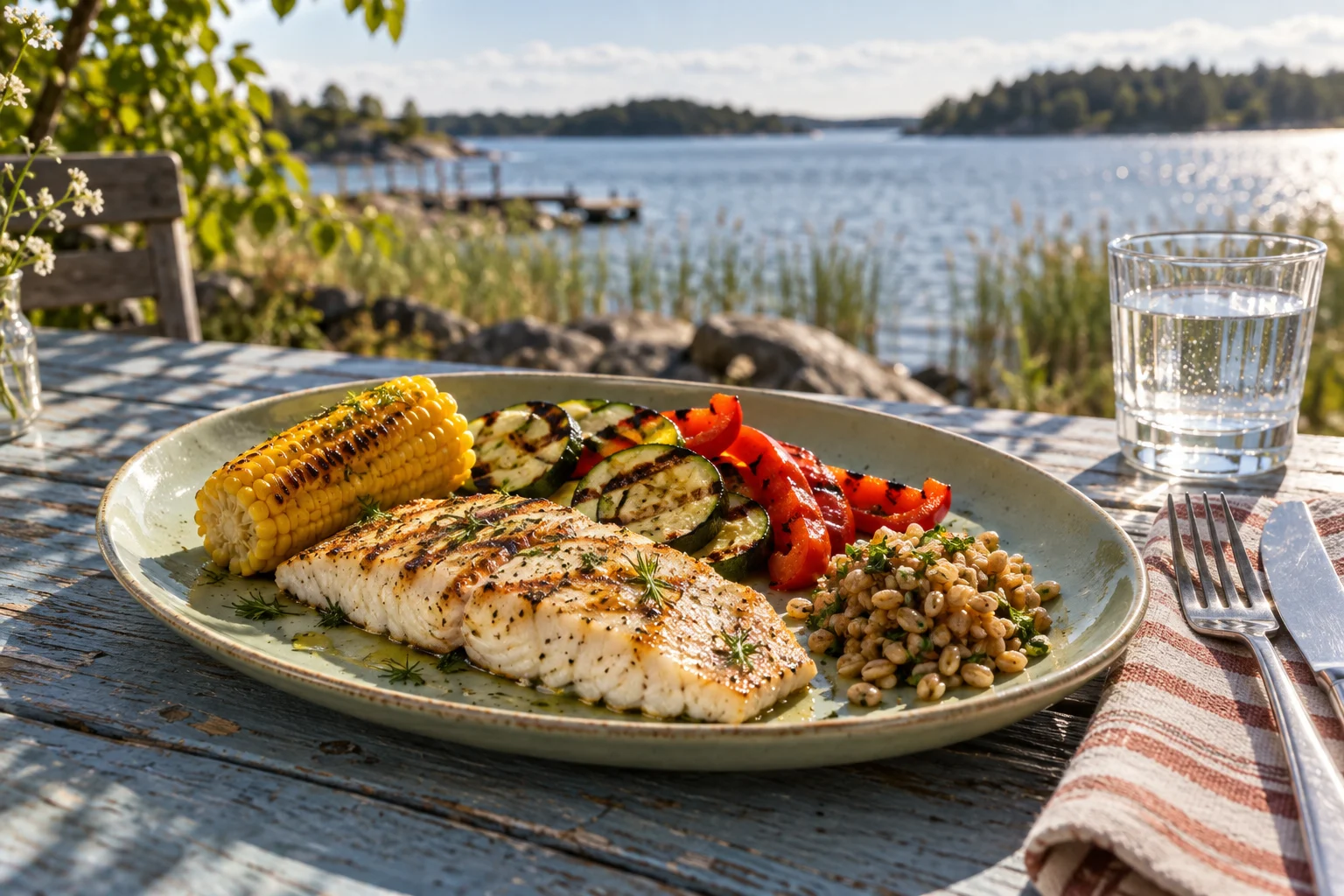
The barbecue is the vacationer's best friend for eating well while keeping weight stable — it's essentially high-protein cooking outdoors. What decides the outcome is the choices around it.
| Grill choice | Smart move | Watch out for |
|---|---|---|
| Chicken, fish, seafood | Lean protein that satisfies | Marinades add flavour without much energy |
| Pork shoulder, sausages, halloumi | Delicious — choose deliberately | Fattier picks; let vegetables take half the plate |
| Grilled vegetables | Corn, peppers, zucchini, asparagus fill the plate | Make them the co-star, not a garnish |
| Sides | Bean or grain salads satisfy | Creamy dressings and garlic bread add up fast |
The rule of thumb is simple: half the plate vegetables, a quarter protein, a quarter everything else. That turns barbecue night into an asset for your weight instead of a threat — and you never have to decline it.
Alcohol, ice cream and buffets — without panic#
Alcohol contains 7 kcal per gram, according to Systembolaget. That makes drinks one of vacation's most overlooked energy sources — not because one glass is dangerous, but because glasses rarely get counted.
| Drink | Amount | Energy |
|---|---|---|
| Light beer | 33 cl | 99 kcal |
| Strong beer | 33 cl | 149 kcal |
| Dry white wine | 20 cl | 140 kcal |
| Red wine | 20 cl | 150 kcal |
Source: Systembolaget
Three vacation principles that work without killing the mood:
- Every other drink is water. Halves both the energy intake and tomorrow's headache.
- Choose what you actually want. One glass of wine you enjoy beats three that just tagged along.
- The buffet order again: protein and vegetables first, then the sweet things. You eat less of the energy-dense food when you're already half full.
And the ice cream? One a day on vacation is a deliberate flexible choice, not a failure. That's the difference between flexible and rigid control in practice.
Movement on vacation counts — even without workouts#
The Public Health Agency of Sweden recommends that adults are physically active at moderate intensity for at least 150–300 minutes per week, or 75–150 minutes at high intensity, plus muscle-strengthening activity at least two days a week (Folkhälsomyndigheten).
The good news about vacation: walks to the beach, swimming, bike rides and city wandering all count. Many people move more on vacation than during office life without noticing. Lean into it — walk to the ice cream stand instead of driving, swim while the kids bathe, take the stairs to the viewpoint. Movement doesn't need to be called training to do the job.
After the vacation: return without a crash diet#
This is the most important section of the article, because this is where the kilos are decided. Yanovski's finding — that the gain is not reversed by itself — means the active return to routines is what separates a harmless vacation from a permanent gain.
An evidence-based return looks like this:
- Weigh yourself only after 3–4 days at home. Right after the trip, the scale mostly shows water and gut contents — the number is both misleading and demoralising.
- Resume the meal rhythm on day one. Breakfast, lunch, dinner — the same structure as before the trip. No compensatory starving.
- Plan the first week in advance. A ready-made weekly menu removes the hundred small decisions that are hardest when routine is broken. See the maintenance weekly menu for a concrete setup.
- Check your level. If you're unsure where your energy needs sit, calculate them with the TDEE calculator guide — and read about maintenance calorie budgeting if you're in a maintenance phase.
- Give it 2–4 weeks. Half a kilo disappears with resumed routines — not with a crisis week at 1,200 kcal, which mostly raises the risk of rebound. More on that in stabilisation after weight loss.
Smaklig is built for exactly this transition: the app automatically generates the weekly menu for your first week home, adapted to your calorie goal and your store's current campaign offers, so the return starts in the grocery store instead of in willpower.
Common vacation mistakes#
Mistake 1 — Compensatory starving before the trip. "Banking" a deficit the week before makes you hungrier on site and starts the vacation in all-or-nothing mode.
Mistake 2 — Rigid bans on site. "No dessert the whole trip" lasts three days and ends in its opposite. Flexible control beats rigid (Westenhoefer et al., 2013).
Mistake 3 — Daily weigh-ins on vacation. Fluid balance, salty food and travel days make daily numbers meaningless. Leave the scale at home.
Mistake 4 — No plan for the homecoming. The vacation gain only becomes permanent when "one more week of vacation eating" turns into September. Have the first week's menu ready before you leave.
Action checklist: keep your weight stable on vacation#
- Eat protein first at every meal — breakfast, buffet, barbecue night
- Keep three regular meals a day, even while travelling
- Choose your indulgences deliberately — flexibly, not rigidly
- Every other drink is water on nights out
- Move every day — walks and swimming count
- Leave the scale at home; weigh yourself 3–4 days after returning
- Have your first week's menu ready before departure
- Try Smaklig for free — an AI-generated weekly menu for your first week home, adapted to your goal and your store's campaigns
Sources
- Physiology & Behavior (2016). Cooper & Tokar, 2016 — A prospective study on vacation weight gain in adults
- New England Journal of Medicine (2000). Yanovski et al., 2000 — A Prospective Study of Holiday Weight Gain
- American Journal of Clinical Nutrition (2015). Leidy et al., 2015 — The role of protein in weight loss and maintenance
- Eating Behaviors (2013). Westenhoefer et al., 2013 — Cognitive and weight-related correlates of flexible and rigid restrained eating behaviour
- 1177 Vårdguiden. 1177 Vårdguiden — How to eat healthily (Så äter du hälsosamt)
- Systembolaget. Systembolaget — Alcohol and calories
- Folkhälsomyndigheten. Public Health Agency of Sweden — Guidelines and recommendations for physical activity
Frequently asked questions
How much weight do people gain on vacation?
On average 0.32 kg during a 1–3 week vacation, according to a prospective study of 122 adults (Cooper & Tokar, 2016, Physiology & Behavior). Comparable research on holiday periods shows 0.37 kg (Yanovski et al., 2000, NEJM). That sounds small — but small gains that are never reversed add up over the years.
Does vacation weight disappear on its own?
Often not. Yanovski et al. (2000, NEJM) showed that holiday weight gain was not reversed during the spring or summer months — the net gain of 0.48 kg persisted and probably contributes to the gradual weight increase common in adulthood. What decides the outcome is your return to routines afterwards, not the vacation weeks themselves.
How do you avoid vacation weight gain?
Three evidence-based principles: eat protein first at every meal (higher satiety according to Leidy et al., 2015), keep regular meals — breakfast, lunch, dinner — which reduces snacking according to 1177, and practice flexible control instead of rigid bans (Westenhoefer et al., 2013). Enjoy deliberately; never compensate by starving.
Should you exercise on vacation?
Movement helps, but it doesn't need to be structured training. The Public Health Agency of Sweden recommends 150–300 minutes of moderate activity per week — walks to the beach, swimming and bike rides all count. Vacation is often more active than office life if you lean into it.
How do you lose vacation weight after the trip?
Return to your normal routines immediately — without a crash diet. Weigh yourself only after 3–4 days at home (much of the gain is water), resume regular meals and weekly planning, and give it 2–4 weeks. An abrupt starvation week increases the risk of all-or-nothing patterns that do more damage than the vacation did.
Want more meal planning tips?
More guides on food, health and saving money — and a sous-chef that plans your week for you.
Get started
Founder, Smaklig
Writer at Smaklig. We write about food, health, and how to eat better without breaking the bank.
Related articles
May 8, 2026 · 7 min
Maintenance Calories: Calculate Your TDEE
How to calculate your maintenance calories after weight loss. Learn TDEE, Mifflin-St Jeor, and why manual calculations carry a 5–10% margin of error.
Read moreMay 8, 2026 · 7 min
Maintenance Weekly Menu: 5 Days at TDEE
A practical 5-day weekly menu at maintenance calories (TDEE) with no deficit. Swedish staples, supermarket promotion substitutions, and NNR 2023-aligned nutrition.
Read moreMay 8, 2026 · 8 min
Stabilisation After Weight Loss: Avoid Rebound
How to prevent weight regain after reaching your goal weight. Metabolic adaptation, plateau management, and the psychology of long-term weight stabilisation.
Read moreReady to plan smarter?
Smaklig creates your weekly menu with AI based on store campaigns. Tailored to your goals and allergies.
Get started free