Protein for Elderly: Sweden's New Over-65 Advice (2026)
Protein for elderly after 65: Sweden's new 2026 advice, three easy recipes and a full nutrition table. How much protein per day, plus tips when appetite drops.
Download Smaklig – now on the App Store and Google Play The Smaklig app is now on the App Store (iPhone) and Google Play (Android). Download it free.
Download SmakligShort answer: In June 2026 the Swedish Food Agency (Livsmedelsverket) presented new dietary guidelines for people over 65. The foundation is the ordinary advice for adults — plus a little extra protein and vitamin D.
- Prioritize a little extra protein — the need increases with age (Swedish Food Agency, 2026)
- 1.2–1.5 g protein per kg body weight/day for over-65s, versus 0.83 g/kg for younger adults
- 70 kg → about 84–105 g protein per day — spread across several meals
- When appetite drops, every bite counts — prioritize protein and energy
- Everyone over 75 is advised to take 20 µg of vitamin D daily
Protein for the elderly has taken on new relevance: in June 2026 the Swedish Food Agency (Livsmedelsverket) presented updated dietary guidelines for everyone over 65. The message is simple — eat in line with the ordinary dietary advice, but prioritize a little extra protein, because the need increases with age. This guide covers how much protein you need after 65, which foods give the most, and what to do when your appetite starts to fade.
The advice is aimed both at you who are 65+ and active, and at you who have noticed your appetite isn't what it used to be. If you're a relative caring for a parent who eats too little, there's a dedicated section further down. Everything is based on the Swedish Food Agency's material and is nutrition information — not medical advice.
Sweden's new 2026 advice: why you need more protein after 65#
On 15 June 2026 the Swedish Food Agency launched new dietary guidelines for people over 65 under the heading "Good eating habits can contribute to more healthy years." The core is that the foundation is the same as for other adults, with a couple of important additions on protein and vitamin D (Swedish Food Agency).
The reason protein is highlighted comes down to how muscles work over the years. Muscles are built up and broken down constantly. After 65 the breakdown increases, and it becomes harder to keep your muscles the older you get — an age-related muscle loss sometimes called sarcopenia. Protein is needed for strong muscles and a strong immune system, and it is food combined with exercise that preserves your strength.
In concrete terms, the protein requirement per kilo of body weight is higher for you over 65 than for younger adults. For the rest of the adult population the recommendation is 0.83 g of protein per kg of body weight per day. For you over 65, a higher intake is recommended instead, to prevent muscle loss and declining physical function (L 2026 no. 07). We'll cover exactly how much next.
Good eating habits after 65 aren't only about muscles. They also reduce the risk of several common diseases — cardiovascular disease, type 2 diabetes, and cancer — and, according to new knowledge, the risk of dementia too. Research has not been able to name any age at which it's too late to start eating better.
How much protein do you need after 65?#
For you over 65, the Swedish Food Agency recommends a protein intake of 1.2–1.5 grams per kg of body weight per day, which corresponds to roughly 15–20 percent of your energy intake. That is noticeably more than the 0.83 g/kg for younger adults, and the aim is to prevent age-related muscle loss and preserve physical function (L 2026 no. 07).
Translated into everyday life, it's easier to grasp with a calculation. Multiply your weight in kilos by 1.2 and by 1.5 to get your daily range:
| Body weight | Protein per day (1.2–1.5 g/kg) |
|---|---|
| 60 kg | 72–90 g |
| 70 kg | 84–105 g |
| 80 kg | 96–120 g |
A person weighing 70 kg therefore needs around 84–105 grams of protein a day. It's hard to get all of that at a single meal, so the trick is to spread the protein across the day — a little at each meal and preferably in snacks too.
If you have kidney disease or a prescribed protein-restricted diet, follow your doctor's or dietitian's recommendation, not the range in this article. The advice here applies to healthy older adults without specific nutritional treatment.
The good news is that no supplements or special products are needed. If you eat varied, you easily get enough, because protein is found in many everyday foods. In the next section we look at exactly how much different foods provide.
The best protein-rich foods for older adults – with a nutrition table#
Protein is found in fish, poultry, meat, eggs, dairy, beans, lentils, nuts, and seeds. Bread, pasta, and grains contribute too. The point isn't to eat one single "protein bomb," but to let something protein-rich be part of every meal.
The table below shows protein per 100 grams for common foods, taken directly from the Swedish Food Composition Database. Use it as a guide to which choices give the most protein for the amount.
| Food (per 100 g) | Protein |
|---|---|
| Hard cheese, 28% fat | 26.2 g |
| Salmon, fried | 24.1 g |
| Chicken breast, fried, skinless | 23.0 g |
| Almonds | 20.7 g |
| Mackerel, hot-smoked | 20.1 g |
| Cottage cheese, plain | 13.4 g |
| Egg, boiled | 12.2 g |
| Black pudding | 11.0 g |
| Quark, plain | 10.0 g |
| Herring, pickled | 9.8 g |
| Liver pâté | 9.5 g |
| Green lentils, cooked | 9.4 g |
| Chickpeas, cooked | 8.1 g |
Source: Swedish Food Composition Database, nutrient search, version 2026-07-01. Values refer to the edible portion and vary somewhat between products and cooking methods.
A couple of things are worth noting. Oily fish such as salmon and mackerel provide both plenty of protein and beneficial omega-3 fat, and the Swedish Food Agency recommends fish two to three times a week. Dairy products like quark, cottage cheese, and hard cheese are easy to eat even when appetite is low. And classics such as black pudding, liver pâté, and herring provide a lot of nutrition for the money — useful to remember if the food budget is tight.
If you want concrete recipes built around protein, there are more ideas in the guides to high-protein dinner and high-protein breakfast. They're written for a broader audience, but the protein sources and portion thinking work just as well after 65.
Three easy protein-rich recipes for older adults#
Want concrete meals rather than a table? Here are three simple, soft dishes that are easy to chew and provide around 25–35 grams of protein per serving. The protein amounts are estimated from the Swedish Food Composition Database and vary with portion size.
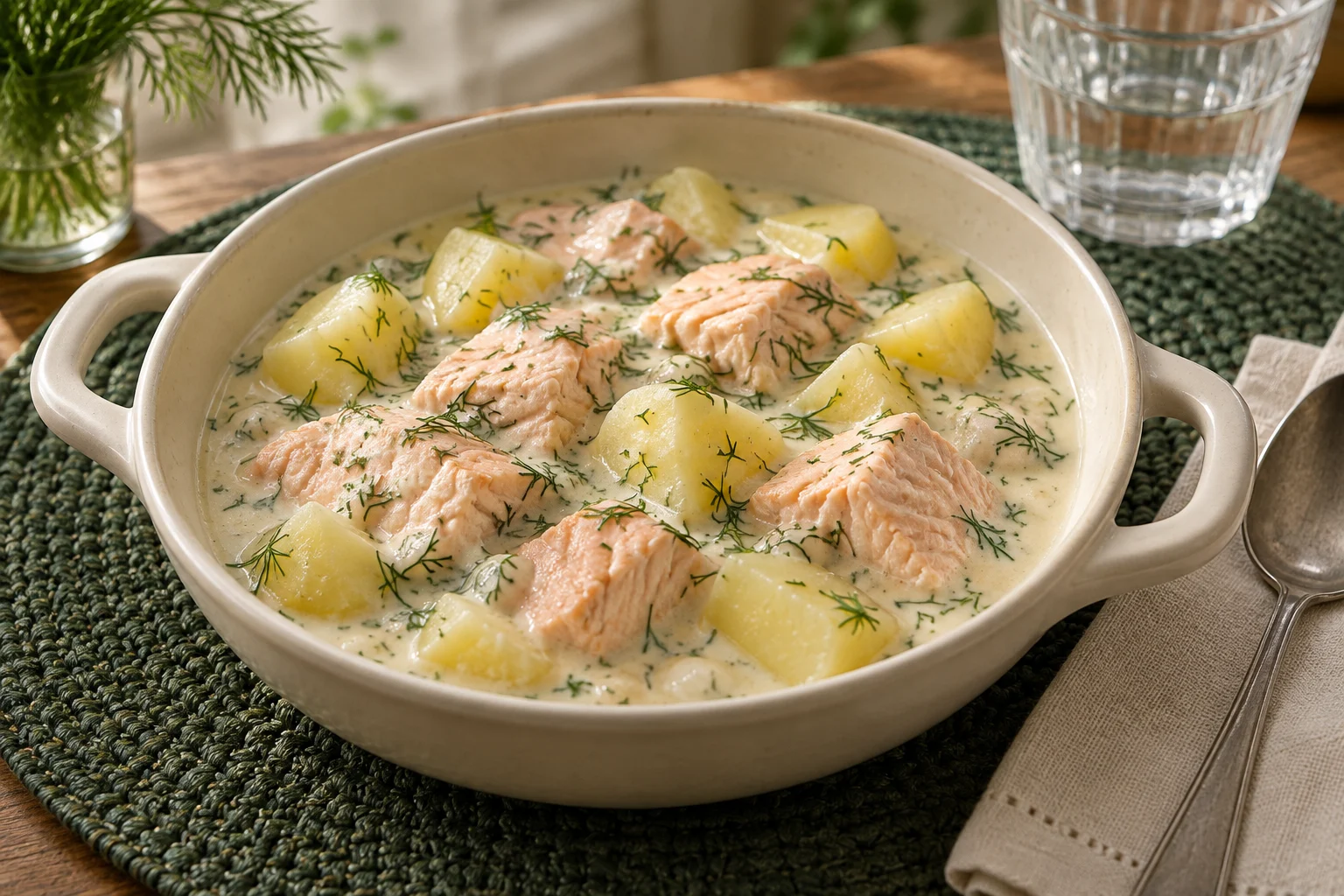
1. Creamy salmon stew with potato (about 35 g protein/serving)
A soft stew with no hard fried surface — gentle to chew and easy to reheat.
- 150 g salmon fillet in pieces, 2 boiled potatoes, 1 dl cooking cream, a little dill, salt
- Boil the potatoes until soft. Let the salmon simmer in the cream for 5–6 minutes until cooked through, stir in the potatoes, and season with dill.
- Why: salmon provides both protein and omega-3, and the cream adds energy when appetite is low.
2. Scrambled eggs with cottage cheese and smoked ham (about 30 g protein/serving)
Quick, easy to chew, and good as an evening meal too.
- 2 eggs, 100 g cottage cheese, one slice of smoked ham in strips, butter
- Whisk the eggs lightly, stir in the cottage cheese, cook slowly in butter until creamy, and top with the ham.
- Why: eggs, cottage cheese, and ham together give plenty of protein in a small, soft portion.
3. Quark bowl with berries, nuts, and honey (about 25 g protein/serving)
Smooth and easy to eat — perfect breakfast or snack when appetite is faltering. If chewing is difficult, blend or skip the nuts.
- 200 g quark (plain), a handful of soft berries, a little honey, and (if you like) 1 tbsp finely chopped or blended nuts/almonds
- Stir together the quark and honey and top with berries. To include the nuts but keep it smooth, blend them first — or leave them out entirely.
- Why: quark is protein-rich and easy to eat, and honey plus berries make it energy-dense without being heavy.
If you want to vary further, the protein sources in the nutrition table above work in almost any everyday dish — the point is to let something protein-rich be part of every meal.
When appetite drops: prioritize protein and energy#
With age it's natural for appetite to decrease and for you not to feel hunger and thirst the way you used to. Your sense of taste can fade too. Weight can then decrease gradually without you noticing — and unlike earlier in life, losing weight isn't always an advantage when you get older. A few extra kilos give more resilience and help you cope better with a period of illness.
If you can't eat portions as large as before, you need to think a little differently: get enough energy and protein even though the amount of food is smaller. The Swedish Food Agency describes it as a reversed plate model.
Reverse the plate model. In the usual plate model, vegetables fill a large part of the plate. When appetite is low you do the opposite: prioritize the protein part — fish, poultry, meat, eggs, beans, lentils — and eat as much as you can manage of the potatoes/pasta/bread and vegetables. Protein and energy matter most when you can only manage a small portion (Swedish Food Agency, 65+ with reduced appetite).
Here the advice differs clearly from ordinary weight loss. This applies with low appetite and involuntary weight loss — not if your goal is to lose weight. When you struggle to eat enough it's actually good to add extra fat to get more energy: a splash of oil or cream in the food, extra sauce or mayonnaise. It can feel unfamiliar if you're used to cutting back on fat, but for someone eating small portions the fat provides important energy.
Another approach is to eat more often rather than more. Instead of three large meals, you can spread out many small, nutritious ones across the day:
- Something small first thing in the morning and just before bed
- Breakfast, mid-morning snack, lunch, afternoon snack, dinner, and an evening snack
Good protein-rich snacks can be a sandwich with plenty of topping (cheese, egg, liver pâté, herring), a boiled or fried egg, an omelette, pancakes, or soured milk, yoghurt, cottage cheese, and quark with a little muesli, berries, and nuts. Choose full-fat or high-protein versions of the dairy products.
If you regularly struggle to get enough despite this — contact your health center or a dietitian. Homemade, energy-rich meals do not replace prescribed nutritional drinks in cases of diagnosed malnutrition.
Are you a relative of someone who eats too little?#
Often it's relatives who first notice that an older person is starting to eat worse. Someone who has lost their appetite often also has less interest in everything to do with food, and the change happens gradually. The Swedish Food Agency has gathered five simple questions that help you keep track — for yourself or a loved one:
- Do you often feel tired during the day?
- Have you lost your desire for food?
- Are you not finishing the food in the fridge?
- Are you buying less food?
- Are your clothes, watch, or rings starting to feel too loose?
Weigh yourself regularly so you notice early if your weight changes. The Swedish Food Agency's advice is clear: "Contact healthcare if you start losing weight without knowing why." Involuntary weight loss can be a sign of illness, and healthcare can make a proper assessment.
As a relative you can make a concrete difference. The Swedish Food Agency highlights that you can eat together sometimes, help with the shopping, cook and freeze meals in portions, and remind someone why it's important to eat enough. Planning a week with both meals and small, energy-rich snacks is often what makes the biggest difference in practice — especially since one in three people over 65 in Sweden lives in a single-person household, and it's less appealing to cook and eat alone.
That's exactly what Smaklig is built for. You can set up a weekly menu for a parent, get a ready shopping list, and ask the sous-chef for nutrient-dense, protein-rich dishes in reasonable portions. When the structure is already there, it becomes easier to support someone who needs to eat more — without it taking over your day. To get started with weekly planning, our pillar guide what should we eat tonight? is a good starting point.
Exercise, fluids, and vitamin D after 65#
Food is one piece of the puzzle, but not the whole thing. To keep your muscles and strength you also need to move. The Public Health Agency's advice, which the Swedish Food Agency refers to, is to train balance, strength and mobility on three or more days a week and complement it with daily physical activity that raises your pulse — aim for 150–300 minutes a week. It's never too late to start; 1177 has more on exercise for older adults.
Fluids are also easy to forget, because the sensation of thirst weakens with age. Try to drink about 1.5–2 liters a day on top of the fluid in your food. Getting too little can make you tired and dizzy, which raises the risk of falling.
Finally, vitamin D. The skin's ability to form vitamin D from sunlight decreases over the years, so everyone over 75 is advised to take a supplement of 20 micrograms of vitamin D every day. Vitamin D is needed for a strong skeleton and lowers the risk of osteoporosis. The supplement is available over the counter.
Summary: how to eat protein-rich after 65#
- Prioritize a little extra protein — 1.2–1.5 g/kg body weight per day, versus 0.83 g/kg for younger adults.
- Work out your range: weight × 1.2 to weight × 1.5. A 70-kilo person lands at about 84–105 g/day.
- Spread the protein across the day's meals and snacks — not all at once.
- Vary the sources: fish, poultry, meat, eggs, dairy, beans, lentils, nuts. See the nutrition table above.
- When appetite drops: reverse the plate model, add extra fat for energy, and eat many small meals — but only with involuntary weight loss, not with a weight-loss goal.
- A relative? Watch for the five signs and contact healthcare for involuntary weight loss.
- Everyone over 75: 20 µg of vitamin D daily. Drink 1.5–2 liters of fluid and train balance and strength.
Want to skip planning it all yourself? Try Smaklig for free — get protein-rich, nutrient-dense weekly menus and shopping lists tailored to you or a loved one, in portions that work even when appetite is low.
Sources
- Swedish Food Agency (Livsmedelsverket) (2026). Good eating habits can contribute to more healthy years – new dietary advice for people over 65
- Swedish Food Agency (Livsmedelsverket) (2026). L 2026 no. 07 – Dietary advice for adults over 65 with normal and reduced appetite (management report)
- Swedish Food Agency (Livsmedelsverket) (2026). Advice for you over 65 with normal appetite
- Swedish Food Agency (Livsmedelsverket) (2026). Advice for you 65+ with reduced appetite
- Swedish Food Agency (Livsmedelsverket) (2026). A Taste for Life – Good food advice for you over 65 (brochure)
- Swedish Food Agency (Livsmedelsverket) (2026). Swedish Food Composition Database – nutrient search (version 2026-07-01)
- 1177 (Swedish healthcare guide) (2026). Physical activity and exercise as an older adult
- Folkhälsomyndigheten (Public Health Agency of Sweden) (2026). Riktlinjer och rekommendationer för fysisk aktivitet och stillasittande (guidelines on physical activity and sedentary behaviour)
- Kunskapsguiden / National Board of Health and Welfare (2026). Assessment and investigation of malnutrition risk
Frequently asked questions
How much protein do seniors need per day?
After 65, the Swedish Food Agency recommends 1.2–1.5 g of protein per kg of body weight per day (or 15–20 percent of energy intake), versus 0.83 g/kg for younger adults. A person weighing 70 kg therefore needs about 84–105 g of protein per day. If you have kidney disease or a prescribed protein-restricted diet, follow your doctor's or dietitian's advice instead.
Why do older adults need more protein than younger people?
After 65, muscle breakdown increases and it becomes harder to maintain muscle mass. Extra protein, together with exercise, is needed to preserve strength, immune function, and the ability to live independently. That is why Sweden's new advice for over-65s (2026) adds the message 'prioritize a little extra protein'.
What are the best protein sources for older adults?
Protein is found in fish, poultry, meat, eggs, dairy, beans, lentils, nuts, and seeds — bread, pasta, and grains contribute too. Per 100 g, chicken breast provides about 23 g of protein, salmon 24 g, hard cheese 26 g, egg 12 g, quark 10 g, and cooked lentils 9 g (Swedish Food Composition Database). Vary the sources and reaching the amount becomes easy.
How can you tell an older person is not eating enough?
Signs can include often feeling tired, a lost appetite, not finishing the food in the fridge, buying less food, or clothes, watches, and rings feeling too loose. Weigh yourself regularly. Contact healthcare for involuntary weight loss when you don't know the cause.
Do older adults need vitamin D supplements?
The Swedish Food Agency recommends that everyone over 75 take a supplement of 20 micrograms of vitamin D daily, because the skin's ability to form vitamin D from sunlight decreases with age. Vitamin D is needed for a strong skeleton and lowers the risk of osteoporosis. The supplement is available over the counter.
Are there easy protein-rich recipes for older adults?
Yes. Choose soft, easy-to-chew dishes with around 25–35 g of protein per serving — for example creamy salmon stew with potato, scrambled eggs with cottage cheese and smoked ham, or quark with berries and nuts. See the three recipes in the article. Add a little extra fat (cream, oil, butter) for more energy when appetite is low.
Want more meal planning tips?
More guides on food, health and saving money — and a sous-chef that plans your week for you.
Get started
Founder, Smaklig
Writer at Smaklig. We write about food, health, and how to eat better without breaking the bank.
Related articles
September 17, 2026 · 12 min
Air fryer vegetables: times, temperature and 3 staples
Air fryer vegetables: times and temperatures for root veg, cabbage and more — plus three cheap, long-lasting everyday staples and how to avoid acrylamide.
Read moreSeptember 4, 2026 · 9 min
How to choose a meal-planning app in Sweden (2026)
Choose a meal-planning app for Sweden by comparing store offers, AI recipes, shopping lists and food logging. Test a real week and check terms before paying.
Read moreAugust 13, 2026 · 6 min
GLP-1 Recipes: 8 Filling Meals With Fiber & Protein
8 GLP-1 recipes with fiber and protein that support your body's own satiety signals — breakfast, lunch and dinner built on fiber- and protein-rich ingredients.
Read moreReady to plan smarter?
Smaklig creates your weekly menu with AI based on store campaigns. Tailored to your goals and allergies.
Get started free