Electrolytes for Training in the Heat — Do You Need Them? (2026)
Do you need electrolytes when you exercise in the heat? When water is enough, when salt matters — sweat losses, homemade rehydration and foods that cover it.
Download Smaklig – now on the App Store and Google Play The Smaklig app is now on the App Store (iPhone) and Google Play (Android). Download it free.
Download SmakligShort answer: Most people who exercise don't need extra electrolytes — water and regular food are enough. During long or intense training in the heat, the math changes.
- Under 60–90 minutes in normal weather: water is enough — most exercisers are unlikely to deplete their electrolyte stores (ACSM)
- The Swedish Food Agency is explicit: extra salt or electrolyte products after training or during heatwaves are not needed — the body adapts
- Long/intense training in the heat: 0.5–2 litres of sweat per hour at ~35 mmol sodium per litre — that's when salt becomes relevant
- Homemade rehydration solution: 1 litre of water + 6 level teaspoons of sugar + ½ teaspoon of salt (1177) — costs next to nothing
- Too much water is the bigger risk — drinking beyond your sweat rate is the primary factor in exercise-associated hyponatremia (ACSM)
Do you need extra electrolytes when you exercise in the heat — or is it mostly marketing? Summer shelves are packed with electrolyte powders and sports drinks, but the evidence points the other way: for most training sessions, plain water and normal food are enough, and Swedish authorities explicitly advise against routine supplementation. At the same time, there are situations where salt genuinely matters — long sessions in strong heat with heavy sweating. This guide covers what the research and the authorities actually say: when water is enough, when electrolytes become relevant, and how to cover the need with food instead of powder.
This guide is about training and sweating. If you're wondering what to eat and drink in hot weather in general — without the training focus — see what to eat when it's hot. Here the focus is physical exertion: sweat losses, rehydration and salt balance.
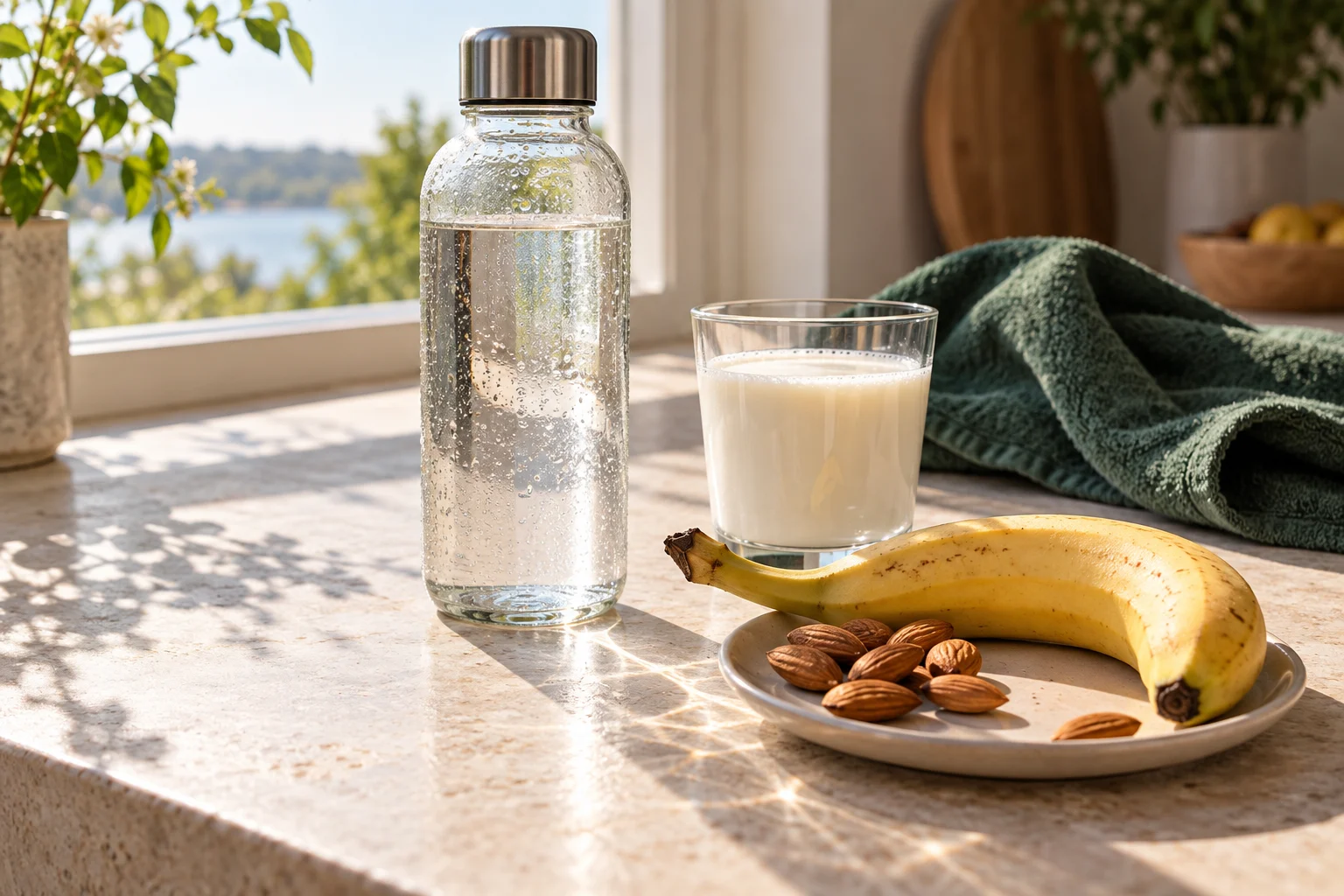
What are electrolytes — and what do they do during exercise?#
Electrolytes are minerals with an electric charge in the body's fluids — mainly sodium, potassium, magnesium, calcium and chloride. They regulate the fluid balance between cells and blood, and they are required for nerves and muscles to function. When you sweat, you lose both water and electrolytes — by far the most sodium.
How much? According to the American College of Sports Medicine's position stand on fluid and exercise, individuals often achieve sweating rates of 0.5–2.0 litres per hour during physical activity, and sweat sodium concentration averages about 35 mmol per litre, with a wide individual range of 10–70 (Sawka et al., 2007, ACSM Position Stand). Sweat also contains smaller amounts of potassium, calcium and magnesium. This loss is what electrolyte products claim to replace — the question is whether the loss is large enough to require anything beyond food and water.
Do you need electrolytes when you exercise?#
For most people: no. ACSM's assessment is blunt: most fitness exercisers and athletes who train for less than 60–90 minutes a day in normal weather conditions are unlikely to become dehydrated or depleted of electrolytes (ACSM, 2025). The same source notes that commercial electrolyte replacers are generally more about convenience than necessity.
The Swedish Food Agency goes even further. Its page on salt states outright that it's easy to believe extra salt — such as rehydration products with added salts — is needed after training or during heatwaves, but that this is not the case: the body is good at adapting, and getting enough water is sufficient even if you have been sweating heavily (Livsmedelsverket — Salt). The body's basic salt requirement is small: 1.5 grams per day covers it, while the health recommendation is not to eat more than 6 grams — most Swedes are already above that.
As a fluid reference, EFSA states that an adequate daily intake is about 2.0 litres for women and 2.5 litres for men — under conditions of moderate temperature and moderate physical activity (EFSA, 2010). Training in the heat raises your fluid needs — but that does not automatically mean you need added electrolytes.
When do electrolytes actually become relevant?#
During long or intense training in the heat — the rule of thumb is sessions beyond 60–90 minutes, especially with heavy sweating. The Swedish Food Agency's page on water makes exactly that distinction: during intense physical activity, or training in hot temperatures, humid climates or at high altitude, we also need salt (sodium) and possibly glucose alongside the fluid (Livsmedelsverket — Water).
The numbers explain why. A heavy sweater might lose about 500–700 mg of sodium in an hour of vigorous exercise (ACSM, 2025). After a two-hour session in summer heat, the salt loss can amount to a meaningful share of your daily intake — and at that point, salt in your recovery meal or drink genuinely helps. ACSM's practical advice ahead of exercise in the heat is to consume about 500 mg of sodium roughly 90 minutes before the session — through regular food such as salted oatmeal, eggs or a salted meal, not necessarily through products.
| Situation | What's enough? |
|---|---|
| Walk, gym class, strength <60 min, normal weather | Plain water + regular food |
| Session 60–90 min, hot weather, moderate sweating | Water + a salted meal afterwards |
| Long session >90 min in the heat, heavy sweating | Water + salt/glucose during or right after (e.g. homemade rehydration solution) |
| Stomach flu, diarrhoea, vomiting | Pharmacy rehydration products — contact your healthcare provider if needed |
If you're a beginner wondering how to even reach those durations — start at the right end with the training guide for beginners.
Can you drink too much water?#
Yes — and this is the lesser-known but more serious risk. Consuming more fluid than you sweat is the primary factor leading to exercise-associated hyponatremia — blood sodium becoming too diluted; the ACSM position stand grades this as Evidence Category A. Symptomatic hyponatremia can occur when plasma sodium rapidly drops to about 130 mmol/L and below (Sawka et al., 2007). It is a serious condition that requires medical care.
The phenomenon is well documented in Swedish medical press too. An article in Läkartidningen (the Swedish Medical Journal) — with the telling headline "Drink when you're thirsty — too much water can be life-threatening" — cites blood samples from 488 runners after the 2002 Boston Marathon, where 16 percent had hyponatremia, and notes that no study recommends more than about 1 litre of fluid per hour even during heavy exertion in hot, humid weather (Fagrell, Läkartidningen, 2009).
The practical takeaway: drink to thirst and your approximate sweat rate — not as much as you can. To learn your own sweat rate: weigh yourself before and after a session; the difference (plus whatever you drank during it) is your loss.
Rehydration solution: make your own — and know when the pharmacy is right#
Oral rehydration solution is water with salt and sugar in proportions the gut absorbs easily — the same principle as the WHO's classic ORS formula against dehydration. The Swedish health service guide 1177 gives a simple base recipe: 1 litre of water, 6 level teaspoons of granulated sugar and half a teaspoon of salt (1177 — Rehydration solution). The ingredients are in every kitchen and cost next to nothing per litre — compare that with ready-made electrolyte powders at 5–15 SEK per serving.
An important caveat: 1177's recipe is written for illness — severe vomiting and diarrhoea. Here we borrow the principle for a different context: long training sessions in the heat, where sweating raises salt and fluid needs. In case of illness — stomach flu, diarrhoea, vomiting — different rules apply: use pharmacy rehydration products and contact 1177 or your healthcare provider if needed. This article gives no dosage advice for illness, and for children always follow 1177's own guidance.
For training use you can also halve the sugar if you're already eating during the session — the point is the sodium and the fluid, not the energy itself.
Food as a natural source of electrolytes#
Here is the cheapest truth in this whole topic: your regular food is already an electrolyte product. This is how much potassium and magnesium a few everyday foods contain, according to the Swedish Food Agency's food database (version 2026-07-01):
| Food (per 100 g) | Potassium | Magnesium | Sodium |
|---|---|---|---|
| Almonds | 1,010 mg | 273 mg | 0 mg |
| Banana | 330 mg | 27 mg | 0 mg |
| Milk (3% fat) | 158 mg | — | 34 mg |
Source: Swedish Food Agency food database, version 2026-07-01
Sodium comes above all from normally salted cooked food — which is why a proper meal after a sweaty session solves most of the "electrolyte problem" on its own. A handful of almonds and a glass of milk in the evening tops up potassium and magnesium. Dairy also contributes fluid, sodium and protein at once — a good combination after training.
How to build the full recovery meal — protein, carbohydrates and fluid after strength sessions — is covered in recovery nutrition for strength training.
Smaklig's perspective: plan the electrolytes into regular food#
If the conclusion is "regular food is almost always enough", the next question is: which food, and when? That's where planning does the work. Smaklig generates weekly menus based on your profile and your store's campaign offers — and if you train long sessions in summer heat, you can ask the sous-chef for potassium-rich dinners or a properly salted recovery meal after the long session, so the right ingredients land on your shopping list automatically.
It also puts your money in the right place: instead of electrolyte powder at 5–15 SEK per serving, the kronor go to real food — which delivers protein, fibre and satiety in the bargain.
Common mistakes with electrolytes and exercise#
Mistake 1 — Sports drink for the half-hour session. Under 60–90 minutes in normal weather, the electrolyte drink provides no measurable benefit — it just costs money and sometimes unnecessary calories. Water is enough.
Mistake 2 — Drinking on autopilot. Downing as much water as possible "to be safe" is riskier than drinking slightly too little: overdrinking is the primary factor in exercise-associated hyponatremia. Drink to thirst.
Mistake 3 — Extra salt at every heatwave. The Swedish Food Agency is clear: the body adapts, and with ordinary sweating, water and a normal diet are enough. The 6-gram daily salt cap applies in summer too.
Mistake 4 — Forgetting that food already delivers. A salted meal, a banana, a handful of almonds — there are your electrolytes, no powder needed.
Action checklist: electrolytes in the heat#
- Training <60–90 min in normal weather? Drink water, eat as usual — done
- Long session >90 min in the heat: plan salt/glucose — homemade rehydration solution or a salted meal right after
- Before training in strong heat: ~500 mg sodium via regular food about 90 minutes before the session
- Weigh yourself before/after a sweaty session to learn your sweat rate
- Drink to thirst — never more than about 1 litre per hour even in the heat
- Stomach flu/diarrhoea: pharmacy rehydration products + your healthcare provider — not the training recipes
- Try Smaklig for free — ask the sous-chef for potassium-rich dinners and salted recovery meals after long sessions
Sources
- American College of Sports Medicine (2007). Exercise and Fluid Replacement — ACSM Position Stand (Sawka et al., Med Sci Sports Exerc 2007;39:377-390)
- Livsmedelsverket (Swedish Food Agency). Salt — dietary advice on salt intake
- Livsmedelsverket (Swedish Food Agency). Water — nutrient
- 1177 (Swedish national health service guide). Oral rehydration solution (vätskeersättning)
- EFSA (2010). Scientific Opinion on Dietary Reference Values for water (EFSA Journal 2010;8(3):1459)
- American College of Sports Medicine (2025). 9 Facts About Hydration & Electrolytes (Nancy Clark, MS, RD, CSSD)
Frequently asked questions
Do you need electrolytes when you exercise?
For most people: no. If you train for less than 60–90 minutes in normal weather, you are unlikely to deplete your electrolyte stores, according to ACSM. During longer or intense exercise in the heat, sodium becomes relevant — you can sweat 0.5–2 litres per hour, and heavy sweaters may lose 500–700 mg of sodium per hour.
What is oral rehydration solution and when is it needed?
Water with salt and sugar in proportions the body absorbs easily. For stomach flu, diarrhoea or vomiting: use pharmacy rehydration products and contact your healthcare provider if needed. For long training sessions in the heat the same principle applies — the Swedish 1177 base recipe is 1 litre of water, 6 level teaspoons of sugar and half a teaspoon of salt.
Can you drink too much water?
Yes. Drinking more than you sweat is the primary factor behind exercise-associated hyponatremia (diluted blood sodium), according to the ACSM position stand. Symptomatic hyponatremia can occur when plasma sodium rapidly drops to about 130 mmol/L or below — a serious condition requiring medical care. Drink to thirst and sweat rate, not as much as you can.
Which foods contain electrolytes?
Potassium is found in bananas (330 mg per 100 g) and almonds (1,010 mg per 100 g, plus 273 mg magnesium); sodium comes from normally salted food and dairy such as milk (34 mg per 100 g), according to the Swedish Food Agency's food database. A regular day of eating covers the electrolyte needs of most exercisers.
What are electrolytes?
Minerals with an electric charge in the body's fluids — mainly sodium, potassium, magnesium, calcium and chloride. They regulate fluid balance plus nerve and muscle function. Through sweat you lose mostly sodium: on average about 35 mmol per litre of sweat (range 10–70), according to ACSM.
Want more meal planning tips?
More guides on food, health and saving money — and a sous-chef that plans your week for you.
Get started
Founder, Smaklig
Writer at Smaklig. We write about food, health, and how to eat better without breaking the bank.
Related articles
October 1, 2026 · 12 min
Everyday exercise – movement that changes your life
Everyday exercise is the movement you get outside of training. Why every walk counts, how much you should move and how to build a habit that lasts over time.
Read moreSeptember 30, 2026 · 9 min
Stress, cortisol and a body that no longer responds as usual
How stress, cortisol, insulin, 'cortisol belly' and muscle fit together, what supplements are good for and when to see a doctor.
Read moreSeptember 23, 2026 · 16 min
Weekly Family Meal Plan: 5 Easy Dinners, One Grocery List
A simple weekly family meal plan with five dinners for four people. Get the recipes, one shared grocery list and tips for different tastes – 25–40 minutes each.
Read moreReady to plan smarter?
Smaklig creates your weekly menu with AI based on store campaigns. Tailored to your goals and allergies.
Get started free