What to Eat When It's Hot: No-Oven Dinners (2026)
What should you eat when it's hot? Water-rich, cool food with no stove: protein salads, cold soups, and the everyday foods that hold the most water.
Download Smaklig – now on the App Store and Google Play The Smaklig app is now on the App Store (iPhone) and Google Play (Android). Download it free.
Download SmakligQuick answer: When it's hot, the body wants cool, water-rich food — not heavy stews. Sweden's Public Health Agency recommends water-rich food like vegetables and fruit, and drinking regularly.
- Water-rich food — vegetables and fruit, per the Public Health Agency
- Cucumber 96%, tomato 95%, watermelon 91% water — among the most hydrating foods (USDA)
- Skip the oven and stove — salads, cold soups and meals you don't need to heat
- Protein without cooking — tuna, chickpeas, halloumi, pre-grilled chicken
- Drink water regularly — don't wait for thirst; avoid alcohol and large amounts of sugary drinks
What should you eat when it's hot? The answer is shorter than you'd think: cool, water-rich food you don't have to cook on a stove or in an oven. When the thermometer climbs past 25 degrees, appetite fades for many people — and there's a biological reason for that. This guide covers what research and Swedish authorities actually recommend, which foods hold the most water, and how to build a dinner without heating up the kitchen.
This is about heat, not lack of time. If you want fast weeknight food regardless of weather, see quick dinner in 20 minutes. Here the focus is coolness: food that works when it's too hot to cook — and to eat — anything heavy.
What do the authorities say about food in a heatwave?#
Water-rich food and regular drinking. Sweden's Public Health Agency (Folkhälsomyndigheten) is clear in its heatwave advice: "Drink more. Don't wait until you feel thirsty. Eat water-rich food such as vegetables and fruit. Avoid large amounts of sugary drinks and alcohol" (Folkhälsomyndigheten, 2022).
Krisinformation.se repeats almost the same advice verbatim, and 1177 Vårdguiden writes that you should "eat food with plenty of fluid, such as fruit and vegetables" (1177). The message is consistent: in the heat, the focus shifts from heavy, warm meals to light and water-rich ones.
Why does it matter? The Public Health Agency explains the mechanism: heat causes the surface blood vessels to dilate and sweating to increase, and if you don't replace the fluid lost to sweating, the blood becomes more concentrated and the risk of blood clots rises (Folkhälsomyndigheten, 2022). Food with a high water content contributes to your fluid intake alongside what you drink.
Which foods contain the most water?#
Fruit and vegetables top the list — several are more than 90% water. Below is the water content per 100 grams according to USDA FoodData Central, which measures nutrient content at the food level:
| Food | Water content |
|---|---|
| Cucumber (with peel) | 96% |
| Iceberg lettuce | 96% |
| Tomato | 95% |
| Bell pepper (green) | 94% |
| Bell pepper (red) | 92% |
| Watermelon | 91% |
| Strawberries | 91% |
| Plain yogurt | 88% |
Source: USDA FoodData Central
These foods do double duty in the heat: they contribute to fluid balance and provide few calories, while being cool and fresh to eat. Build the summer meal around them — a plate of cucumber, tomato, pepper and a protein source is both filling and hydrating without you turning on a single burner.
Why do you lose your appetite in the heat?#
There's a physiological link between body temperature and hunger. A study in mice showed that a small rise in body temperature activates so-called POMC neurons, which suppress appetite (Yu et al., 2018, PLOS Biology). The finding is in animals and not directly proven in humans, but it offers a plausible mechanism behind an experience many recognise: in strong heat, a heavy meal appeals less.
There's also a thermodynamic component. Digesting food produces heat — the so-called thermic effect of food. It's largest for protein: one review reports 20–30% of the energy content for protein, versus 5–10% for carbohydrates and 0–3% for fat (Westerterp, 2004, Nutrition & Metabolism). A large, protein-heavy meal therefore generates more internal heat to shed — which may explain why a light salad feels better than a meat stew on a hot summer evening.
The takeaway isn't to skip protein — it's needed for satiety and muscle — but to spread it across smaller, cooler portions through the day instead of in a single heavy meal. To dig deeper into protein sources, see high-protein dinner: 25 recipes with 30 g+ protein.
No-oven dinner: how to build a cool meal#
The basic formula is simple: a water-rich base + a protein you don't have to cook + flavour and fat that lift it. Here are the building blocks.
Protein without a stove#
You don't need to cook protein from scratch to get it. Smart choices that keep the kitchen cool:
- Canned tuna, mackerel or sardines — protein-rich, ready straight from the tin
- Chickpeas and white beans — rinse and top the salad; cheap and filling
- Pre-grilled chicken — buy it grilled, skip the oven entirely
- Halloumi and feta — halloumi can be eaten as is or pan-seared in minutes
- Eggs — boil a batch in the morning while it's cool, store in the fridge
- Plain yogurt and quark — a base for both breakfast and a cool, savoury dressing
Cold soups and raw dishes#
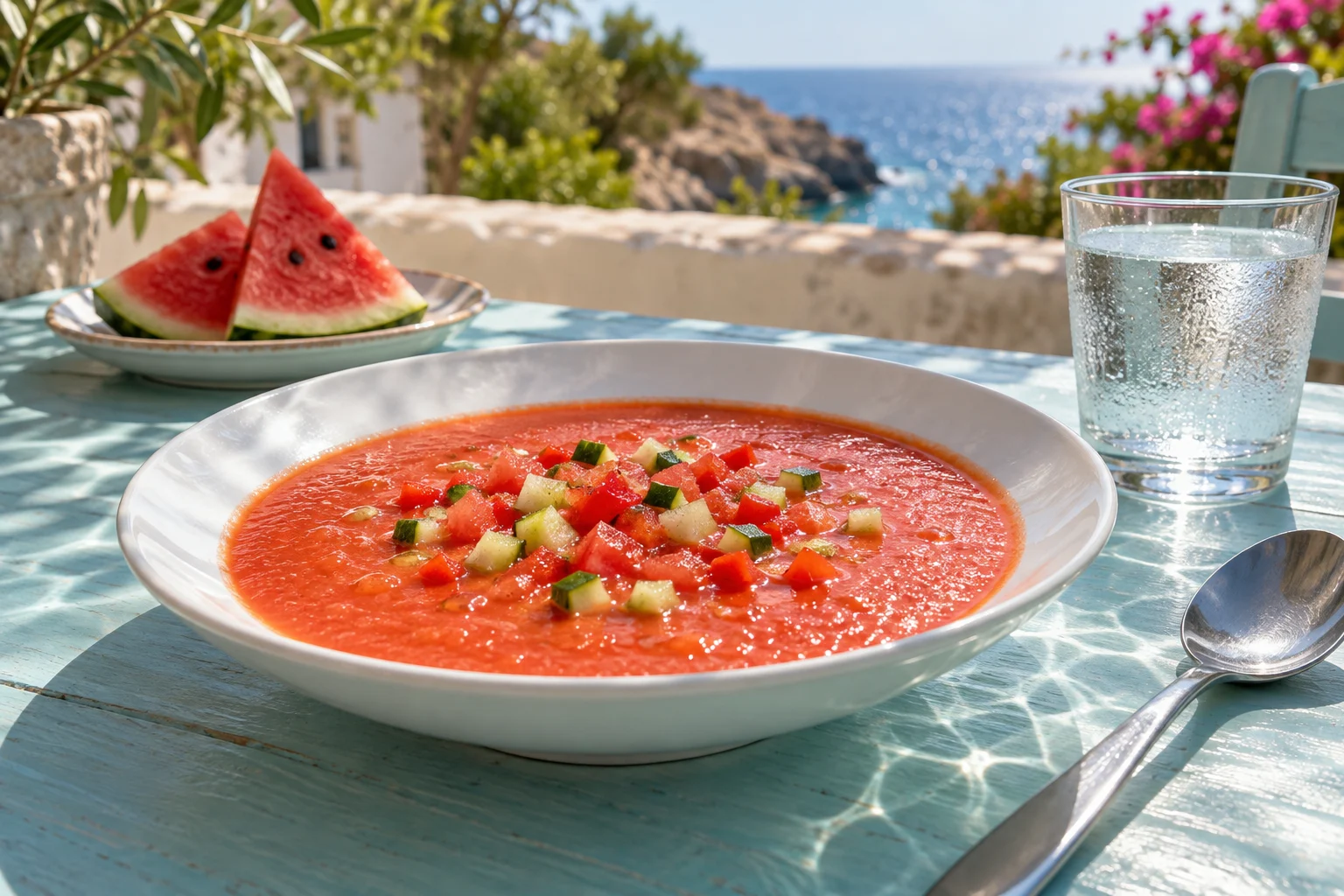
Gazpacho — cold Spanish tomato soup made from tomato, cucumber, pepper and garlic — is the archetype of heat food: nutritious, hydrating and entirely uncooked. Blend the ingredients, chill, serve. Other cool options are cold cucumber-yogurt soup, melon-and-feta salad, and rice or pasta salad cooked early in the day and chilled.
Smaller portions, more often#
Instead of one heavy dinner, several smaller cool meals through the day can feel lighter when appetite is low — it ensures you get both energy and fluid without straining digestion. Make sure each small meal has both a water-rich vegetable or fruit and some protein.
What to drink — and avoid — in the heat#
Water first, and regularly. The Public Health Agency's core advice is not to wait for thirst. As a reference value, EFSA states that an adequate total fluid intake is about 2.0 litres per day for women and 2.5 litres for men — but explicitly "under conditions of moderate temperature and moderate physical activity" (EFSA, 2010). During a heatwave the need is therefore higher, since you lose more fluid through sweat.
What to hold back on: alcohol and large amounts of sugary drinks, according to the Public Health Agency and krisinformation.se. Alcohol is also a diuretic and a poor strategy when the body is already struggling with fluid balance.
If you train long or intense sessions in the heat, that's a different question from everyday fluid balance — sweat losses, salt and rehydration are covered in electrolytes for training in the heat.
An important caveat for risk groups: 1177 advises that "if you are older than 65 and have heart disease, kidney disease or take medication, you should talk to your doctor about how much extra to drink" (1177). More fluid isn't always better for everyone — some heart and kidney patients have individual limits.
Especially vulnerable in the heat — mind the risk groups#
Not everyone is affected equally. The Public Health Agency identifies several particularly sensitive groups: older people (temperature regulation and the sense of thirst decline with age), the chronically ill (cardiovascular disease, kidney disease, diabetes and others), people with disabilities, and small children and pregnant women — small children often haven't fully developed their ability to sweat (Folkhälsomyndigheten, 2022).
For them, water-rich food and regular drinking is not a comfort question but a safety one. Keep an eye on relatives in these groups during a heatwave, and actively offer water-rich food and drink.
Smaklig's perspective: plan cool in advance#
The biggest challenge with hot-weather food is that appetite and energy fail exactly when you need to decide what to eat. The solution is to move the decisions to before the heat hits. Smaklig generates weekly menus based on your profile and your store's campaigns — and for a summer week you can ask the sous-chef for cool, stove-free dishes with high water content, so your shopping list is already adapted for the heat when you're in the store.
The point is that you avoid improvising in a hot apartment with low appetite. If the ingredients for a gazpacho or a protein salad are already home, the cool choice is also the easiest one. For more ideas across the whole week, see the pillar guide what's for dinner tonight.
Common mistakes in the heat#
Mistake 1 — Waiting for thirst. Thirst is a late signal. Drink regularly through the day, just as the Public Health Agency advises.
Mistake 2 — Skipping food entirely. Low appetite is normal, but not eating at all causes an energy shortfall. Choose light and water-rich instead of nothing.
Mistake 3 — Cool drink = soda and alcohol. Sugary drinks and alcohol work against fluid balance. Water is still the base.
Mistake 4 — The usual heavy dinner. A protein-heavy stew generates more internal heat to shed. Save it for cooler days.
Action checklist: eat right when it's hot#
- Stock the fridge with water-rich produce: cucumber, tomato, pepper, watermelon, lettuce
- Keep protein that needs no oven at home: tuna, chickpeas, halloumi, pre-grilled chicken
- Boil eggs, rice or pasta early in the morning while it's cool
- Drink water regularly — don't wait for thirst
- Avoid alcohol and large amounts of sugary drinks
- Keep an eye on older people and small children in the household during the heat
- Try Smaklig for free — ask the sous-chef for cool, stove-free dishes and get your shopping list adapted for the heat
Sources
- Folkhälsomyndigheten (Public Health Agency of Sweden) (2022). Advice during heatwaves — For you, your friends and relatives (art. no. 21306, 2022)
- Krisinformation.se. High temperatures and heatwaves
- 1177 Vårdguiden. Advice during very hot weather
- EFSA (2010). Scientific Opinion on Dietary Reference Values for water (EFSA Journal 2010;8(3):1459) — summarised in EFSA press release
- Nutrition & Metabolism (2004). Westerterp, 2004 — Diet induced thermogenesis
- U.S. Department of Agriculture. USDA FoodData Central — water content per food
Frequently asked questions
What should you eat during a heatwave?
Water-rich food such as vegetables and fruit, according to Sweden's Public Health Agency. Choose cool dishes you don't need to cook on a stove or in an oven: protein salads (chickpeas, tuna, halloumi, pre-grilled chicken), cold soups like gazpacho, and water-rich foods like cucumber and watermelon. Eat smaller portions more often rather than heavy meals.
What should you drink when it's hot?
Water first, and regularly — don't wait until you feel thirsty, advises the Public Health Agency. EFSA's baseline is about 2.0 litres of fluid per day for women and 2.5 litres for men at moderate temperature, so you need more in the heat. Avoid large amounts of sugary drinks and alcohol. If you're 65+ with heart or kidney disease, ask your doctor how much you should drink.
Why do you lose your appetite when it's hot?
There's a biological link between body temperature and appetite. Animal studies show a small rise in temperature activates appetite-suppressing neurons (Yu et al., 2018). Heavy, protein-rich meals also cost more energy to digest — the thermic effect is 20–30% for protein versus 0–3% for fat (Westerterp, 2004), which makes light, water-rich meals more appealing in the heat.
Which foods contain the most water?
Cucumber (about 96% water), iceberg lettuce (96%), tomato (95%), bell pepper (92–94%), watermelon (91%) and strawberries (91%) according to USDA FoodData Central. They support hydration while providing few calories — an ideal base for cool summer meals.
Is it dangerous to eat little in the heat?
Occasional days of lower appetite are rarely a problem for healthy adults, as long as you stay hydrated. But risk groups — older people, small children, pregnant women and the chronically ill — are more sensitive to both heat and dehydration. Make sure they get water-rich food and drink regularly, and seek care at signs of dehydration or heat stroke.
Want more meal planning tips?
More guides on food, health and saving money — and a sous-chef that plans your week for you.
Get started
Founder, Smaklig
Writer at Smaklig. We write about food, health, and how to eat better without breaking the bank.
Related articles
May 8, 2026 · 7 min
Maintenance Weekly Menu: 5 Days at TDEE
A practical 5-day weekly menu at maintenance calories (TDEE) with no deficit. Swedish staples, supermarket promotion substitutions, and NNR 2023-aligned nutrition.
Read moreOctober 1, 2026 · 12 min
Everyday exercise – movement that changes your life
Everyday exercise is the movement you get outside of training. Why every walk counts, how much you should move and how to build a habit that lasts over time.
Read moreSeptember 30, 2026 · 9 min
Stress, cortisol and a body that no longer responds as usual
How stress, cortisol, insulin, 'cortisol belly' and muscle fit together, what supplements are good for and when to see a doctor.
Read moreReady to plan smarter?
Smaklig creates your weekly menu with AI based on store campaigns. Tailored to your goals and allergies.
Get started free