Budget meal plan: turn this week's offers into dinners
A budget meal plan built on this week's supermarket offers: start with what you have, stretch each deal over several dinners and check unit price and terms.
Download Smaklig – now on the App Store and Google Play The Smaklig app is now on the App Store (iPhone) and Google Play (Android). Download it free.
Download SmakligShort answer: A budget meal plan built on this week's offers starts in the fridge, not in the flyer. See what you already have, pick offers that stretch to several dinners and count the cost of the whole meal.
- Start with what you have at home – rice, beans or yoghurt in the cupboard decide which offers are worth buying
- One ingredient, several evenings – chicken, potatoes and carrots can become a tray bake, a soup and an omelette
- Compare the unit price – under the Swedish Price Information Act, the price per kilo or litre must as a general rule be shown for goods
- Read the terms – membership, several packs or a minimum spend may be required
- Buy amounts you will eat – household food waste costs on average SEK 1,330 per person a year (calculated with 2022 prices), according to the Swedish Food Agency
- In Smaklig the plan becomes a weekly menu based on the offers where you shop, with a shopping list
This week's offers – how do they actually become dinner?#
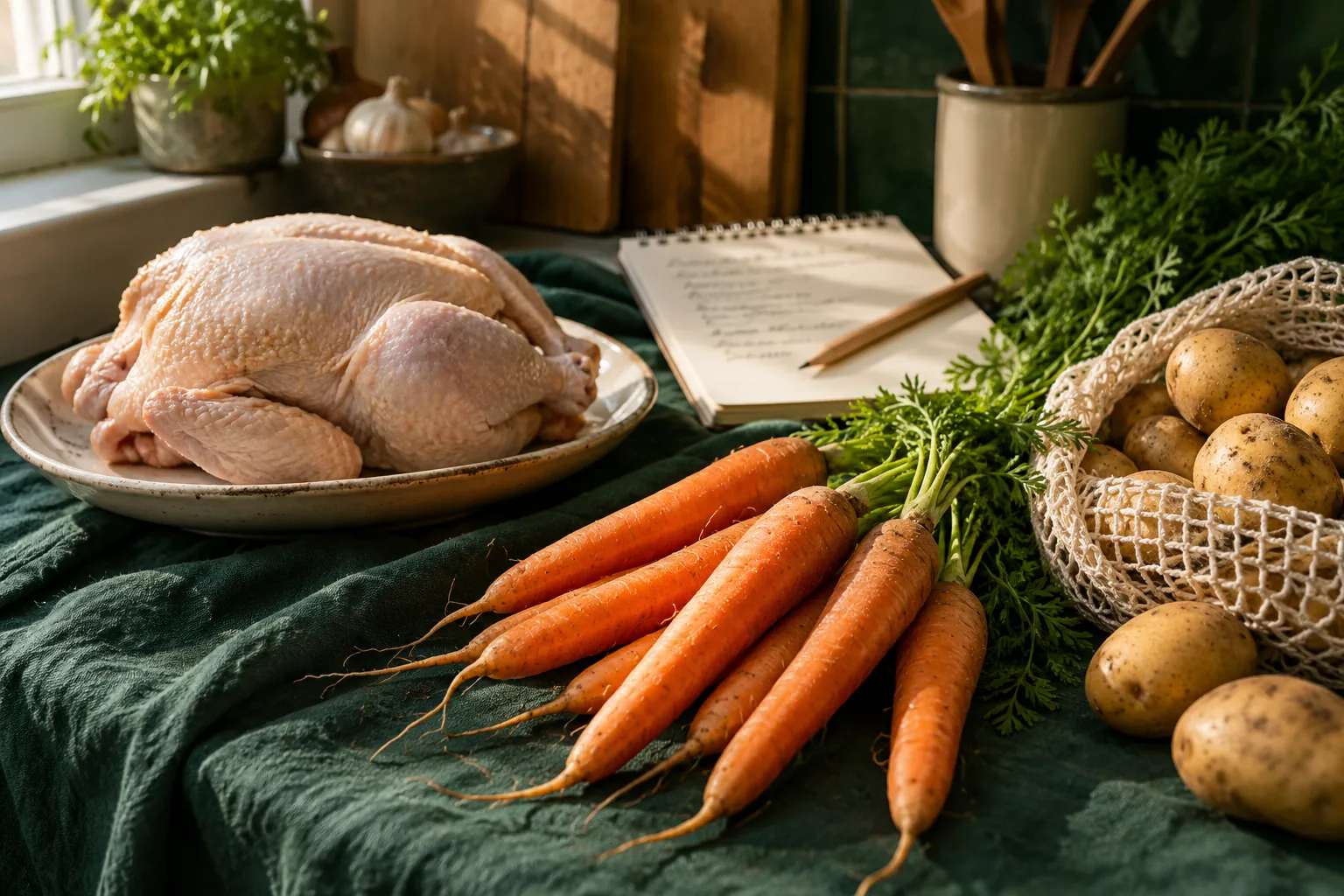
Chicken on offer. A big bag of carrots. Potatoes with a red price tag. The offers may be good, but at home you still have to work out what to cook. A cheap ingredient only becomes useful when it fits into a meal you want to eat.
Smaklig's idea is to make the link between this week's offers and this week's dinners easier. Here we show how you can think when you plan.
Why doesn't a cheap offer automatically make a cheap dinner?#
Because the cost of a dinner is the sum of all its ingredients, not just the price of the item with the red sign. An offer that needs several new extras can make a more expensive dinner than a dish you already have most things for at home. And an item that never gets cooked is a pure loss, however cheap it was.
That is why it pays to plan in two steps: first what you have, then what you buy. If you want ready-made ideas for everyday dishes that keep costs down, there are more cheap dinners to start from.
Start with what you already have#
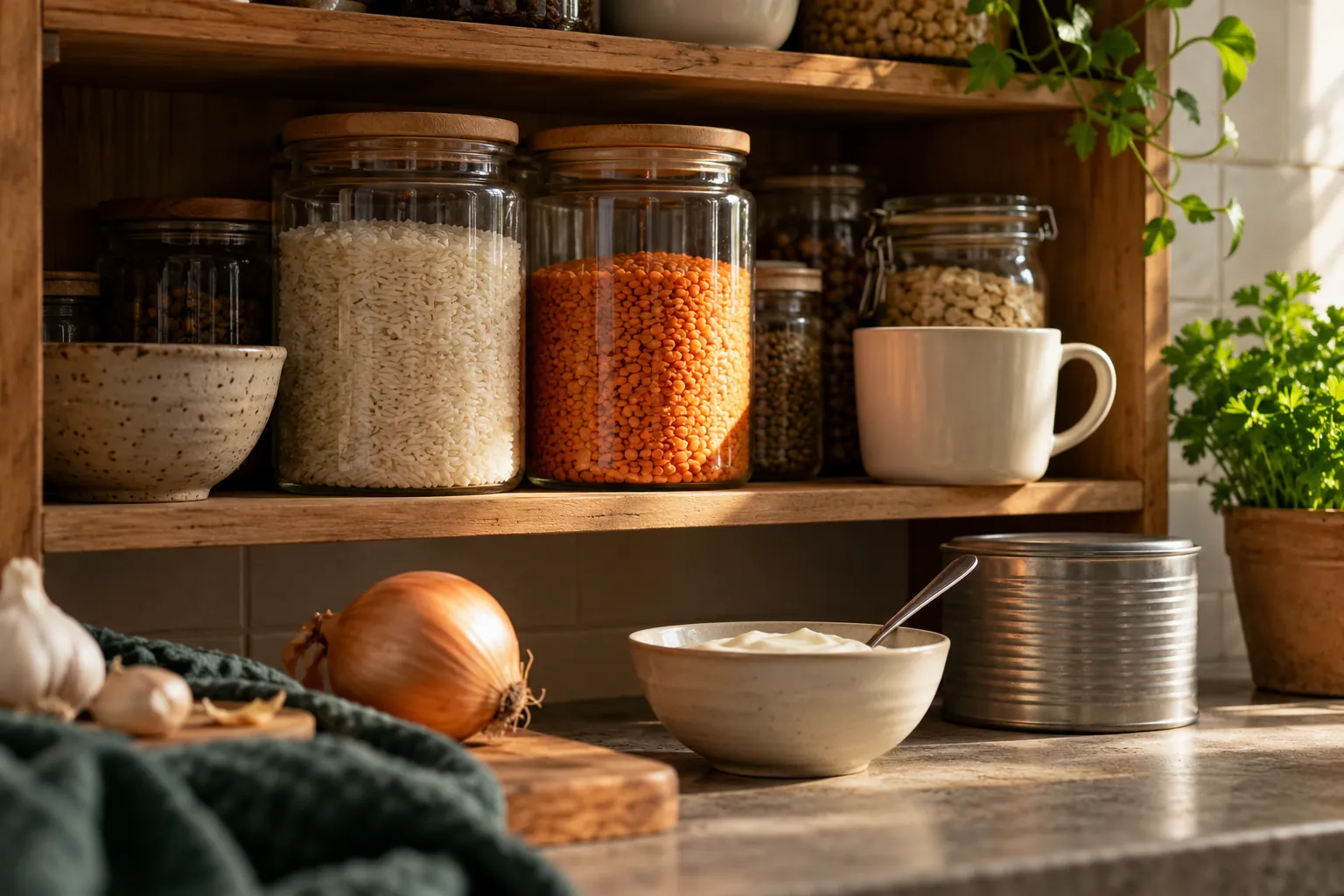
Before you choose offers, look in the fridge and the cupboard. Do you have rice, a tin of beans and yoghurt at home? Then they can shape which offers are worth buying.
It is easy to get stuck on the price of the main ingredient. But if the recipe needs several new extras, the whole dinner can still end up more expensive than you thought. So ask both what the item costs and what you need to buy to be able to use it.
Three offers can become several dinners#
Imagine your shop has offers on chicken, potatoes and carrots. The example is made up and does not describe any current offers.
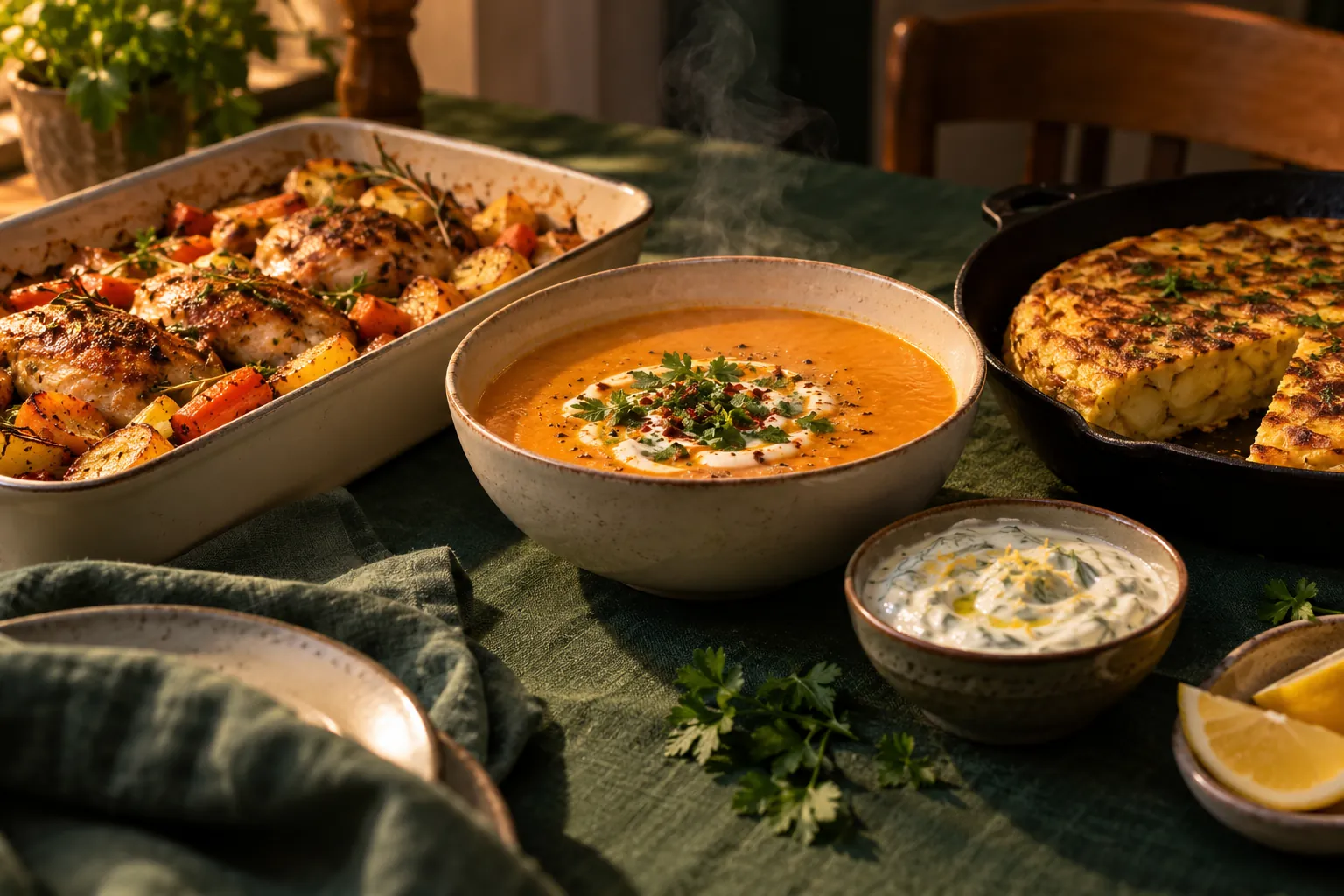
On the first evening you make oven-baked chicken with potatoes and carrots. A little yoghurt, lemon and spices make a sauce. Adjust the amounts to how many people are eating.
Another evening you use more of the carrots in a soup with red lentils. If you already have lentils in the cupboard, you may only need to add onion and stock. Potatoes left in the bag can go into an omelette with eggs and whatever vegetables you have at home.
You now have a plan for several ingredients before you shop. That makes it easier to judge how big a pack you really need and which purchases you can cross off.
What does a budget meal plan built on offers look like?#
A budget meal plan built on offers lets two or three deals carry four or five dinners and fills the gaps with what is already in the cupboard. The table builds on the same made-up example, without prices, because offers differ between shops and weeks.
| Day | Dinner | Offer | Already at home | Buy extra |
|---|---|---|---|---|
| Monday | Oven-baked chicken with potatoes, carrots and yoghurt sauce | Chicken, potatoes, carrots | Yoghurt, spices | Lemon |
| Tuesday | Carrot soup with red lentils | Carrots | Red lentils | Onion, stock |
| Wednesday | Omelette with potatoes and vegetables | Potatoes | Vegetables | Eggs |
| Thursday | Rice with beans and roasted carrots | Carrots | Rice, beans | – |
| Friday | Chicken in pitta bread with yoghurt sauce | Chicken | Yoghurt | Pitta bread |
Look at the column on the far right. The shorter it is, the more of the week is carried by the offers and the cupboard. For more ideas on dinners made from what is already at home, there is a guide to pantry dinners and leftovers.
Compare the cost of the whole plan#
A good offer is one you have a use for. Check the unit price and the terms: is membership required, several packs or a certain minimum spend? Choose amounts that suit your household and plan how the food will be used.
If you want to compare two dinners, include every ingredient. Also separate the cost of what you use from the total at the till. A bottle of oil costs more to buy than the small amount a recipe uses.
What is a unit price, and what applies to special offers?#
The unit price is the item's final price per kilo, litre, metre or other common measure, in kronor and including VAT and other taxes. Under the Swedish Price Information Act, price information for goods must as a general rule give both the price and the unit price, with some exceptions (Prisinformationslag 2004:347, sections 2 and 7). The unit price is what shows whether the big pack really is cheaper than the small one.
If an item is marketed with a price reduction, the shop must as a main rule also state the previous price, and that must be the lowest price during the 30 days before the reduction (section 7 a). The law makes an exception for goods that can quickly deteriorate or go out of date, so for some fresh foods the previous price may be missing. That makes the unit price the safest measure when you are standing at the shelf. A related measure when you compare whole dinners is price per portion.
Which mistakes make shopping the offers more expensive?#
Most mistakes come from buying the offer before it has a place in the week. Five common traps:
- Multibuys you don't use – "buy three" only pays off if all three packs become food
- Terms you don't meet – a member price or a minimum spend means the price at the till is different
- Packs that are too big – the unit price is lower, but the rest may be left over
- New extras for every offer dish – the total at the till grows even though the main ingredient was cheap
- Waste after the week – the Swedish Food Agency has calculated that household food waste, 33 kilos per person a year, costs on average SEK 1,330 per person and SEK 5,320 for a family of four, at 2022 prices per kilo. Fruit and vegetables are the single most expensive part (Livsmedelsverket, 2024)
More ways to keep food costs down are in the guide to saving money on food. If you shop at ICA, there is also a separate walkthrough of ICA's offers and bonus deals.
Checklist: from this week's offers to a shopping list#
The checklist sums up the method in seven steps that take you from the flyer to a finished list.
- Look in the fridge, freezer and cupboard and note what needs using first.
- Go through this week's offers at the shop where you buy your food.
- Pick two or three offers that work in several dinners.
- Spread the dinners across the week and start with the freshest ingredients.
- Check the unit price and terms for each offer.
- Write the shopping list and cross off what you already have at home.
- Choose pack sizes by how much you will actually have time to eat.
If you are new to planning the whole week, there is a step-by-step guide to meal planning for beginners, and for families a ready-made weekly family meal plan.
How do you make a budget meal plan from the offers in Smaklig?#
Smaklig plans the week's dinners around this week's offers where you shop, across all seven chains: ICA, Coop, Willys, Hemköp, Lidl, City Gross and Costco, and makes the shopping list for you. You tell it what you have at home, and the plan starts from that.
This is the whole picture we want to help with in Smaklig: going from offers to a food week that hangs together. Prices and ranges vary between shops, so always check what applies where you shop.
Open Smaklig and create a weekly menu. Use this week's offers and what you already have at home as your starting point when you choose your dinners.
How to get started:
- Choose the shop where you buy your food and fill in what is in your cupboard.
- Write in the chat, for example: "Make a weekly menu with five dinners based on this week's offers. I have rice, red lentils and yoghurt at home." Smaklig then makes the shopping list from the menu. If you shop at ICA or Coop, the list is matched against the store's range, the cheapest products are picked and they are added to the basket in the app.
Smaklig is available on the App Store, on Google Play and on the web, and is free during the beta.
Sources
- Sveriges riksdag (2004). Prisinformationslag (2004:347) — Swedish Price Information Act. Svensk författningssamling (as amended up to SFS 2022:654).
- Livsmedelsverket (Swedish Food Agency) (2024). Vad kostar matsvinnet i hemmet? (PM 2024) — What does household food waste cost?. Livsmedelsverket PM.
Frequently asked questions
How do I make a budget meal plan from this week's offers?
Start by checking what you already have at home. Then pick two or three offers that work in several dinners and write the shopping list from the plan. Count the cost of the whole meal, not just the main ingredient.
Is a special offer always cheaper?
Not necessarily for your household. An offer only pays off if you use the product and the terms suit you, such as membership, a number of packs or a minimum spend. Compare the unit price, the price per kilo or litre, between pack sizes.
What is a unit price?
The unit price, called jämförpris in Sweden, is the final price per kilo, litre, metre or other common measure, in kronor and including VAT. Under the Swedish Price Information Act, shops must as a general rule show both the price and the unit price for goods, so you can compare pack sizes.
How many dinners can one offer stretch to?
It depends on the pack size and how many of you there are. One example is chicken, potatoes and carrots spread over oven-baked chicken, carrot soup with red lentils and a potato omelette. Decide the dinners before you shop, and you know how much you need.
How do I stop offers turning into food waste?
Only buy what your household has time to eat, and decide in advance which dinner each item will become. The Swedish Food Agency has calculated that household food waste costs on average SEK 1,330 per person a year, at 2022 prices per kilo, and that fruit and vegetables are the most expensive part.
How do I use this week's offers when planning meals?
Start with what you have at home, then pick two or three offers that can become several dinners and write the shopping list from the menu. Check the unit price and the conditions before you shop.
Want more meal planning tips?
More guides on food, health and saving money — and a sous-chef that plans your week for you.
Get started
Co-founder & Growth, Smaklig
Writer at Smaklig. We write about food, health, and how to eat better without breaking the bank.
Related articles
October 30, 2026 · 10 min
Christmas dinner on a budget: more Christmas for less
Christmas dinner on a budget: pick the favourites, buy offers that fit the menu, check the pantry first and plan easy meals for the leftovers after Christmas.
Read moreSeptember 4, 2026 · 13 min
Photograph Your Fridge — Get Dinner Ideas (2026)
Photograph your fridge and let AI identify ingredients and suggest recipes you can cook now. See how it works, what it can miss, and how it reduces food waste.
Read moreJuly 31, 2026 · 11 min
Meal Prep: Freezer-Friendly Meals for the Week (2026)
Meal prep for the week: choose recipes, scale portions, cool food safely and freeze practical meals. Plan grocery quantities so each ingredient has a clear use.
Read moreReady to plan smarter?
Smaklig creates your weekly menu with AI based on store campaigns. Tailored to your goals and allergies.
Get started free