Weekly Family Meal Plan: 5 Easy Dinners, One Grocery List
A simple weekly family meal plan with five dinners for four people. Get the recipes, one shared grocery list and tips for different tastes – 25–40 minutes each.
Download Smaklig – now on the App Store and Google Play The Smaklig app is now on the App Store (iPhone) and Google Play (Android). Download it free.
Download SmakligShort answer: A weekly family meal plan is easiest with five weeknight dinners that share ingredients and come from a single grocery list.
- Five dinners for four people – spaghetti with meat sauce, oven-baked chicken, baked fish, lentil stew and tortillas
- 25–40 minutes per dinner, no special equipment needed
- One grocery list – carrots, yoghurt, onion and crushed tomatoes come back in several dishes
- Different tastes are solved at the table – the base, sides and spices are served separately
- Close to the adult dietary guidelines – on average about 125 g raw minced beef per person across the week's dinners and pulses on three days; fish once, so add a fish dinner at the weekend
What should we eat this week? Here is a weekly meal plan for families with five simple dinners for four people. You get one shared grocery list and small ways to adapt each dish when the family likes different things. Plan on about 25–40 minutes per dinner.
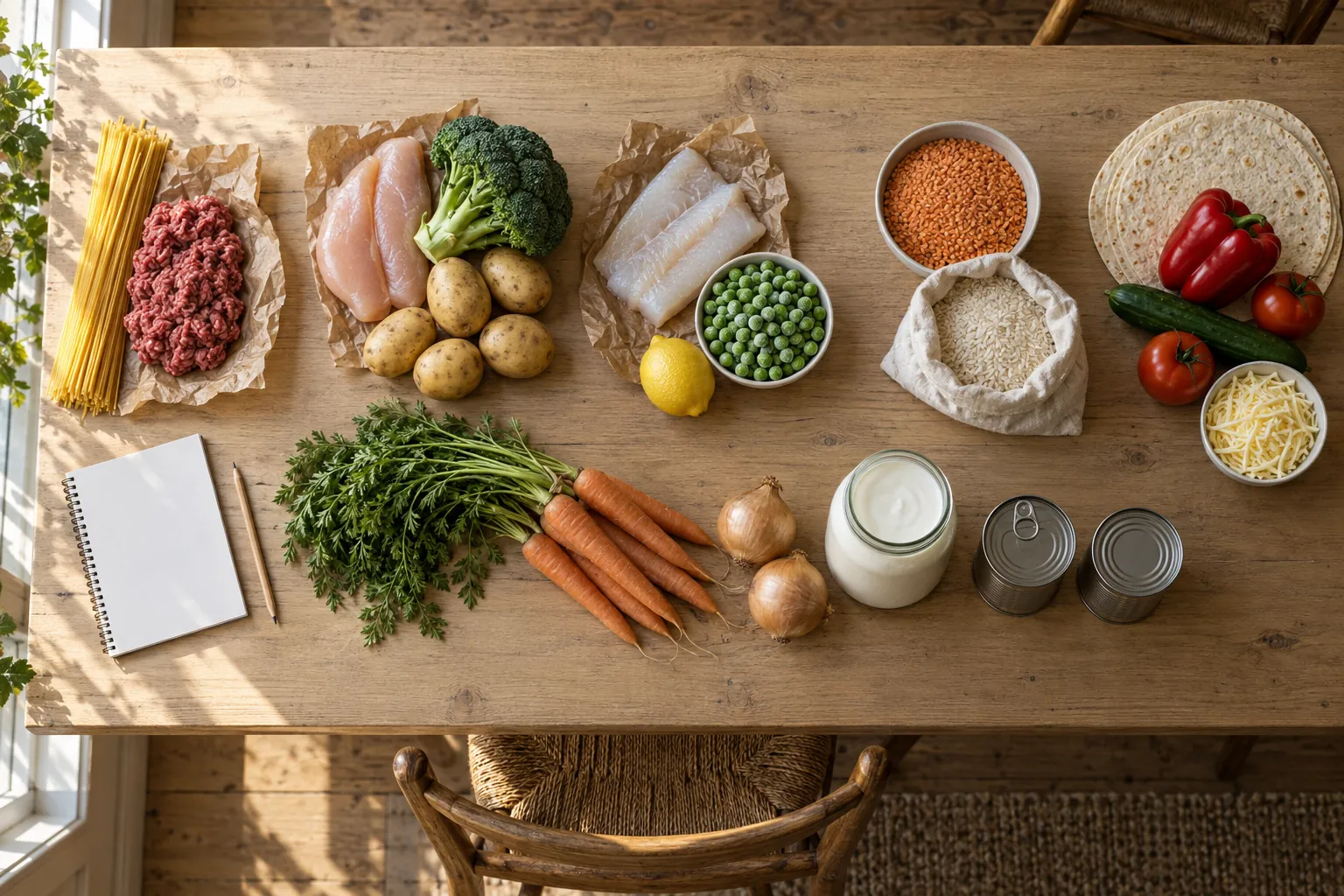
This week's dinners#
| Day | Dinner |
|---|---|
| Monday | Spaghetti with meat sauce and grated carrots |
| Tuesday | Oven-baked chicken and potatoes with cold yoghurt sauce |
| Wednesday | Oven-baked fish with potatoes, peas and lemon yoghurt |
| Thursday | Mild lentil stew with rice |
| Friday | Tortillas with beans, vegetables and cheese |
The weekly family meal plan in numbers#
All five dinners take 25–40 minutes, and two of them are vegetarian. Energy and protein are calculated per serving, meaning a quarter of the dish, using the Swedish Food Agency's food composition database. Adults usually eat more than a quarter and children less.
| Day | Dinner | Time | Energy per serving | Protein per serving | Protein source |
|---|---|---|---|---|---|
| Monday | Spaghetti with meat sauce | about 30 min | about 750 kcal | about 41 g | Red meat |
| Tuesday | Oven-baked chicken and potatoes | about 40 min | about 480 kcal | about 50 g | Chicken |
| Wednesday | Oven-baked fish with potatoes and peas | about 35 min | about 390 kcal | about 36 g | Fish |
| Thursday | Mild lentil stew with rice | about 30 min | about 660 kcal | about 28 g | Lentils |
| Friday | Tortillas with beans | about 25 min | about 720 kcal | about 33 g | Beans and cheese |
Monday: Spaghetti with meat sauce#
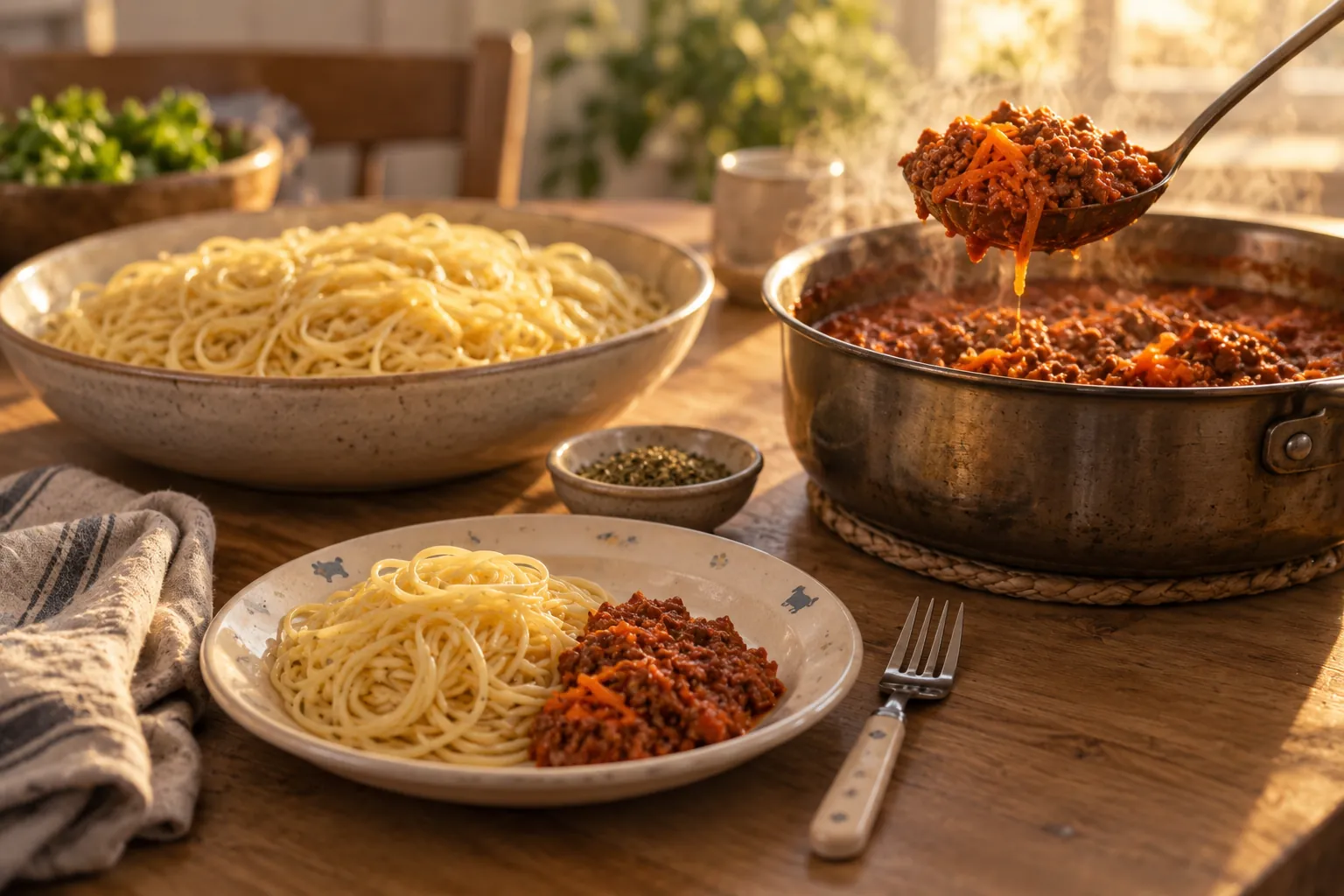
Estimated energy: 750 kcal per serving (1/4). Rounded estimate calculated from the ingredient amounts using the Swedish Food Agency's food composition database. The minced meat is counted as 10% fat beef mince and the oil as 1 tbsp rapeseed oil. Each serving provides about 41 g protein, 19 g fat and 97 g carbohydrates. One serving is a quarter of the dish; adults often eat more and children less. Not a laboratory-measured value.
You need: 500 g pasta, 500 g minced beef, 1 yellow onion, 2 carrots, 1 pack crushed tomatoes (about 400 g), oil and dried oregano (optional).
- Cook the pasta according to the package.
- Chop the onion and grate the carrots. Fry them in a little oil, add the minced beef and fry until cooked through.
- Pour in the crushed tomatoes and about 100 ml water. Season with oregano, salt and pepper. Simmer for 10 minutes.
For different tastes: Serve the pasta and sauce separately. Some want more sauce, others just a little.
Tuesday: Oven-baked chicken and potatoes#
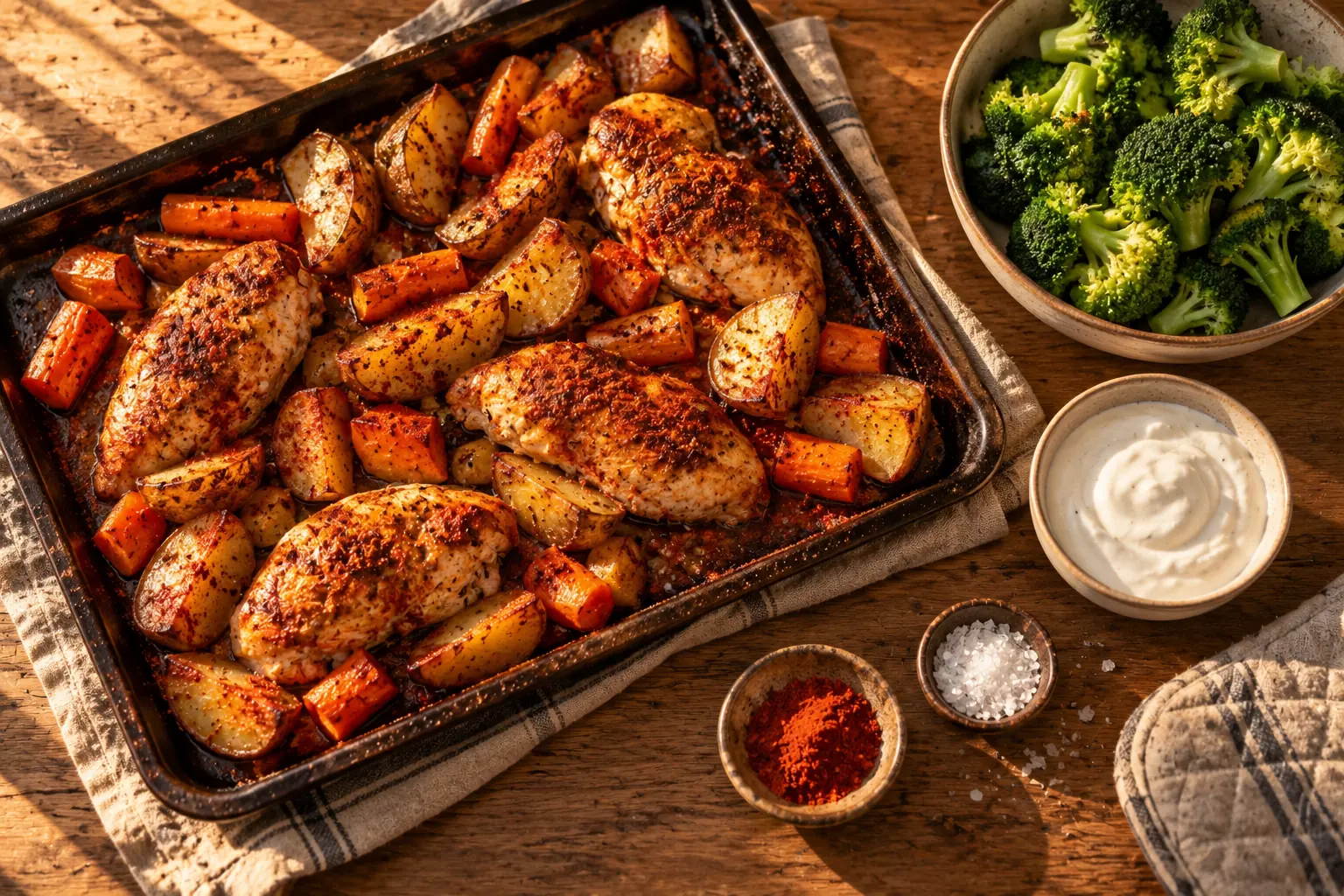
Estimated energy: 480 kcal per serving (1/4). Rounded estimate calculated from the ingredient amounts using the Swedish Food Agency's food composition database. The oil is counted as 1 tbsp rapeseed oil and the broccoli as 400 g. Each serving provides about 50 g protein, 8 g fat and 46 g carbohydrates. One serving is a quarter of the dish; adults often eat more and children less. Not a laboratory-measured value.
You need: about 700 g chicken breast fillet, 900 g potatoes, 2 carrots, 1 head of broccoli, 250 g plain yoghurt, oil and paprika powder.
- Heat the oven to 225 °C. Cut the potatoes and carrots into smaller pieces. Toss with oil, salt and a little paprika powder on a baking tray. Roast for about 15 minutes.
- Cut the chicken into even pieces and add it to the tray. Roast for another 15–20 minutes, until the chicken is cooked through and the potatoes are soft.
- Boil or steam the broccoli. Serve with plain yoghurt as a cold sauce.
For different tastes: Put the spices on the table so anyone who wants can season more. Serve the broccoli and yoghurt sauce on the side.
Wednesday: Oven-baked fish with potatoes and peas#
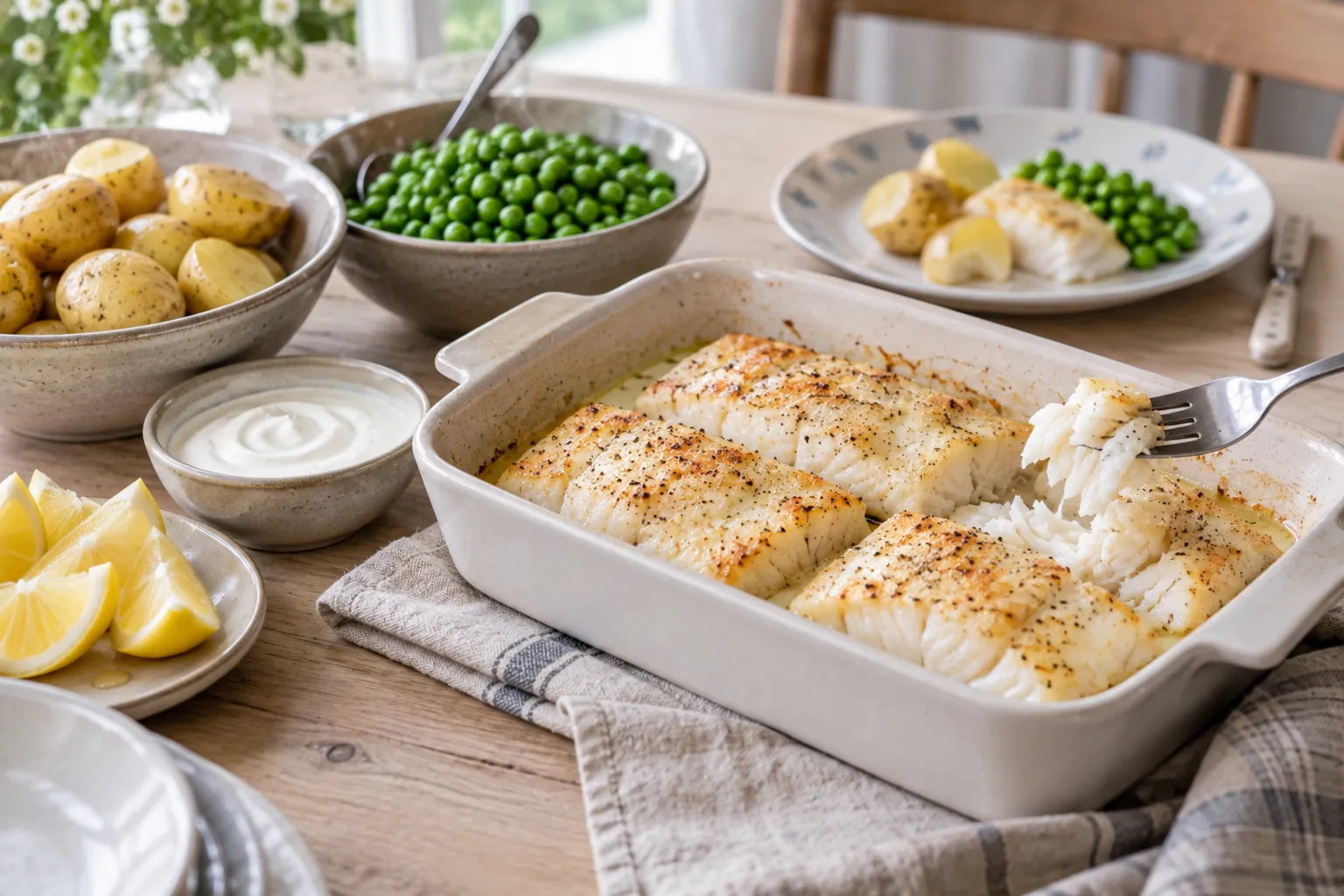
Estimated energy: 390 kcal per serving (1/4). Rounded estimate calculated from the ingredient amounts using the Swedish Food Agency's food composition database. The white fish is counted as cod and the oil as 1 tbsp rapeseed oil. Each serving provides about 36 g protein, 6 g fat and 42 g carbohydrates. One serving is a quarter of the dish; adults often eat more and children less. Not a laboratory-measured value.
You need: about 600 g white fish, 800 g potatoes, 250 g frozen peas, 1 lemon and 250 g plain yoghurt.
- Boil the potatoes. Heat the oven to 200 °C.
- Place the fish in an ovenproof dish with a little oil, salt and pepper. Bake for about 15–20 minutes, depending on the thickness of the fish, until it is done.
- Warm the peas. Mix the yoghurt with a little lemon juice and serve lemon wedges on the side.
For different tastes: Let everyone add lemon themselves. Yoghurt also works as a mild sauce without lemon.
Thursday: Mild lentil stew with rice#
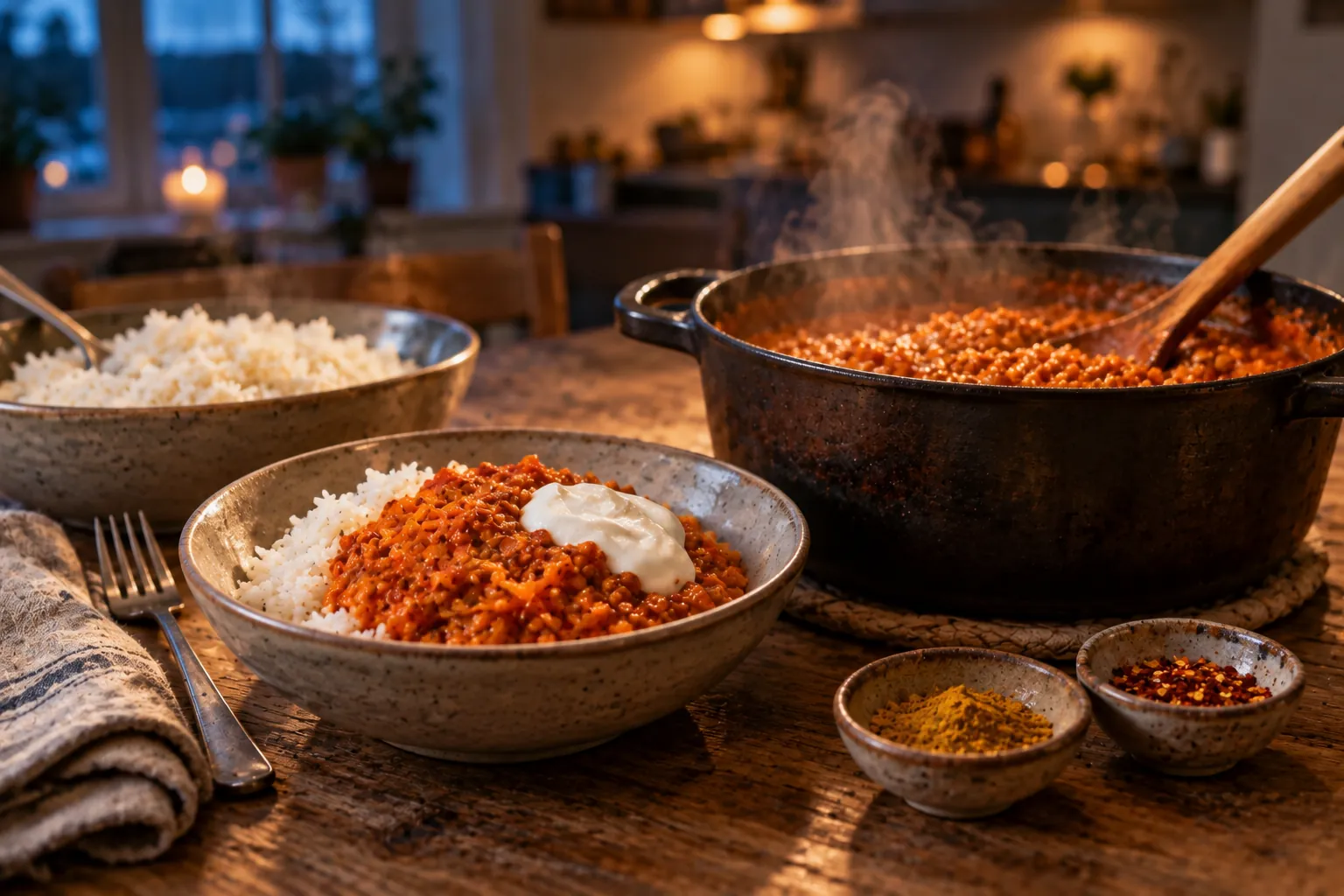
Estimated energy: 660 kcal per serving (1/4). Rounded estimate calculated from the ingredient amounts using the Swedish Food Agency's food composition database. The oil is counted as 1 tbsp rapeseed oil. Each serving provides about 28 g protein, 6 g fat and 117 g carbohydrates. One serving is a quarter of the dish; adults often eat more and children less. Not a laboratory-measured value.
You need: 300 g dried red lentils, 350 g rice, 1 yellow onion, 2 carrots, 1 pack crushed tomatoes (about 400 g) and 200 g plain yoghurt.
- Cook the rice according to the package.
- Chop the onion and grate the carrots. Fry in a little oil. Add the rinsed lentils, crushed tomatoes and about 600 ml water.
- Simmer for about 15–20 minutes until the lentils are soft. Add more water if the stew gets too thick. Season with salt and serve with yoghurt.
For different tastes: Keep the stew mild and put out, for example, curry powder or chilli flakes for anyone who wants more flavour.
Friday: Tortillas with beans, vegetables and cheese#
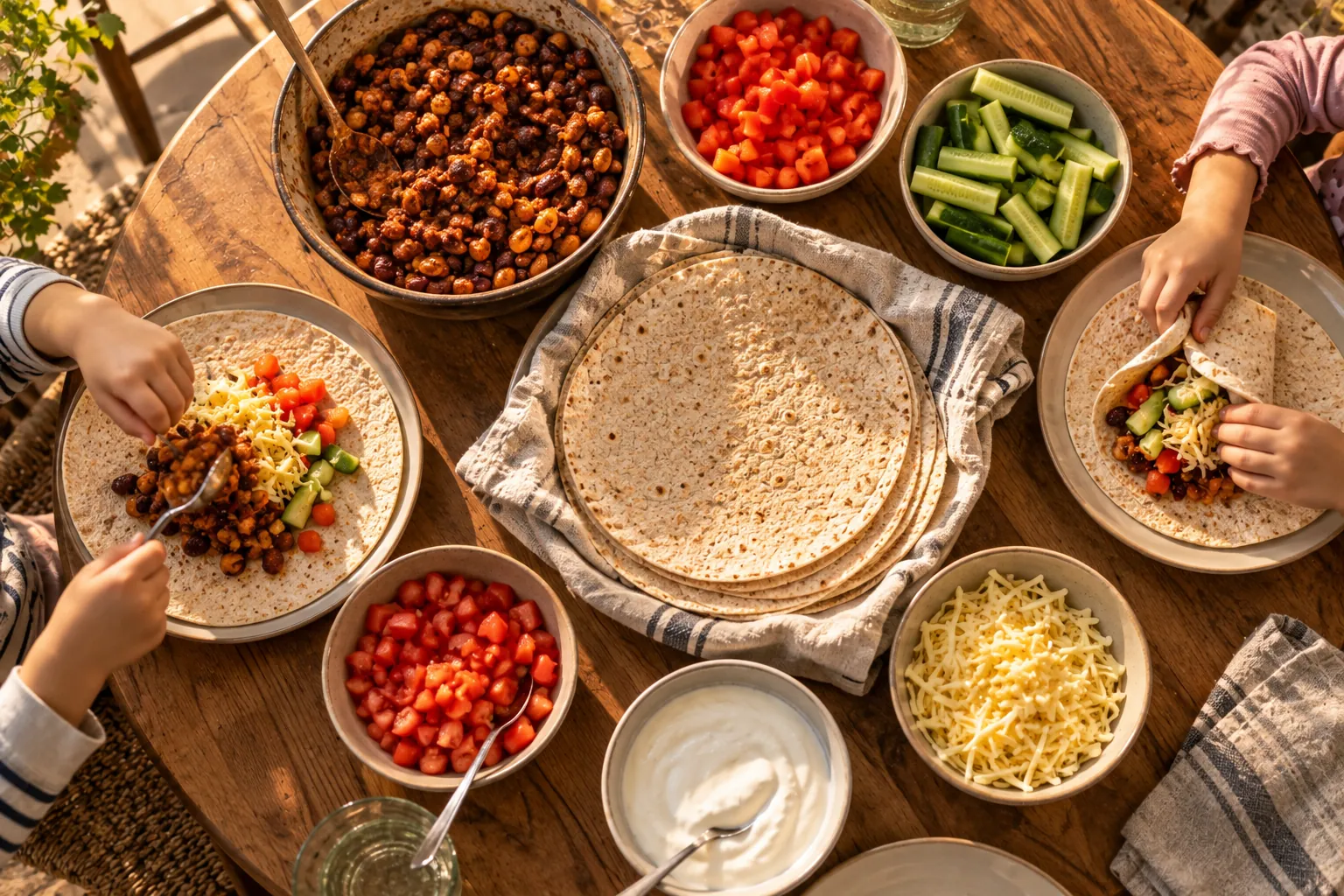
Estimated energy: 720 kcal per serving (1/4). Rounded estimate calculated from the ingredient amounts using the Swedish Food Agency's food composition database. The tortillas are counted as 60 g each, the beans as kidney beans, the cheese as 28% fat hard cheese and the oil as 1 tbsp rapeseed oil. Each serving provides about 33 g protein, 22 g fat and 90 g carbohydrates. One serving is a quarter of the dish; adults often eat more and children less. Not a laboratory-measured value.
You need: 8 large tortillas, 2 packs cooked beans (about 230 g drained weight each), 1 bell pepper, ½–1 cucumber, 2 tomatoes, about 150 g grated cheese and 250 g plain yoghurt.
- Rinse the beans and warm them in a frying pan with a little oil. Season to taste, for example with paprika powder and cumin.
- Chop the vegetables and warm the tortillas according to the package.
- Set everything out in bowls so everyone can fill their own tortilla.
For different tastes: Anyone who doesn't want to mix everything can eat the beans, vegetables and bread separately. If you have chicken left over from Tuesday, it can go in as a filling too.
Grocery list for five dinners#
The quantities are for four people. Check what you already have at home before you shop.
Vegetables and fruit#
- About 2 kg potatoes
- 6 carrots
- 2 yellow onions
- 1 head of broccoli
- 1 bell pepper
- 1 cucumber
- 2 tomatoes
- 1 lemon
Meat, fish and pulses#
- 500 g minced beef
- About 700 g chicken breast fillet
- About 600 g white fish
- 300 g dried red lentils
- 2 packs cooked beans
Dairy and frozen#
- 1 kg plain yoghurt
- About 150 g grated cheese
- 250 g frozen peas
Pantry#
- 500 g pasta
- 350 g rice
- 8 large tortillas
- 2 packs crushed tomatoes, about 400 g each
- Oil, salt and pepper
- Optional: oregano, paprika powder, cumin, curry powder or chilli
How can one grocery list cover five dinners?#
It works because the same ingredients come back in several dishes. Carrots appear in three of the five dinners, plain yoghurt in four, and onion and crushed tomatoes in two. That is what a family meal plan with a grocery list looks like when it is built around the list. You buy larger packs of fewer items, and most of it gets used during the week. That keeps the list short and lowers the risk of something being forgotten at the back of the fridge.
| Ingredient | Used on | Total for the week |
|---|---|---|
| Carrots | Monday, Tuesday, Thursday | 6 |
| Plain yoghurt | Tuesday, Wednesday, Thursday, Friday | 950 g (list: 1 kg) |
| Potatoes | Tuesday, Wednesday | 1.7 kg (list: about 2 kg) |
| Yellow onion | Monday, Thursday | 2 |
| Crushed tomatoes | Monday, Thursday | 2 packs |
| Paprika powder | Tuesday, Friday | to taste |
| Oil, salt and pepper | every day | pantry |
It is the same principle that makes a weekly meal plan cheaper than shopping day by day: less food waste and fewer half-used packs. Read more about what food waste costs a household and how to make dinner from what you already have.
How do you handle different tastes at the same family dinner?#
Serve the parts separately and let everyone build their own plate. You cook one dinner, but everyone eats it their way. Each dinner in the plan has a base most people eat, sides served separately, and spices that go on the table instead of into the pot.
| Day | The base everyone eats | On the side | On the table |
|---|---|---|---|
| Monday | Pasta | Meat sauce | Oregano |
| Tuesday | Chicken, potatoes and carrots | Broccoli and yoghurt sauce | Paprika powder, salt |
| Wednesday | Fish and potatoes | Peas and yoghurt | Lemon wedges |
| Thursday | Mild lentil stew and rice | Yoghurt | Curry powder, chilli flakes |
| Friday | Tortillas | Beans, vegetables, cheese and yoghurt in bowls | Paprika powder, cumin |
Letting children choose works better than pressure. In a study of 195 children aged one to seven, parents' pressure to eat was linked to more picky eating and more fear of new foods (Kutbi, 2020, IJERPH). A systematic review of 19 studies points the same way: pressure to eat was a risk factor, while a varied diet was protective (Torres et al., 2020, Revista Paulista de Pediatria). The studies show associations, not causes, but the advice is the same: put the food out and let the child help themselves. More ideas for picky eaters and family-friendly dinners are in a separate guide.
How many times does a child need to taste a new food?#
There is no exact number, but repetition helps. You often hear ten to fifteen times. In a British experimental study of 72 toddlers aged nine months to just over three years, the children ate more of a new vegetable after just five tastings than the first time, and the effect was still there five weeks later (Caton et al., 2013, British Journal of Nutrition). An earlier randomised study with schoolchildren found that repeatedly tasting red bell pepper increased both how much the children liked it and how much they ate (Wardle et al., 2003, European Journal of Clinical Nutrition).
For the meal plan, that means the same vegetables are welcome to come back. Carrots appear in three dinners, and broccoli, peas, bell pepper and cucumber in one each. Put a small piece on the plate or in a bowl next to it, with no demand that it has to be finished.
Does this weekly family meal plan follow the Swedish dietary guidelines?#
Largely, but there is not enough fish. The plan has little red meat and pulses on three days, in line with the Swedish Food Agency's 2025 dietary guidelines for adults. Fish is on the menu only once, while the guideline is two to three times a week.
| Adult guideline (Swedish Food Agency 2025) | The meal plan | Where you stand |
|---|---|---|
| Fish 2–3 times a week | Once (Wednesday) | Add one more fish dish, for example at the weekend |
| At most 350 g red meat a week, cooked weight (400–500 g raw) | 500 g minced beef across the week's dinners, on average about 125 g raw per person | Well under the limit, even if the adults eat more than the children |
| Pulses often, preferably every day | Peas Wednesday, lentils Thursday, beans Friday | Three out of five days |
| At least 500 g vegetables, fruit and berries a day – potatoes and pulses don't count | Vegetables with four of five dinners (Wednesday's peas count as a pulse) | Dinner alone is not enough – fruit and vegetables are needed during the rest of the day |
The guidelines are for adults, and children eat smaller portions. The per-person figure assumes the mince is shared equally and only covers the week's five dinners, not the weekend or other meals.
How do you handle leftovers safely?#
Cool leftovers quickly and put them in the fridge. The Swedish Food Agency says that rice, pasta and mashed potatoes that have been cooled within no more than two hours and then kept in a fridge at about 4 °C carry a very small risk of harmful bacterial growth (Livsmedelsverket). The problem is not the leftovers themselves, but leaving them out too long.
Leftovers in this meal plan can be used like this:
- Chicken from Tuesday becomes a filling for Friday's tortillas. It should already be cooked through on Tuesday, with clear juices.
- Rice from Thursday can go into Friday's tortillas, as long as it was cooled straight after dinner.
- Meat sauce from Monday can be frozen in portions for a day when time is short.
If you want to cook double batches and freeze them, there are more tips in the guide to meal prep and freezer meals.
How do you adapt the meal plan – vegetarian, lactose-free or gluten-free?#
Swap one ingredient at a time and keep the rest of the recipe. Two of the dinners are already vegetarian, and the yoghurt and tortillas are the ingredients most often swapped on a lactose-free or gluten-free diet.
| Day | Vegetarian | Lactose-free | Gluten-free |
|---|---|---|---|
| Monday | Plant-based mince or extra red lentils in the sauce | No dairy in the recipe | Gluten-free pasta |
| Tuesday | Chickpeas roasted on the tray instead of chicken | Lactose-free yoghurt | No gluten ingredients in the recipe |
| Wednesday | Boiled eggs or white beans (the fish guideline is then not met) | Lactose-free yoghurt | No gluten ingredients in the recipe |
| Thursday | Already vegetarian | Lactose-free yoghurt | No gluten ingredients in the recipe |
| Friday | Already vegetarian | Lactose-free cheese and yoghurt | Gluten-free tortillas or corn tortillas |
The table covers the ingredients in the recipes, not individual products. Lactose-free products help with lactose intolerance but not with cow's milk protein allergy – that needs fully dairy-free alternatives to yoghurt and cheese. Also keep in mind that swaps can introduce new allergens, for example soy in plant-based mince and egg on Wednesday. With an allergy or coeliac disease, always check the ingredient list on the pack, including spice mixes, curry powder, dried lentils and pre-cooked beans.
Which kitchen tasks can children help with?#
Small tasks that can be done at the table. Children who help cook often eat more of the food. In a Swiss study of 47 children aged six to ten, those who had cooked lunch themselves ate 76 percent more salad and 27 percent more chicken than the children in the control group (van der Horst et al., 2014, Appetite). The study was small and covered a single meal, but the point holds: children who helped are keen to taste.
| Day | A task for the children |
|---|---|
| Monday | Grating the carrots (with supervision) and stirring the sauce |
| Tuesday | Tossing the potatoes and carrots in oil on the tray |
| Wednesday | Cutting lemon wedges and mixing the lemon yoghurt |
| Thursday | Rinsing the lentils in a sieve |
| Friday | Rinsing the beans, grating the cheese and setting out the bowls |
How much does food cost for a family?#
The Swedish Consumer Agency estimates that food for a family of two adults and two children (aged 4–6 and 7–10) costs about SEK 8,440 per month in 2026 (Konsumentverket). That is all food for a month, not only dinners. Split by week, it comes to roughly SEK 1,950.
What this particular meal plan costs depends on the store and the week's offers. Three things keep the price down: the plan is built on staples such as potatoes, lentils, pasta and frozen peas; the same ingredients are used several times; and you shop once instead of several times. Compare the price per serving when choosing between pack sizes, and read more about how to save money on food.
Why plan the week's dinners in advance?#
Because it makes eating a varied diet easier and spares you the question every afternoon. In a French cross-sectional study of more than 40,000 adults, people who planned their meals ahead had a more varied diet and better diet quality than those who did not (Ducrot et al., 2017, IJBNPA).
Eating together matters too. A meta-analysis of more than 180,000 children and adolescents found that having dinner with the family at least three times a week was linked to healthier eating patterns (Hammons and Fiese, 2011, Pediatrics). A larger, more recent meta-analysis confirmed the link but showed that the effect is small (Dallacker et al., 2018, Obesity Reviews). Shared dinners are no miracle cure, but a meal plan makes them easier to fit in.
If you are new to planning, there is a step-by-step guide to meal planning for beginners, and more ideas for the question what's for dinner tonight.
Make the food week easier#
Decide in advance which parts of dinner can be served separately. Then the whole family can eat the same main dish without you having to cook several different dinners. Start the week by checking what you already have at home and adjust the grocery list to match.
Plan your own food week in Smaklig: choose dinners that suit you, swap out what you don't like and gather everything you need on one grocery list.
Turn the meal plan into a shopping cart with Smaklig#
With Smaklig the whole chain happens in one go: from weekly meal plan to grocery list and straight into your ICA online cart. Each line on the grocery list is matched to the range in your ICA store, and Smaklig suggests the cheapest products. You review the cart and approve it yourself before you order. To start from this week's offers, see the ICA weekly menu based on current deals.
Sources
- Swedish Food Agency (Livsmedelsverket) (2025). Livsmedelsverkets generella kostråd för den vuxna befolkningen (L 2025 nr 04). Livsmedelsverket report series.
- Livsmedelsverket. Livsmedelsdatabasen — Swedish food composition database. Livsmedelsverket food composition database.
- Livsmedelsverket. Nedkylning av ris, pasta och potatismos (Cooling rice, pasta and mashed potatoes). Livsmedelsverket — questions and answers.
- Swedish Consumer Agency (Konsumentverket) (2026). Vad kostar maten varje månad? (What does food cost each month?). Konsumentverket.
- Caton SJ, Ahern SM, Remy E, Nicklaus S, Blundell P, Hetherington MM (2013). Repetition counts: repeated exposure increases intake of a novel vegetable in UK pre-school children compared to flavour-flavour and flavour-nutrient learning. British Journal of Nutrition.
- Wardle J, Herrera ML, Cooke L, Gibson EL (2003). Modifying children's food preferences: the effects of exposure and reward on acceptance of an unfamiliar vegetable. European Journal of Clinical Nutrition.
- Kutbi HA (2020). The Relationships between Maternal Feeding Practices and Food Neophobia and Picky Eating. International Journal of Environmental Research and Public Health.
- Torres TO, Gomes DR, Mattos MP (2020). Factors Associated with Food Neophobia in Children: Systematic Review. Revista Paulista de Pediatria.
- van der Horst K, Ferrage A, Rytz A (2014). Involving children in meal preparation. Effects on food intake. Appetite.
- Ducrot P, Méjean C, Aroumougame V, et al. (2017). Meal planning is associated with food variety, diet quality and body weight status in a large sample of French adults. International Journal of Behavioral Nutrition and Physical Activity.
- Hammons AJ, Fiese BH (2011). Is frequency of shared family meals related to the nutritional health of children and adolescents?. Pediatrics.
- Dallacker M, Hertwig R, Mata J (2018). The frequency of family meals and nutritional health in children: a meta-analysis. Obesity Reviews.
Frequently asked questions
How long do the dinners in this meal plan take?
Plan on about 25–40 minutes per dinner. Friday's tortillas are the quickest, since everything just needs warming and chopping. Tuesday's chicken and potatoes take longest, around 40 minutes, because the tray goes into the oven in two rounds. While it roasts you can cook the broccoli and set the table.
Does the meal plan work for more or fewer than four people?
The quantities are for four people. For more or fewer, scale every ingredient by the same factor, for example half of everything for two. Spices, salt and oil are best added to taste rather than measured exactly.
How do I make the meal plan vegetarian?
Thursday's lentil stew and Friday's tortillas are already vegetarian. On Monday, swap the minced beef for plant-based mince or extra red lentils, and on Tuesday roast chickpeas on the tray instead of chicken. If you replace Wednesday's fish, add fish on another day, because the Swedish Food Agency recommends fish two to three times a week.
How much does food cost for a family per month?
The Swedish Consumer Agency estimates that food for a family of two adults and two children aged 4–6 and 7–10 costs about SEK 8,440 per month in 2026. That covers all food for the month, not only dinners. Your own cost depends on the store, the week's offers and how much food you throw away.
How many times does a child need to taste a new food?
There is no exact number. You often hear ten to fifteen tries, but in a British study of toddlers the children ate more of a new vegetable after just five tastings than the first time. What matters is that the food keeps coming back without pressure. Serve the new vegetable on the side so your child can taste it when ready.
Can I add the grocery list straight to my ICA cart?
Yes, with Smaklig. You pick the week's dinners, Smaklig builds the grocery list and matches each line to your ICA store's range, suggesting the cheapest products. Everything then goes into your ICA online cart. You review and approve the cart yourself before you order.
Want more meal planning tips?
More guides on food, health and saving money — and a sous-chef that plans your week for you.
Get started
Co-founder & CMO, Smaklig
Writer at Smaklig. We write about food, health, and how to eat better without breaking the bank.
Related articles
September 22, 2026 · 12 min
Creamy Food Without Cream: Cottage Cheese and Quark
Creamy food without cream works with blended cottage cheese and quark. The technique, the umami and three recipes with calculated nutrition per serving.
Read moreSeptember 22, 2026 · 24 min
Creatine: A Useful Supplement, but No Miracle Cure
Creatine is one of the most studied supplements, but no miracle cure. What it is good for, when to take it, women, kidneys and twelve common myths checked.
Read moreSeptember 17, 2026 · 12 min
Air fryer vegetables: times, temperature and 3 staples
Air fryer vegetables: times and temperatures for root veg, cabbage and more — plus three cheap, long-lasting everyday staples and how to avoid acrylamide.
Read moreReady to plan smarter?
Smaklig creates your weekly menu with AI based on store campaigns. Tailored to your goals and allergies.
Get started free