Creamy Food Without Cream: Cottage Cheese and Quark
Creamy food without cream works with blended cottage cheese and quark. The technique, the umami and three recipes with calculated nutrition per serving.
Download Smaklig – now on the App Store and Google Play The Smaklig app is now on the App Store (iPhone) and Google Play (Android). Download it free.
Download SmakligShort answer: Creamy food without cream works by replacing what cream does — texture, roundness and depth — one property at a time, rather than hunting for a single substitute.
- Blend the cottage cheese completely smooth — the curds disappear and you get a silky base
- Combine cottage cheese and quark — 200 g cottage cheese, 100 g quark and 100 ml stock comes closest to a cream sauce
- Never boil afterwards — the protein can curdle well below boiling point, and boiling makes it near-certain
- Build umami with stock, miso, mushrooms or aged cheese — a bland low-fat sauce usually lacks umami, not fat
- Keep a little flavourful fat — 20 g of Parmesan or a tablespoon of oil does more than 300 ml of cream
Creamy food without cream is entirely possible, but not by simply leaving the cream out. Whipping cream, crème fraîche and cream cheese are loved in Swedish kitchens for a reason: they turn a plain stew into comfort food and make soups velvety. They also account for most of a meal's fat and calories. This guide shows what cream actually contributes, how to replace each property separately, and gives three recipes with calculated nutrition. It is written by Smaklig's CFO — the person who works out what the service may cost a Swedish household, and who asks the same question in his own kitchen.
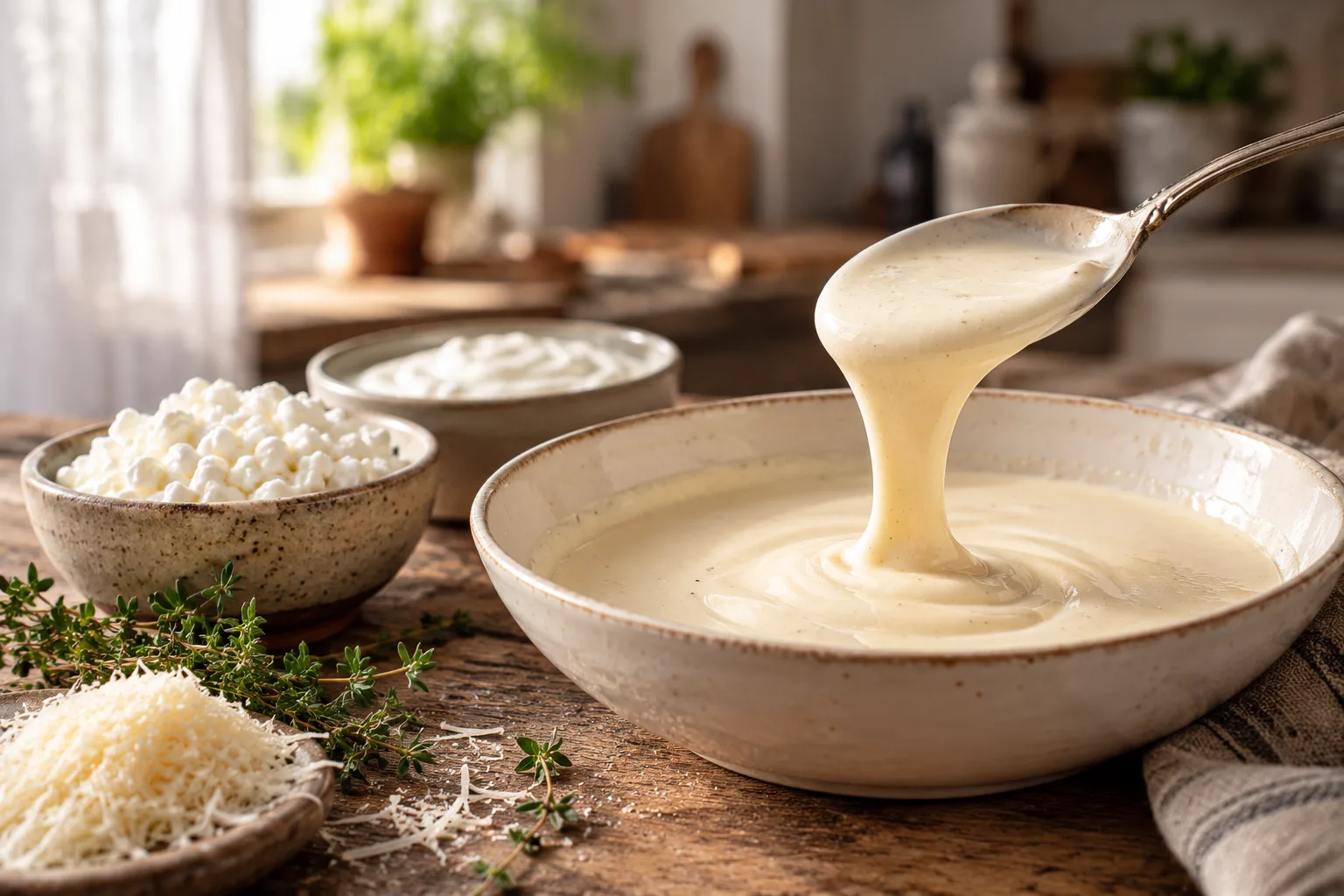
What does cream actually do in food?#
Cream does four things at once: it creates a creamy texture, a full mouthfeel, a round and mild flavour, and it balances spice and acidity. That is why light versions so often fall flat — they remove the cream without replacing any of its work. The key is to rebuild each property from its own source: texture from blended dairy, roundness from protein and a little fat, and depth from umami.
Cottage cheese — the most underrated base for creaminess#
Plain cottage cheese is the smartest ingredient for high-protein sauces, stews and bakes. Blended completely smooth, its characteristic curds disappear and what remains is a silky base with remarkable body. It works in everything from bolognese and chicken stews to soups and gratins.
Three things decide the outcome:
- Blend until completely smooth. A stick blender is enough. Half-blended cottage cheese gives a grainy sauce — the most common failure.
- Add it late in the cooking. It should be warmed, not boiled.
- Never boil hard afterwards. Like other high-protein dairy, cottage cheese prefers gentle heat.
Low-fat cottage cheese holds around 11 g of protein per 100 g per the product label, against whipping cream's 2 g in the Swedish Food Composition Database.
Quark adds fullness and more protein#
Quark is the second tool for creamy food with a better nutritional profile. It is high in protein and brings a lightly tangy note that suits chicken dishes, mushroom stews and herb sauces particularly well.
Quark is also more heat-sensitive than cottage cheese. To stop it splitting: whisk the quark with a little hot liquid from the pan first, then stir that mixture into the rest. The tempering takes ten seconds and saves the sauce.
Which combination tastes most like a cream sauce?#
A base of 200 g blended cottage cheese, 100 g quark and 100 ml of stock. The best answer is rarely cottage cheese or quark alone but the combination: the cottage cheese brings creaminess and body, the quark protein and fullness, and the stock the depth that would otherwise be absent. Together they come surprisingly close to a traditional cream sauce, and the base works in everything from chicken stews to pasta sauces and bakes.
Cream versus cottage cheese and quark — what actually differs?#
The difference is larger than most people expect, and it sits almost entirely in the fat. The table compares this article's chicken stew in two versions, per serving across four servings:
| Per serving | With 300 ml whipping cream (40%) | With 200 g cottage cheese + 150 g quark |
|---|---|---|
| Energy | about 520 kcal | about 300 kcal |
| Protein | about 40 g | about 49 g |
| Fat | about 37 g | about 8 g |
| Carbohydrate | about 6 g | about 6 g |
Method: Both versions are calculated on identical quantities otherwise — 600 g chicken breast, 250 g mushrooms, 1 onion (about 110 g), 1 tbsp rapeseed oil (about 14 g), 200 ml stock, 1 tbsp Dijon mustard and 20 g Parmesan — divided across four servings. Cream, quark, chicken, mushrooms, onion and rapeseed oil are taken from the Swedish Food Composition Database (40% cream = 374 kcal and 40 g fat per 100 g). The cream is counted as 300 ml ≈ 300 g. Low-fat cottage cheese is a label value — the database has no entry for that variant, and its 4%-fat cottage cheese is a richer product. The full working, with food numbers, assumed weights and conversions, is in apps/web/content/_nutrition/kramig-mat-utan-gradde.md. Choosing a 15% cooking cream lowers the cream column considerably. The figures are rounded estimates from raw quantities, not measured laboratory values, and another brand gives another result.
Umami is the real flavour secret#
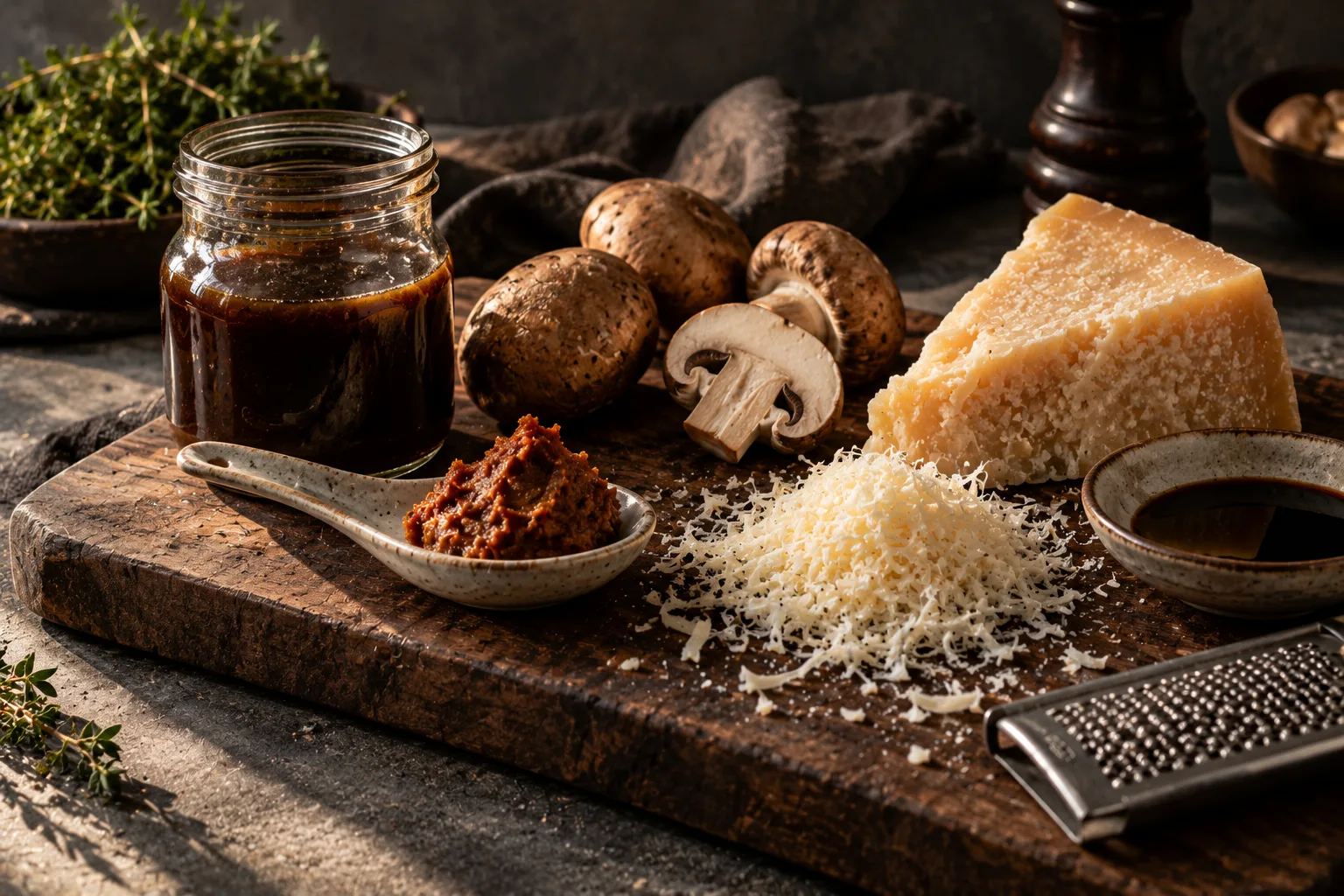
When a low-fat sauce tastes dull, the cause is rarely the missing fat. Far more often it is missing umami — the deep, savoury quality that makes food feel satisfying. Cream adds roundness, but carries no depth of its own.
Build the umami with veal or chicken stock, soy sauce, miso, mushrooms, Parmesan or another aged cheese. A tablespoon of stock often does more for the flavour than another 100 ml of cream. And do not skip the browning: the seared surface on chicken, mince and mushrooms is an umami source in itself, and it is lost if you boil the ingredients instead of frying them.
Three recipes that show the technique#
The recipes below apply the same core technique in three formats — stew, soup and bake. The nutrition figures are calculated from ingredient quantities, not measured.
Recipe 1: Creamy chicken and mushroom stew with Parmesan#
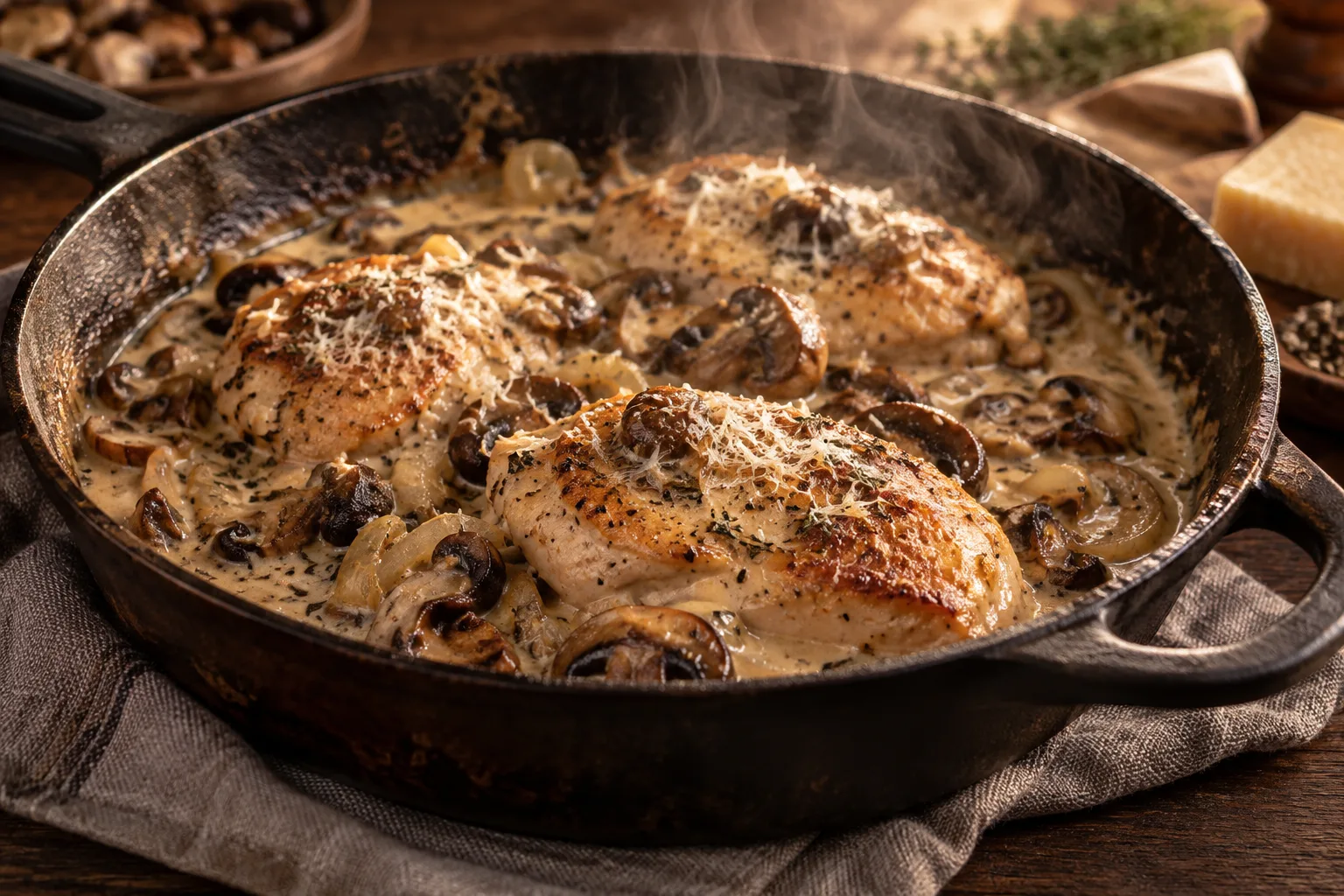
Estimated energy: 300 kcal per serving (1/4). Rounded estimate calculated from the raw ingredient quantities using low-fat cottage cheese, quark and 1 tbsp rapeseed oil. Per serving it gives roughly 49 g protein, 8 g fat and 6 g carbohydrate. Not a measured laboratory value.
This is the recipe where the technique shows most clearly. Browned mushrooms and Parmesan carry the umami, and the cottage cheese and quark combination produces a sauce that coats the chicken exactly as a cream sauce does.
Ingredients (4 servings)
- 600 g chicken breast
- 250 g mushrooms
- 1 yellow onion
- 1 tbsp rapeseed oil
- 200 g low-fat cottage cheese
- 150 g quark
- 200 ml chicken stock
- 1 tbsp Dijon mustard
- 1 tsp dried thyme
- 20 g Parmesan
- salt and black pepper
Method
- Blend the cottage cheese completely smooth with a stick blender. This step decides the result — skip it and the sauce turns grainy.
- Cut the chicken into pieces, slice the mushrooms and chop the onion.
- Brown the chicken, mushrooms and onion in the rapeseed oil in a wide pan until everything has good colour.
- Add the stock, Dijon mustard and thyme. Simmer until the chicken is cooked through, about 5 minutes depending on the size of the pieces.
- Whisk the quark with a couple of tablespoons of the hot sauce. Then stir in the blended cottage cheese, the tempered quark and the grated Parmesan.
- Warm gently without boiling. Season with salt and black pepper.
Recipe 2: Velvety cauliflower soup with quark#
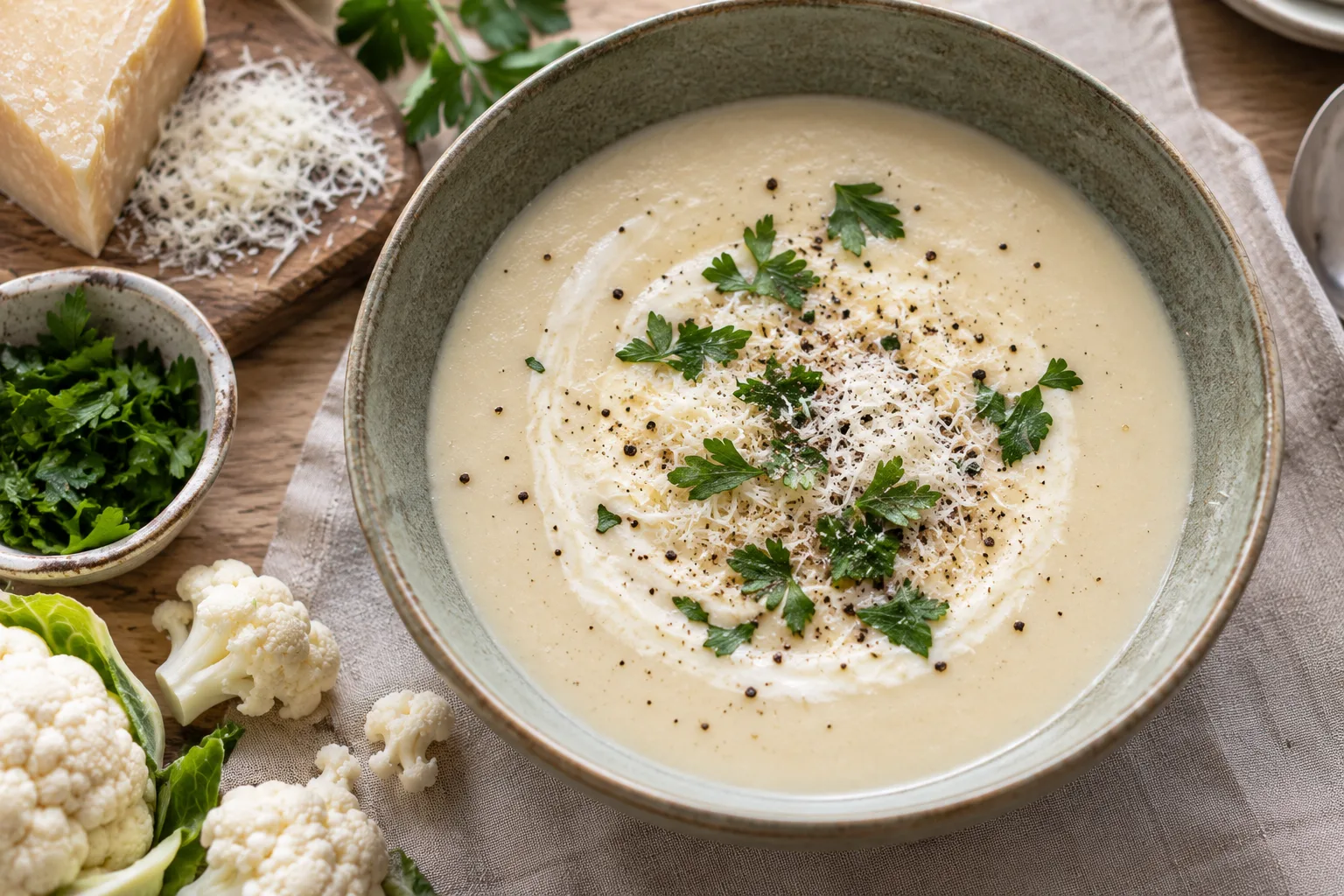
Estimated energy: 155 kcal per serving (1/4). Rounded estimate calculated from the raw ingredient quantities using quark, low-fat cottage cheese and 1 tsp rapeseed oil. Per serving it gives roughly 16 g protein, 5 g fat and 12 g carbohydrate. Not a measured laboratory value.
Soups are perhaps where this technique works best of all. Cauliflower, celeriac, white beans and potato all contribute natural creaminess when blended — combined with quark or blended cottage cheese, you often reach the same smoothness as a classic cream soup.
Ingredients (4 servings)
- 700 g cauliflower
- 1 yellow onion
- 1 garlic clove
- 1 tsp rapeseed oil
- 700 ml vegetable stock
- 200 g quark
- 150 g low-fat cottage cheese
- 20 g Parmesan
- black pepper
- fresh parsley
Method
- Soften the chopped onion and garlic in the rapeseed oil in a large saucepan.
- Add the cauliflower florets and the stock. Boil until the cauliflower is completely tender, about 12 minutes.
- Take the pan off the heat and add the cottage cheese.
- Blend the soup and the cottage cheese completely smooth with a stick blender. The cottage cheese must be blended into the soup, otherwise it stays grainy.
- Whisk the quark with a couple of tablespoons of the hot soup and stir the mixture in.
- Add the grated Parmesan, warm gently without boiling and top with chopped parsley and black pepper.
Recipe 3: High-protein lasagne with cottage cheese and quark#
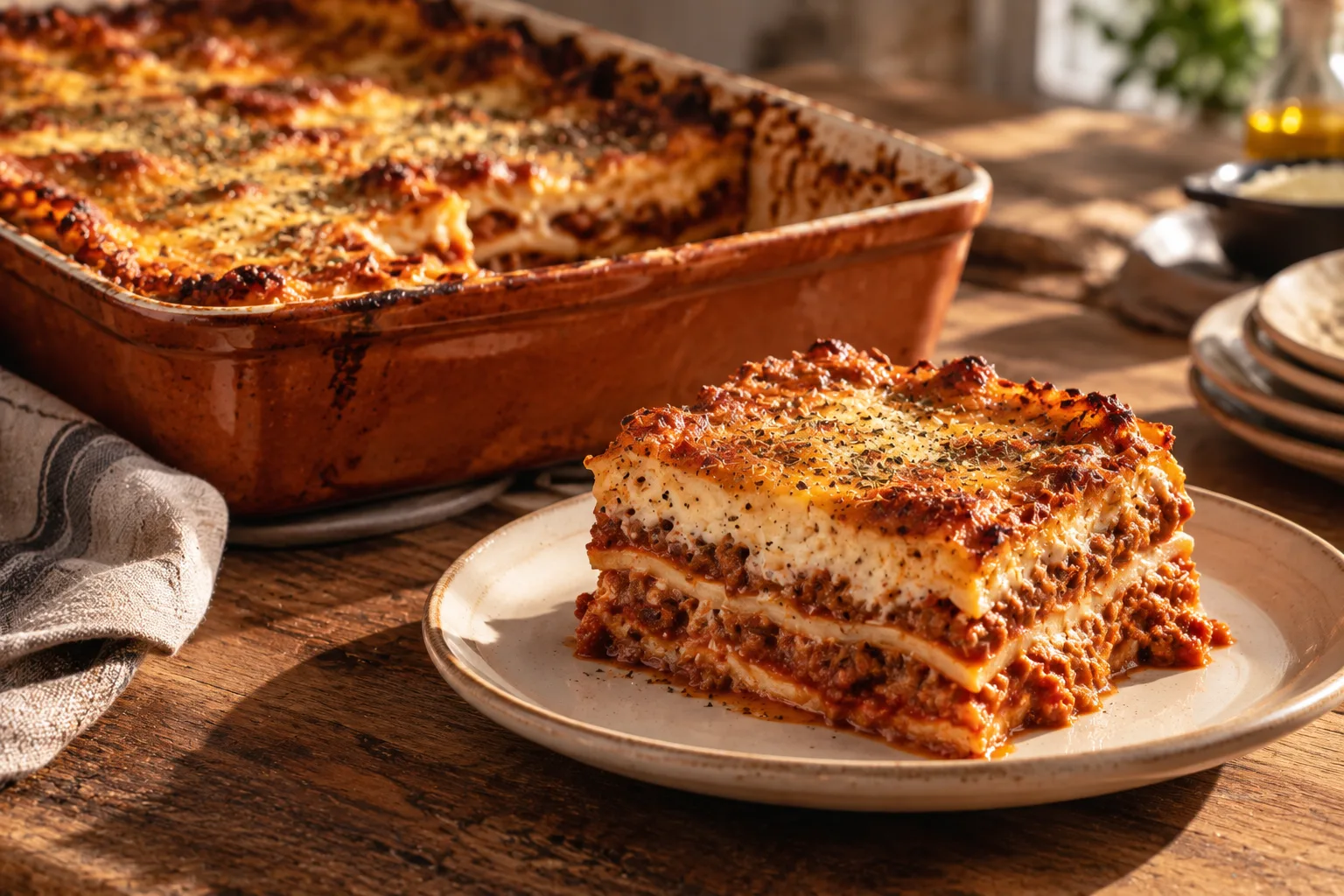
Estimated energy: 390 kcal per serving (1/6). Rounded estimate calculated from the raw ingredient quantities using 5% beef mince, low-fat cottage cheese, quark and 1 tbsp olive oil. Per serving it gives roughly 41 g protein, 13 g fat and 25 g carbohydrate. Not a measured laboratory value.
In bakes, cottage cheese and quark work unusually well, because they contribute not only protein but structure. Combined with eggs they set in a way that recalls a classic gratin, but with a considerably higher protein content.
Ingredients (6 servings)
- 600 g beef mince, 5% fat
- 1 yellow onion
- 2 garlic cloves
- 1 tbsp olive oil
- 500 g crushed tomatoes
- 1 tsp dried oregano
- 1 tsp dried basil
- 300 g low-fat cottage cheese
- 250 g quark
- 2 eggs
- 50 g Parmesan
- 9 lasagne sheets
- salt and black pepper
Method
- Blend the cottage cheese completely smooth with a stick blender.
- Whisk the blended cottage cheese with the quark, eggs and half the grated Parmesan. Season with salt and pepper.
- Soften the chopped onion and garlic in the olive oil, add the beef mince and brown it thoroughly.
- Add the crushed tomatoes, oregano and basil. Simmer for 10 minutes and adjust the seasoning.
- Layer the meat sauce, lasagne sheets and protein béchamel in a baking dish. Finish with béchamel and the remaining Parmesan.
- Bake at 200°C for about 35 minutes, until the top is golden. Rest for 10 minutes before serving.
What does the research say about protein and satiety?#
Protein is a satiating nutrient, and a higher protein intake can contribute to greater satiety. In Western diets, dairy protein makes up a large share of daily protein intake. Milk protein is roughly 80% casein and 20% whey, and the two differ in absorption rate: whey appears more satiating in the short term, casein more so in the long term (Bendtsen et al., 2013, Advances in Nutrition).
That same review is explicit about the limits of what can be claimed: there is no clear evidence that any single protein source produces more favourable changes in body weight than another. Amino acid composition, absorption rate and the food's texture do appear to matter.
A more recent review describes the mechanisms: amino acids and peptides interact with receptors on enteroendocrine cells and trigger the release of satiety hormones such as CCK, GLP-1 and PYY. The authors stress that more clinical research is needed to understand the mechanisms and the long-term effects (Ignot-Gutiérrez et al., 2024, Nutrients).
For practical cooking the conclusion holds this far: more protein in the portion is reasonable if you want to stay full longer, and dairy is a simple route there. To work out your own requirement, see how much protein you need, and for more dinners built on the same principle, high-protein dinner. The terms are explained in the glossary.
Five common mistakes when replacing cream#
- Half-blended cottage cheese. The grain remains and the whole dish reads as "light". Blend until the surface is glossy.
- Boiling after adding it. The protein coagulates and the sauce splits. Gentle heat is enough — do not treat boiling point as the threshold, since whey proteins denature around 70–80°C.
- Untempered quark. Cold quark straight into a hot pan separates into grains. Whisk it with hot liquid first.
- Too little salt and acid. A low-fat sauce needs more seasoning than a cream sauce, not less. Lemon, mustard or a splash of vinegar lifts it.
- Removing all the fat. 20 g of Parmesan or a tablespoon of oil carries fat-soluble flavour compounds. Take out all the fat and the flavour goes with it.
Planning cream-free weeknight dinners with Smaklig#
This technique suits weekly planning particularly well, since cottage cheese and quark are staples that stretch across several dishes. Smaklig builds the weekly menu around your nutrition targets, creates the shopping list and matches the lines against your store's range — so a week of cream-free dinners becomes one basket instead of seven separate trips. You choose which recipes come along, and you always have the final say before the order goes through.
If you are short on time, the same technique fits straight into quick dinners in 20 minutes — the stew above takes 30 minutes, and the soup 25.
Checklist: five rules for creamy high-protein food#
- Always blend the cottage cheese completely smooth
- Avoid hard boiling once quark or cottage cheese has been added
- Use stock to build flavour
- Lean on umami-rich ingredients: mushrooms, miso, soy, aged cheese
- Do not fear a small amount of Parmesan, butter or olive oil
The real secret behind creamy, satisfying food is not large quantities of whipping cream. It is texture, umami and the right technique. With blended cottage cheese, quark, stock, mushrooms and a little flavourful fat you can cook stews, soups and bakes that feel every bit as indulgent as the originals — while delivering more protein and considerably less fat.
Get started free — plan the week's dinners in a couple of minutes.
Sources
- Livsmedelsverket. Swedish Food Agency — protein
- Livsmedelsverket. Swedish Food Composition Database — search nutrient content
- Advances in Nutrition, 2013. Bendtsen et al., Effect of dairy proteins on appetite, energy expenditure, body weight, and composition: a review of the evidence from controlled clinical trials
- Nutrients, 2024. Ignot-Gutiérrez et al., Proteins and Peptides from Food Sources with Effect on Satiety and Their Role as Anti-Obesity Agents: A Narrative Review
Frequently asked questions
Can you replace cream with cottage cheese when cooking?
Yes, provided you blend the cottage cheese completely smooth first. That removes the curds and leaves a silky base that works in stews, soups and bakes. Add it late in the cooking and never boil the sauce afterwards — the protein can curdle well below boiling point, as whey proteins start denaturing around 70–80°C, and how fast depends on time, acidity and fat content. Roughly 200 g of blended cottage cheese matches 200 ml of cream in body.
Why does quark curdle in a hot sauce?
Quark's protein coagulates at high heat and separates into grains. Whisk the quark with a little hot liquid from the pan before stirring it into the rest, and keep the sauce below boiling afterwards. The same care applies to cottage cheese and other high-protein dairy.
How much protein do cottage cheese and quark give compared with cream?
Whipping cream holds around 2 g of protein per 100 g and quark around 12 g according to the Swedish Food Composition Database. Low-fat cottage cheese sits around 11 g per the product label — the database has no entry for low-fat cottage cheese specifically, and its 4%-fat cottage cheese is higher. In this article's chicken stew, swapping 300 ml of whipping cream (40% fat) for 200 g cottage cheese plus 150 g quark gives roughly 49 g protein per serving instead of 40 g, while cutting fat from about 37 g to about 8 g.
Why does my low-fat sauce taste bland?
Usually it lacks umami, not fat. Cream adds roundness but carries no depth of its own. A tablespoon of veal stock, a teaspoon of miso, browned mushrooms or a little aged cheese typically does more for the flavour than another 100 ml of cream. Brown your ingredients properly too — the seared surface is an umami source in itself.
Which combination comes closest to a real cream sauce?
A base of 200 g blended cottage cheese, 100 g quark and 100 ml of stock. The cottage cheese supplies creaminess and body, the quark protein and a lightly tangy fullness, and the stock the depth that would otherwise be missing. The base works in chicken stews, pasta sauces and bakes.
Can you freeze dishes made with cottage cheese and quark?
Bakes and lasagne freeze well because the eggs and cheese hold the structure. Plain sauces and soups can separate when thawed. Reheat them slowly and whisk thoroughly, or blend the soup again with a stick blender to bring back its smoothness.
Want more meal planning tips?
More guides on food, health and saving money — and a sous-chef that plans your week for you.
Get startedCo-founder & CFO, Smaklig
Writer at Smaklig. We write about food, health, and how to eat better without breaking the bank.
Related articles
September 17, 2026 · 12 min
Air fryer vegetables: times, temperature and 3 staples
Air fryer vegetables: times and temperatures for root veg, cabbage and more — plus three cheap, long-lasting everyday staples and how to avoid acrylamide.
Read moreSeptember 9, 2026 · 11 min
Alternative to Linas Matkasse – compared with Smaklig (2026)
Looking for an alternative to Linas Matkasse? Compare a delivered meal box with free weekly planning and a shopping list linked to every ICA store.
Read moreSeptember 4, 2026 · 9 min
How to choose a meal-planning app in Sweden (2026)
Choose a meal-planning app for Sweden by comparing store offers, AI recipes, shopping lists and food logging. Test a real week and check terms before paying.
Read moreReady to plan smarter?
Smaklig creates your weekly menu with AI based on store campaigns. Tailored to your goals and allergies.
Get started free