How Much Protein Do You Need Per Day? Full 2026 Guide
How much protein you need per day and per meal — plus a table of protein in common foods like eggs, chicken and quark. Source: the Swedish Food Agency.
Download Smaklig – now on the App Store and Google Play The Smaklig app is now on the App Store (iPhone) and Google Play (Android). Download it free.
Download SmakligQuick answer: How much protein you need depends on your body weight and situation:
- Healthy adults: 0.83 g protein per kg body weight/day (Swedish Food Agency/NNR 2023) — 70 kg ≈ 58 g/day
- Older adults 65+: 1.2–1.5 g/kg (NNR 2023) — the need rises with age
- With resistance training: up to about 1.6 g/kg (Morton et al., 2018)
- Per meal: 20–30 g as a practical benchmark, spread across the day
- Kidney disease/pregnancy/prescribed diet: follow a doctor or dietitian, not this guide
How much protein per day you need is one of the most common nutrition questions — and the answer is simpler than it sounds. This guide covers the official daily requirement, how much protein different foods provide (with a table), how to spread it across the day, and when the need is higher. Everything is based on the Swedish Food Agency's recommendations and is nutrition information, not medical advice.
How much protein do you need per day?#
For healthy adults, the Swedish Food Agency and the Nordic Nutrition Recommendations (NNR 2023) recommend 0.83 grams of protein per kg of body weight per day (Swedish Food Agency, NNR 2023). In everyday terms:
| Body weight | Protein per day (0.83 g/kg) |
|---|---|
| 60 kg | ~50 g |
| 70 kg | ~58 g |
| 80 kg | ~66 g |
| 90 kg | ~75 g |
As a share of energy, that corresponds to roughly 10–20 percent of daily calorie intake for adults. Most people reach this level without difficulty, because protein is found in many everyday foods.
The need is higher in some situations:
- Adults over 65: the Swedish Food Agency recommends 1.2–1.5 g/kg/day, because muscle breakdown increases with age and it becomes harder to maintain muscle mass (see the guide to protein for the elderly).
- With resistance training: for those who train for strength and want to build or preserve muscle, research suggests a need up to about 1.6 g/kg/day — the effect plateaued around 1.62 g/kg in a large analysis (Morton et al., 2018). Note that this study concerns resistance training in healthy adults, not a general requirement.
- During weight loss: extra protein together with resistance training helps preserve muscle mass in a calorie deficit (Morton et al., 2018). Stay above the minimum levels for safe weight loss (about 1,200 kcal/day for women, 1,400 for men) and see the TDEE calculator for setting your protein target within your calorie budget.
How much protein in common foods?#
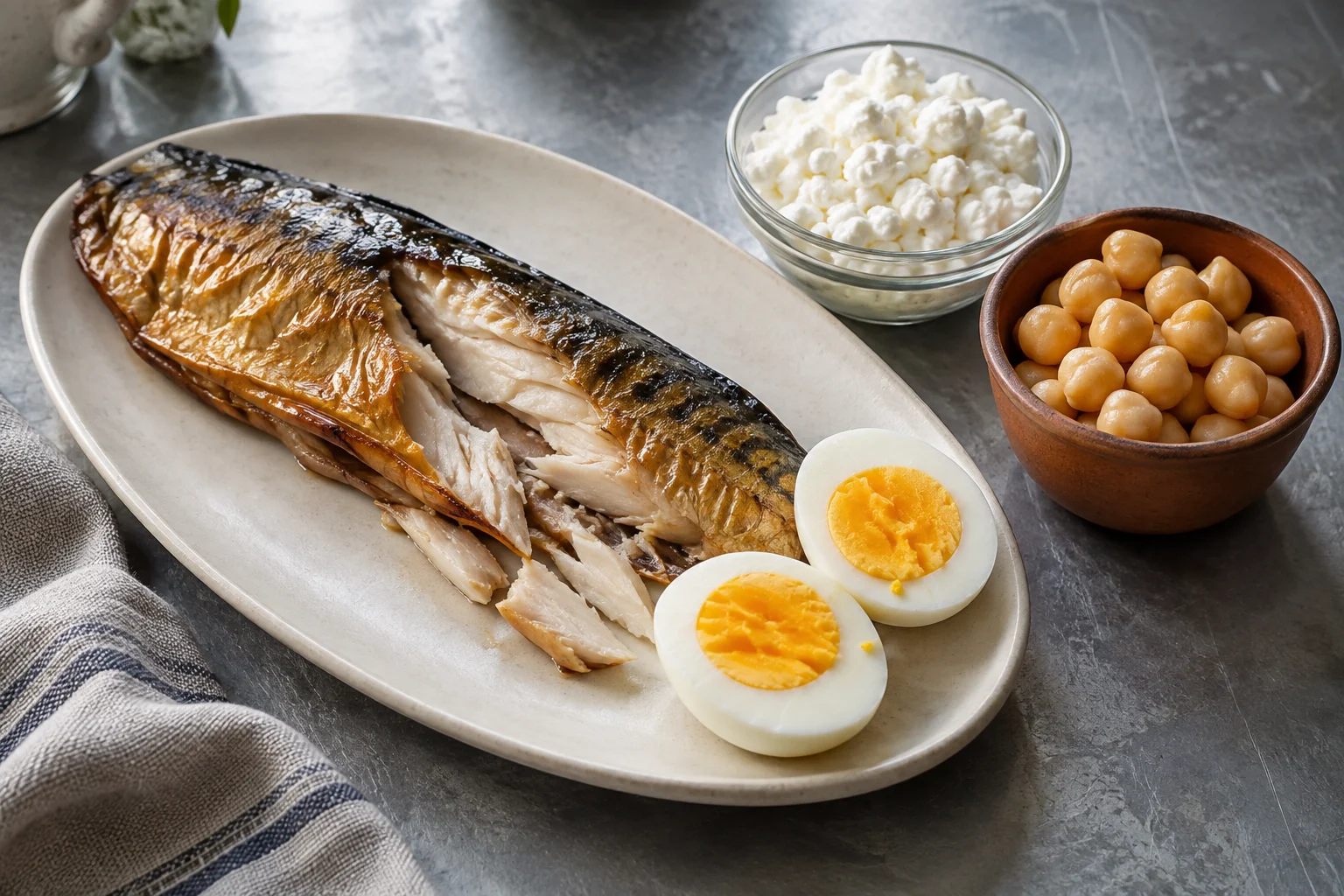
Quick answer: Protein is found in fish, poultry, meat, eggs, dairy, beans, lentils, nuts and seeds — bread, pasta and grains contribute too. The table below shows protein per 100 grams from the Swedish Food Composition Database. One egg (about 55–60 g) provides roughly 7 grams of protein.
| Food (per 100 g) | Protein |
|---|---|
| Hard cheese, 28% fat | 26.2 g |
| Salmon, fried | 24.1 g |
| Chicken breast, fried, skinless | 23.0 g |
| Mackerel, hot-smoked | 20.1 g |
| Cottage cheese, plain | 13.4 g |
| Egg, boiled (≈ 7 g per egg) | 12.2 g |
| Quark, plain | 10.0 g |
| Green lentils, cooked | 9.4 g |
| Chickpeas, cooked | 8.1 g |
Source: Swedish Food Composition Database. Values refer to the edible portion and vary somewhat between products and cooking methods — check the nutrition label on your packaging.
A few practical reference points: a chicken breast of 150 g provides about 35 g of protein, a 150 g serving of quark around 15 g, and two eggs about 14 g. To reach 30 grams of protein at breakfast, quark plus eggs or oats is often enough — see high-protein breakfast.
How much protein per meal?#
Quick answer: A practical benchmark is 20–30 grams of protein per main meal, spread evenly across the day rather than piling almost all of it onto dinner. A small crossover study of eight healthy adults found higher 24-hour muscle protein synthesis with even distribution (roughly 30 g per meal) than with skewed distribution (Mamerow et al., 2014). It is not, however, an established minimum need per meal — what matters most is that the day's total is sufficient.
In practice this means spreading protein out: something protein-rich at breakfast, lunch and dinner, and preferably in snacks too. That makes it easier to reach the daily requirement and keeps you fuller longer, since protein is more satiating than carbohydrates or fat.
Do women need less protein than men?#
Quick answer: The recommendation per kilogram of body weight is the same — 0.83 g/kg for healthy adults regardless of sex. Since women weigh less on average, the total gram figure is often lower, but that comes down to body weight, not sex itself. A woman weighing 65 kg therefore needs about 54 grams per day, a man weighing 80 kg about 66 grams.
During pregnancy and breastfeeding the need rises somewhat — the Swedish Food Agency's specific advice then applies, and individual guidance from a midwife or dietitian takes precedence over general tables.
Can you eat too much protein?#
Quick answer: For healthy kidneys, there is no evidence that a normally elevated protein intake (as seen in sport) is harmful. The picture is different with kidney disease: the international KDIGO 2024 guideline recommends about 0.8 g/kg/day in chronic kidney disease and that people at risk of progression avoid more than 1.3 g/kg/day (KDIGO 2024).
This section is general information. If you have kidney disease, diabetes, are pregnant or follow a prescribed diet, always consult a doctor or dietitian before increasing your protein intake.
For most healthy people, the challenge is getting enough protein rather than too much, especially during weight loss or with advancing age.
How Smaklig works out your protein target#
Smaklig automatically sets a protein target based on your body weight, goals and activity level, and builds weekly menus that reach it — spread across the day's meals and adapted to the week's grocery campaigns. You get the right amount of protein without counting grams yourself, plus a ready shopping list.
Related reading#
- High-protein breakfast for weight loss — how to reach 30 grams of protein in the morning
- High-protein dinner — 25 recipes with 30 g+ protein per serving
- High-protein lunch for weight loss
- Protein for the elderly — the new advice after 65
- TDEE and macros — complete guide — set your protein target within your calorie budget
Sources
- Livsmedelsverket. Swedish Food Agency (Livsmedelsverket) — Protein
- Nordic Council of Ministers. Nordic Nutrition Recommendations 2023 — Protein
- Livsmedelsverket. Swedish Food Composition Database — nutrient search
- Br J Sports Med 52(6):376-384. Morton RW et al. — Protein supplementation augments resistance training muscle gain (2018)
- J Nutr 144(6):876-880. Mamerow MM et al. — Dietary protein distribution and 24-h muscle protein synthesis (2014)
- KDIGO. KDIGO 2024 Clinical Practice Guideline for the Evaluation and Management of CKD
Frequently asked questions
How much protein do you need per day?
The Swedish Food Agency and NNR 2023 recommend 0.83 grams of protein per kg of body weight per day for healthy adults. A person weighing 70 kg needs about 58 grams per day. The need is higher for older adults (1.2–1.5 g/kg for 65+) and for those who do resistance training (up to about 1.6 g/kg). If you have kidney disease or a prescribed diet, follow your doctor's or dietitian's advice.
How much protein is in an egg?
One egg (about 55–60 g) contains roughly 7 grams of protein. Per 100 grams, a boiled egg provides about 12 grams (Swedish Food Composition Database). Two eggs at breakfast therefore give around 14 grams of protein.
How much protein per meal?
A practical benchmark is 20–30 grams of protein per main meal, spread evenly across the day. A small study (n=8) found higher 24-hour muscle protein synthesis with even distribution than with piling almost all of it onto dinner (Mamerow et al., 2014), but it is not an established minimum need per meal.
Do women need less protein than men?
The recommendation per kilogram of body weight is the same (0.83 g/kg for healthy adults). Since women weigh less on average, the total gram figure is often lower — but that comes down to body weight, not sex itself. A woman weighing 65 kg needs about 54 grams per day.
Can you eat too much protein?
For healthy kidneys, there is no evidence that a normally elevated protein intake is harmful. It is different with kidney disease: KDIGO 2024 recommends about 0.8 g/kg and that people at risk of progression avoid more than 1.3 g/kg. With kidney disease, pregnancy or a prescribed diet, always consult a doctor or dietitian.
Want more meal planning tips?
More guides on food, health and saving money — and a sous-chef that plans your week for you.
Get started
Founder, Smaklig
Writer at Smaklig. We write about food, health, and how to eat better without breaking the bank.
Related articles
August 13, 2026 · 6 min
GLP-1 Recipes: 8 Filling Meals With Fiber & Protein
8 GLP-1 recipes with fiber and protein that support your body's own satiety signals — breakfast, lunch and dinner built on fiber- and protein-rich ingredients.
Read moreApril 12, 2026 · 21 min
Lose Weight Without Ozempic: 7 Strategies That Actually Work
Ozempic waitlist, side effects, or just too expensive? Here are 7 evidence-based strategies for losing weight without medication — protein, fiber, sleep, GLP-1 foods, and more.
Read moreSeptember 30, 2026 · 9 min
Stress, cortisol and a body that no longer responds as usual
How stress, cortisol, insulin, 'cortisol belly' and muscle fit together, what supplements are good for and when to see a doctor.
Read moreReady to plan smarter?
Smaklig creates your weekly menu with AI based on store campaigns. Tailored to your goals and allergies.
Get started free