Gluten-Free Meal Plan: 7 Easy Dinners and a Shopping List
Gluten free meal plan with 7 weeknight dinners and a shopping list. What is naturally gluten free, where gluten hides and what the gluten-free label means.
Download Smaklig – now on the App Store and Google Play The Smaklig app is now on the App Store (iPhone) and Google Play (Android). Download it free.
Download SmakligA gluten free meal plan is easy when the dinners are built on foods that are already gluten free: potatoes, rice, maize and quinoa. Here are seven gluten free recipes for a weeknight week, a shopping list for four people and answers to the questions people find tricky. You will learn what is gluten free, where gluten hides, what the label means and why you should not stop eating gluten before you have been tested for coeliac disease.
Short answer: Build your dinners on potatoes, rice, maize and quinoa, read the ingredients list on stock, spice mixes and sauces, and choose pasta, pizza bases and tortillas labelled gluten-free. If you suspect coeliac disease, get tested before you cut out gluten.
- Gluten is found in wheat (including durum and spelt), rye, barley and kamut, according to the Swedish Food Agency (Livsmedelsverket).
- Potatoes, rice, maize, quinoa and millet are naturally gluten free (Swedish Food Agency).
- Labelled gluten-free means no more than 20 mg of gluten per kilo, under EU Regulation 828/2014.
- About two per cent of Sweden's population has coeliac disease (Swedish Food Agency).
- Keep eating gluten until your tests are taken, otherwise coeliac disease will not show in the results (1177, the Swedish national healthcare guide).
Gluten-free meal plan: seven dinners#
These gluten free dinner ideas each start from a base that the Swedish Food Agency counts as naturally gluten free, or from a speciality product labelled gluten-free (Swedish Food Agency, gluten, coeliac disease and cereal allergy). The plan is written for you if you eat gluten free or cook for someone who does. It is not a dietary treatment for coeliac disease. With coeliac disease, how food is handled in the kitchen also matters; ask your doctor or dietitian, or a coeliac patient organisation.
| Day | Dinner | Gluten-free base | Check on the pack |
|---|---|---|---|
| Monday | Chicken curry with coconut milk and rice | rice | stock, curry powder and spice mix |
| Tuesday | Oven-baked salmon with potatoes and a cold yoghurt sauce | potatoes | nothing in particular (plain salmon, natural yoghurt) |
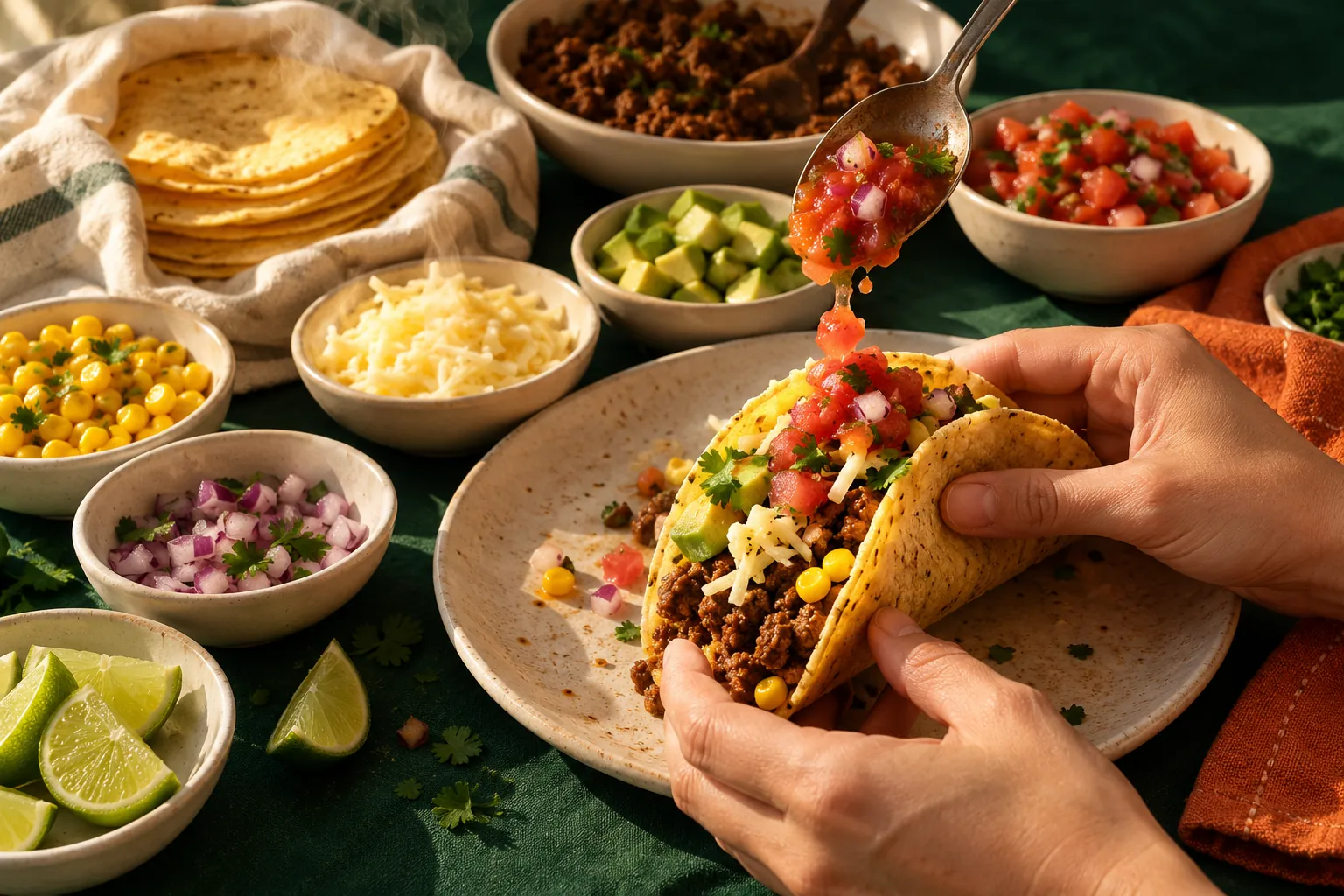
| Wednesday | Tacos with corn tortillas, mince and vegetables | maize | tortillas (labelled gluten-free), taco seasoning |
| Thursday | Bolognese mince sauce with gluten-free pasta | pasta labelled gluten-free | the pasta, stock |
| Friday | Chickpea stew with tomato and quinoa | quinoa | stock |
| Saturday | Pizza on a gluten-free base with ham or vegetables | base labelled gluten-free | the base, grated cheese and toppings |
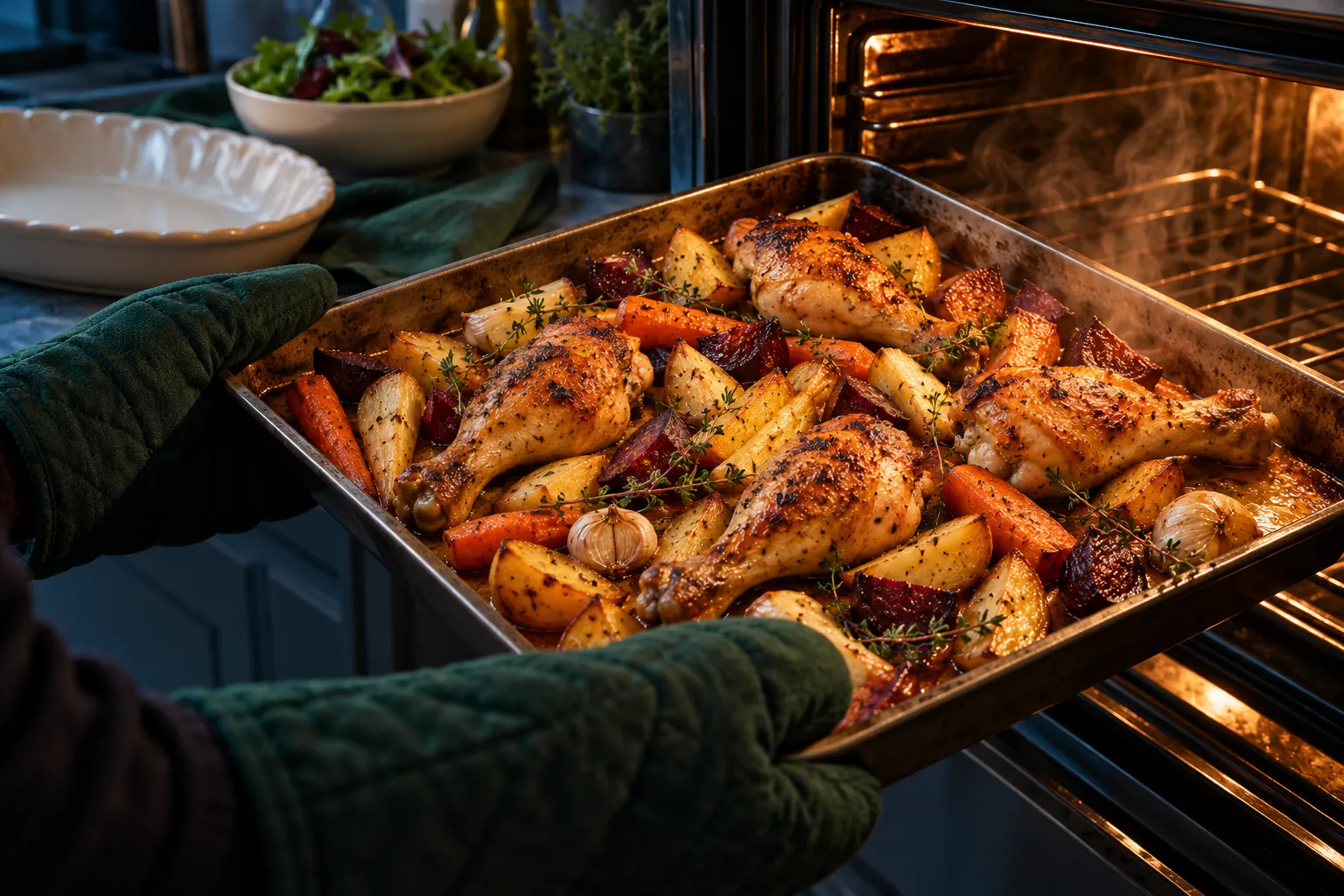
| Sunday | Roast chicken drumsticks with root vegetables and potato wedges | potatoes, root vegetables | ready-made marinade or spice mix |
Monday: chicken curry with coconut milk and rice#
Fry the chicken, add onion, curry powder and coconut milk and let it simmer while the rice cooks. Rice is naturally gluten free. It is the spice mix and the stock that need checking: cereals containing gluten must be declared in the ingredients list, so that is where you look. Rice appears on the plan only once. The Swedish Food Agency writes that wholegrain rice often contains more arsenic than white rice and that it is a good idea not to always choose wholegrain rice (Swedish Food Agency, wholegrain).
Tuesday: oven-baked salmon with potatoes and a cold yoghurt sauce#
Tuesday is the simplest gluten-free dinner of the week. Plain salmon, boiled potatoes and a sauce of natural yoghurt, lemon and dill contain nothing you need to check for gluten. Put the salmon in the oven while the potatoes boil.
Wednesday: tacos with corn tortillas#
Maize is naturally gluten free, but tortillas are made from both maize and wheat. Maize flour can also pick up gluten during milling without it showing on the label (Swedish Food Agency's Kontrollwiki). So choose tortillas labelled gluten-free. The taco seasoning is the other thing to read: cereals containing gluten must be listed in the ingredients. Cook the rest as you would any taco night.
Thursday: bolognese with gluten-free pasta#
Choose pasta labelled gluten-free and follow the cooking time on the packet. The mince sauce is gluten free as long as the stock and any other ready-made ingredients in it are. One larger pack of mince covers both Wednesday's tacos and Thursday's sauce.
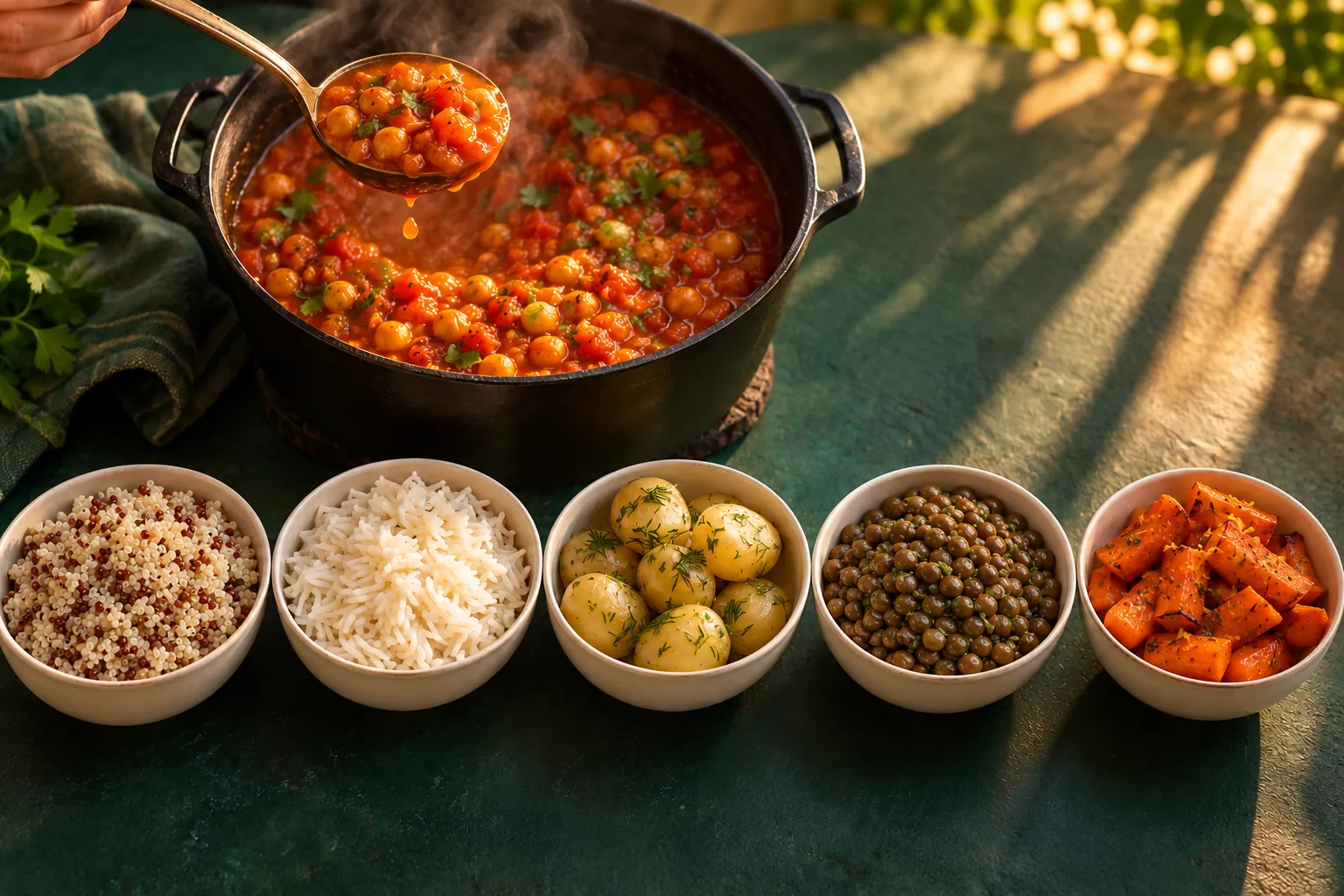
Friday: chickpea stew with tomato and quinoa#
Quinoa is naturally gluten free according to the Swedish Food Agency. Tinned chickpeas, chopped tomatoes, onion and garlic have the stew ready in half an hour. You will find more dinners built on pulses in our vegetarian weekly meal plan.
Saturday: gluten-free pizza#
A gluten-free pizza starts with a base labelled gluten-free. Read the label on the grated cheese and toppings too, and top it with ham or vegetables. The base and Thursday's pasta are the week's two speciality products.
Sunday: chicken drumsticks with root vegetables and potato wedges#
Put chicken drumsticks, potato wedges, carrots and parsnips on the same tray. Season them yourself with oil, salt, paprika and thyme, or read the ingredients list if you use a ready-made marinade.
Allergens in the plan: milk (the yoghurt sauce and the cheese on the pizza), fish (the salmon) and gluten in any pasta or pizza base not labelled gluten-free. Coconut milk is not a dairy product. Gluten-free speciality products can contain other allergens, such as egg, so read the pack. Smaklig helps you spot common allergens in recipes. Always check the pack.
Shopping list for the week#
The list covers four portions per dinner. Quantities are not given, because they depend on how much you eat; follow the packs and your recipe.
Meat, fish and eggs
- Chicken breast fillets (Monday)
- Salmon fillets (Tuesday)
- Mince for the tacos and the bolognese (Wednesday and Thursday)
- Ham (Saturday)
- Chicken drumsticks (Sunday)
Dairy
- Natural yoghurt (Tuesday)
- Grated cheese (Wednesday and Saturday)
Fruit and vegetables
- Potatoes (Tuesday and Sunday)
- Onions and garlic
- Carrots and parsnips (Sunday)
- Tomatoes, cucumber, lettuce and peppers for the tacos and pizza
- Lemon and dill (Tuesday)
Dry goods and tins
- Rice (Monday)
- Quinoa (Friday)
- Pasta labelled gluten-free (Thursday)
- Pizza base labelled gluten-free (Saturday)
- Corn tortillas labelled gluten-free (Wednesday)
- Chickpeas (Friday)
- Chopped tomatoes (Thursday and Friday)
- Coconut milk (Monday)
Store cupboard: read the ingredients list
- Stock
- Curry powder, taco seasoning and other spice mixes
- Rapeseed oil, salt, paprika and thyme
If you are planning by the week for the first time, there are more tips on meal planning for beginners without it taking up your whole Sunday.
What is gluten free?#
Gluten free means the food contains so little gluten that it meets the legal limit, not that it contains no wheat. Potatoes, rice, maize, quinoa and millet are naturally gluten free according to the Swedish Food Agency. Gluten-free speciality products are usually based on rice, millet, maize and buckwheat, or on cereals whose gluten has been greatly reduced, such as specially produced wheat starch. A processed food counts as gluten free when it is labelled gluten-free and contains no more than 20 mg of gluten per kilo (Swedish Food Agency).
People with coeliac disease need to eat gluten free. Coeliac disease is sometimes called gluten intolerance in everyday speech, but coeliac disease is the correct name, and 1177, the Swedish national healthcare guide, writes that it is not an allergy (1177, coeliac disease). About two per cent of Sweden's population has coeliac disease, according to the Swedish Food Agency.
Which grains contain gluten?#
Wheat, rye and barley contain gluten. The Swedish Food Agency writes that gluten is found in "the cereals wheat (including durum wheat and dinkel/spelt), rye, barley, kamut and crosses" of them (our translation, Swedish Food Agency). Durum and spelt are therefore wheat, and kamut and crosses count too. Oats are a separate case, covered further down.
Where does gluten hide?#
In processed food. The Swedish Food Agency writes that these cereals can also be found in "for example sauces, sausages and fish fingers" (our translation). Cereals containing gluten must be declared in the ingredients list, so that is what you read on stock, spice mixes, marinades and ready meals (Swedish Food Agency).
Soy sauce, malt extract and oat cream made from ordinary oats may not be used in foods labelled gluten-free, because they are made from cereals containing gluten. That is a rule for the label. What it means for soy sauce in your own cooking is covered further down.
What does the gluten-free label mean?#
The gluten-free label means the food contains no more than 20 mg of gluten per kilo. Very low gluten means no more than 100 mg per kilo. The limits are set out in EU Regulation (EU) No 828/2014. An ingredient containing gluten may not be used, not even in a small amount, even if the finished product meets the limit. The exception is ingredients specially processed to reduce the gluten, such as purified wheat starch (Swedish Food Agency's Kontrollwiki). So gluten free does not mean wheat free. If you have a wheat allergy, ask your doctor or dietitian.
Compare that with ordinary bread: wheat bread contains roughly 40,000 to 60,000 mg of gluten per kilo, according to the Swedish Food Agency. Gluten free bread may therefore contain at most one two-thousandth of that. The phrase "may contain traces of", on the other hand, has no limits at all (Swedish Food Agency).
The crossed grain symbol is a label described by Svenska Celiakiförbundet, the Swedish coeliac patient association. Products carrying the symbol may contain up to 20 milligrams of gluten per kilo, are tested at least once a year and follow rules from the organisation AOECS (Svenska Celiakiförbundet, the crossed grain).
Are oats gluten free?#
Not always. The Swedish Food Agency writes that oats are often contaminated with wheat, rye and barley. Gluten-free porridge oats come from specially grown oats that may contain no more than 20 mg of gluten per kilo (Swedish Food Agency's Kontrollwiki). People with coeliac disease can try such oats, according to the Swedish Food Agency. How well they work varies from person to person, so check with your doctor or dietitian.
Pure oats are also one of the gluten-free wholegrain options the Swedish Food Agency mentions in its dietary advice on wholegrain (Swedish Food Agency, wholegrain).
Is there gluten-free soy sauce?#
Yes, there is soy sauce labelled gluten-free. The Swedish Food Agency has also tested soy sauces that declare wheat and found no gluten in the classic, thin Chinese and Japanese soy sauces; it considers them no risk for people with coeliac disease. Gluten was found, however, in other soy-based sauces where cereals can be added later in production, and those are not suitable for coeliac disease (Swedish Food Agency). If you are unsure, choose soy sauce labelled gluten-free and read the ingredients list. The plan above manages without soy sauce.
Is gluten-free food healthier if you do not have coeliac disease?#
There is no evidence for that. A cohort study followed 110,017 adults without coeliac disease for 26 years. Gluten intake was not linked to the risk of coronary heart disease. The researchers write that people who avoid gluten may get less of the wholegrain that is good for health, and that a gluten-free diet should not be promoted for people without coeliac disease (Lebwohl et al., 2017).
The Swedish Food Agency advises adults to eat at least 90 grams of wholegrain a day, and in Sweden the median is about 40 grams (Swedish Food Agency, wholegrain). For people who eat gluten free, getting enough wholegrain is harder. A review covering people with coeliac disease or gluten sensitivity concludes that the risk of nutrient deficiencies rises on a gluten-free diet (Abdi et al., 2023). The Swedish Food Agency also writes that more research is needed on "gluten sensitivity" (our translation).
Should you stop eating gluten before being tested for coeliac disease?#
No. 1177, the Swedish national healthcare guide, writes: "You need to keep eating food containing gluten right up until the tests are taken. Otherwise it will not show in the results if you have coeliac disease." (our translation). This applies to both blood tests and tissue samples from the gut (1177, coeliac disease). If you suspect coeliac disease, talk to your doctor or GP before you change what you eat.
If you have already stopped eating gluten, you may need a gluten challenge before the tests. Svenska Celiakiförbundet, the Swedish coeliac patient association, states at least 6 grams of gluten a day, which is roughly three slices of white bread (Svenska Celiakiförbundet, how coeliac disease is diagnosed). You decide how to do it together with your doctor.
How can you make gluten-free food cheaper?#
Let the naturally gluten-free bases carry the week and keep speciality products to a minimum. Potatoes, rice, maize, quinoa, meat, fish and pulses cost no more because you eat gluten free. It is the speciality products, such as bread, pasta and flour, that tend to cost more in gluten-free form.
A Greek price study of 1,058 products in five supermarket chains shows this. There, the estimated difference in median price for gluten-free staples such as bread, pasta and flour was €1.03 per 100 grams compared with the ordinary equivalents, while other gluten-free products were not more expensive (Bathrellou et al., 2025). The prices are Greek. In the plan above, only Thursday's pasta and Saturday's pizza base are speciality products. For more cheap protein from pulses, see our guide to cheap plant-based protein sources.
How do you plan gluten free around the week's offers?#
Keep the gluten-free bases fixed and let the offers decide the rest. Smaklig plans the week's dinners around the offers at the shop where you buy your food, across all seven Swedish chains it covers, and writes the shopping list for you. You add gluten to your allergies once. The planning then gets an instruction to avoid gluten, and if gluten is detected in a recipe you see a warning. Always check the packaging anyway.
The bases in the plan are everyday foods that may be among the week's offers, while the speciality products are what cost more. If you shop at ICA or Coop, you can add the items straight to your basket in the app. If you cook for a family where only one person eats gluten free, there are more ideas in our weekly family meal plan.
If you shop at ICA or Coop, the shopping list is also matched against the shop's range and the cheapest items are chosen. Still check that the pasta, pizza base and tortillas in the basket are labelled gluten-free. If a dinner doesn't suit you, you replace the recipe, and if you want something specific, you can ask Smaklig in the chat for, say, a gluten-free pasta dish.
Common mistakes#
- Stopping gluten before the tests. Coeliac disease will then not show in the results (1177).
- Trusting "may contain traces of". That phrase has no limit. The gluten-free label does.
- Using ordinary oats or oat cream made from ordinary oats. Choose oats labelled gluten-free.
- Mixing up classic soy sauce with other soy-based sauces. The others can contain gluten. Choose soy sauce labelled gluten-free if you are unsure.
- Building the week on speciality products. They cost more, and potatoes, rice, maize and quinoa go a long way.
- Seeing gluten free as a health choice. Without coeliac disease there is no evidence that it is healthier, and your wholegrain intake can drop.
Checklist#
- Potatoes, rice, maize or quinoa as the base every day
- Pasta, pizza base and tortillas labelled gluten-free
- Ingredients list read on stock, spice mixes and marinades
- No malt extract or ordinary oats, and only classic or gluten-free-labelled soy sauce
- Porridge oats labelled gluten-free if oats are on the menu
- Wholegrain from gluten-free sources, such as pure oats
- Gluten kept in your diet until any tests for coeliac disease are taken
- Questions about coeliac disease, oats and the kitchen taken to your doctor, dietitian or a coeliac patient organisation
- A weekly plan and shopping list from Smaklig, with gluten added to your allergies
Sources
- Livsmedelsverket (Swedish Food Agency). Gluten, coeliac disease and cereal allergy (in Swedish)
- Livsmedelsverket (Swedish Food Agency). Limits for free-from foods and special diets, Kontrollwiki (in Swedish)
- Livsmedelsverket (Swedish Food Agency). Handling in the production of free-from foods and special diets, Kontrollwiki (in Swedish)
- European Commission. Commission Implementing Regulation (EU) No 828/2014
- 1177, Swedish national healthcare guide. Coeliac disease (in Swedish)
- Svenska Celiakiförbundet (Swedish Coeliac Association). How coeliac disease is diagnosed (in Swedish)
- Svenska Celiakiförbundet (Swedish Coeliac Association). The Crossed Grain symbol (in Swedish)
- Livsmedelsverket (Swedish Food Agency). Wholegrain, dietary guidelines for adults (in Swedish)
- BMJ. Lebwohl B et al.: Long term gluten consumption in adults without celiac disease and risk of coronary heart disease (2017)
- Nutrients. Abdi F et al.: Nutritional Considerations in Celiac Disease and Non-Celiac Gluten/Wheat Sensitivity (2023)
- Nutrition Bulletin. Bathrellou E et al.: Higher cost of gluten-free products in Greece, staple foods (2025)
Frequently asked questions
What is gluten free?
Gluten is found in wheat (including durum wheat and spelt), rye, barley, kamut and crosses of them. Potatoes, rice, maize, quinoa and millet are naturally gluten free according to the Swedish Food Agency (Livsmedelsverket). Under EU rules, a food labelled gluten-free may contain no more than 20 mg of gluten per kilo.
Are oats gluten free?
Ordinary oats are often contaminated with wheat, rye and barley, according to the Swedish Food Agency. Oats labelled gluten-free may contain no more than 20 mg of gluten per kilo. The agency writes that people with coeliac disease can try such oats. How well they work varies from person to person, so check with your doctor or dietitian.
Should you stop eating gluten before being tested for coeliac disease?
No. 1177, the Swedish national healthcare guide, writes that you need to keep eating food containing gluten right up until the tests are taken, otherwise coeliac disease will not show in the results. If you suspect you cannot tolerate gluten, talk to your doctor or GP.
Is gluten-free food healthier if you do not have coeliac disease?
There is no evidence for that. In a study of 110,017 adults without coeliac disease, gluten intake was not linked to the risk of coronary heart disease. The researchers point out that people who avoid gluten may eat less wholegrain, and the Swedish Food Agency advises adults to eat at least 90 grams of wholegrain a day.
What does the gluten-free label mean?
That the food contains no more than 20 mg of gluten per kilo, under EU Regulation 828/2014. Very low gluten means no more than 100 mg per kilo. May contain traces has no limit at all.
Want more meal planning tips?
More guides on food, health and saving money — and a sous-chef that plans your week for you.
Get started
Founder, Smaklig
Writer at Smaklig. We write about food, health, and how to eat better without breaking the bank.
Related articles
October 22, 2026 · 13 min
Vegetarian Meal Plan: 7 Easy Dinners and a Shopping List
A vegetarian meal plan with seven easy dinners, protein per portion and a shopping list for four. How to get B12 and iron without meat, per Swedish guidance.
Read moreOctober 22, 2026 · 15 min
Calorie Chart for Foods: Calories in Eggs, Bread and More
Calorie chart with kcal per 100 g and per portion for 59 common foods, from eggs and pizza to rice, cheese and beer. All values from the Swedish Food Agency.
Read moreSeptember 17, 2026 · 12 min
Air fryer vegetables: times, temperature and 3 staples
Air fryer vegetables: times and temperatures for root veg, cabbage and more — plus three cheap, long-lasting everyday staples and how to avoid acrylamide.
Read moreReady to plan smarter?
Smaklig creates your weekly menu with AI based on store campaigns. Tailored to your goals and allergies.
Get started free