Cheap Plant-Based Protein Sources: Beans, Lentils, Tofu
Plant based protein sources compared: protein per 100 g and price per 10 g of protein for beans, lentils, tofu and seeds. Dried yellow peas cost the least.
Download Smaklig – now on the App Store and Google Play The Smaklig app is now on the App Store (iPhone) and Google Play (Android). Download it free.
Download SmakligPlant based protein sources do not have to be expensive. Dried yellow peas and lentils give you more protein for your money than almost anything else in the shop, and tofu is cheaper than many people think. Here we compare 16 plant-based protein sources on protein per 100 g, price per 10 g of protein and energy per 10 g of protein.
Quick answer: Dried legumes are the cheapest plant-based protein, and you do not need to combine protein sources at every meal.
- Yellow peas, lentils and porridge oats cost around SEK 0.80–1.20 per 10 g of protein (Swedish store prices, Willys online, Sweden, 22 October 2026; one example from one chain).
- Dried legumes have around 19–24 g of protein per 100 g, tinned and drained ones 7.5–8.8 g. The tins cost roughly 2.5–3 times more per gram of protein.
- Soy products have high protein quality: an average DIAAS of around 85 in one review (van den Berg et al., 2022) and 97 for tofu in a study on minipigs (Reynaud et al., 2021).
- You do not need to combine them in the same meal: legumes, nuts and seeds cover adults' protein needs (Mariotti and Gardner, 2019).
- The Swedish Food Agency advises: pulses often, preferably every day. Median intake among Swedish adults is currently 0 g a day.
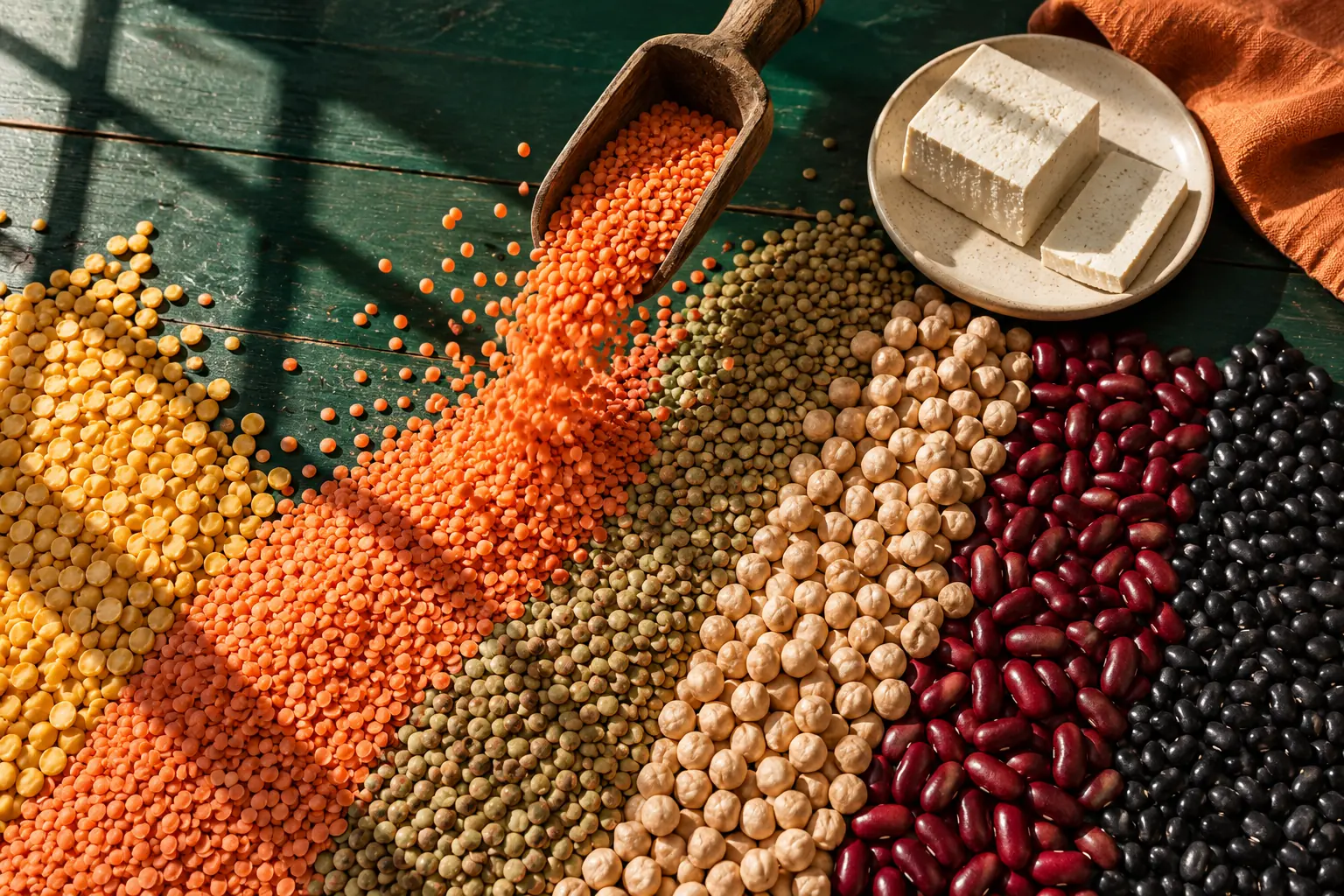
Comparison table: 16 plant-based protein sources#
The table is sorted by price per 10 g of protein. The right-hand column shows how much energy comes with each 10 g of protein, which matters if you are keeping an eye on calories.
| Food | Protein g/100 g | kcal/100 g | SEK per 10 g protein | kcal per 10 g protein |
|---|---|---|---|---|
| Yellow peas, dried | 21.5 | 317 | 0.81 | 147 |
| Porridge oats | 13 | 370 | 0.92 | 285 |
| Red lentils, dried | 24.4 | 339 | 1.17 | 139 |
| Peanuts, roasted and salted | 22.4 | 605 | 1.33 | 270 |
| Green lentils, dried | 24.4 | 339 | 1.38 | 139 |
| Kidney beans, dried | 19.9 | 326 | 1.69 | 164 |
| Sunflower seeds | 20.6 | 618 | 1.75 | 300 |
| Chickpeas, dried | 18.8 | 331 | 1.79 | 176 |
| Pumpkin seeds | 29.8 | 573 | 3.34 | 192 |
| Soy mince, frozen | 18 | 163 | 3.88 | 91 |
| Tofu, firm | 15 | 147 | 3.97 | 98 |
| Kidney beans, tinned | 8.8 | 110 | 4.43 | 125 |
| Edamame, frozen | 10.9 | 130 | 4.57 | 119 |
| Chickpeas, tinned | 7.5 | 128 | 5.28 | 171 |
| Black beans, tinned | 8.1 | 111 | 5.31 | 137 |
| Tempeh | 20 | 272 | 7.48 | 136 |
| Reference: chicken breast fillet, frozen | 23.1 | 104 | 2.99 | 45 |
| Reference: eggs | 12.1 | 136 | ≈ 4.0 | 112 |
Protein: Swedish Food Composition Database (Livsmedelsverket). Price: Swedish store prices in SEK, Willys online, Sweden, 22 October 2026, regular price, one chain on one day. One example, not a price comparison between shops. Tofu, tempeh, porridge oats and soy mince: values from the pack. Tinned products calculated on drained weight. Eggs calculated at 50 g per egg. SEK per 10 g protein = unit price per kg ÷ grams of protein per 100 g.
How much protein is in beans, lentils and chickpeas?#
Dried lentils have 24.4 g of protein per 100 g, yellow peas 21.5 g, kidney beans 19.9 g and chickpeas 18.8 g (Swedish Food Composition Database). Tinned beans and chickpeas have 7.5–8.8 g per 100 g drained weight. The difference is water; the protein has not gone anywhere.
When you cook dried legumes they absorb water and end up weighing roughly 2–2.5 times as much. Dried lentils have 24.4 g of protein per 100 g, cooked ones around 9–11 g. Cooking does not change the protein you get per krona, only the weight of the portion. So compare dried with dried and tinned with tinned.
Among seeds and nuts, pumpkin seeds stand out with 29.8 g of protein per 100 g. Peanuts have 22.4 g and sunflower seeds 20.6 g. They are cheap per gram of protein but bring a lot of energy with them; more on that under common mistakes.
How much protein is in tofu?#
Firm tofu has around 14–15 g of protein per 100 g according to the packs. The brand in the table states 15 g, and two other brands 14 and 14.2 g. The Swedish Food Agency's generic value for tofu is lower, 6.6 g per 100 g, so always check the protein line on the pack you buy.
Using the label's 15 g, the tofu cost SEK 3.97 per 10 g of protein. That is roughly the same as tinned beans and soy mince. Tofu also brings few calories per gram of protein, 98 kcal per 10 g of protein, which is lower than both legumes and nuts.
Ready-made products such as Quorn and Oumph are common in Swedish shops, but their protein content varies from product to product. The Swedish Food Agency points out that the nutritional content of vegetarian products differs (L 2025 nr 04).
What counts as legumes?#
Legumes, or pulses, usually include peas, beans and lentils, according to the Swedish Food Agency's dietary guidelines (L 2025 nr 04). That covers dried, tinned and frozen versions alike. Green peas therefore count as legumes in the guidelines, not as vegetables.
A list of common legumes in the shop:
- Peas: yellow peas, green peas, chickpeas
- Lentils: red, green, brown and black lentils
- Beans: kidney beans, black beans, white beans, soya beans and edamame
Anything eaten pod and all, such as sugar snap peas and green beans, counts as a vegetable instead. Tofu, tempeh and soy mince are made from soya beans.
What is the cheapest plant-based protein?#
Dried yellow peas were the cheapest in our check at SEK 0.81 per 10 g of protein, followed by porridge oats (SEK 0.92) and red lentils (SEK 1.17). Dried kidney beans and chickpeas also came in under SEK 1.80. Tinned beans, tofu and soy mince cost around SEK 4–5 per 10 g of protein, and tempeh around SEK 7.50.
For comparison, frozen chicken breast fillet cost SEK 2.99 per 10 g of protein and eggs around SEK 4. Dried legumes are therefore cheaper per gram of protein than both chicken and eggs. Porridge oats rank high because the bag is cheap, but they bring 285 kcal per 10 g of protein, so they work best as a protein top-up at breakfast.
The prices are Swedish store prices from Willys' online shop on a single day, not a comparison between shops. The order between dried goods, tins and ready-made products tends to hold, though, because the gap is largely down to water and processing. More ideas for eating cheaply day to day are in our guide to cheap meals that fill you up.
Is plant protein as good as animal protein?#
Soy comes close. A review of soy products found an average DIAAS of 84.5 (van den Berg et al., 2022, Front Nutr). DIAAS is a measure of how well the body can absorb and use the essential amino acids. One co-author of the review was employed by Unilever.
A study on minipigs gave tofu a DIAAS of 97, with soy ranking ahead of pea protein and seitan (Reynaud et al., 2021, Food Chem). Results from animal models do not transfer directly to humans, but they give a picture of how the protein sources rank against each other.
The older PDCAAS measure can overestimate the quality of some plant proteins compared with DIAAS, according to a study in pigs (Mathai et al., 2017, Br J Nutr). In short: soy ranks high, peas and wheat a little lower, and a varied diet evens out the differences.
Do you have to combine protein sources in the same meal?#
No. Legumes, nuts and seeds are enough for adults to get sufficient protein, according to a review in Nutrients (Mariotti and Gardner, 2019). The authors write that the risk of amino acid deficiency has been greatly overstated. Varying your protein sources over the day is enough.
Beans and rice in the same meal are tasty, then, but not a requirement. If you have a lentil stew for lunch and porridge with seeds for breakfast, you already have variety. For older adults the question is more complex according to the same review, and there is more on that in our guide to protein for older adults.
How many legumes should you eat?#
Since 2025 the Swedish Food Agency's advice has been "Pulses often, preferably every day" (L 2025 nr 04). Today, median intake of cooked legumes among Swedish adults is 0 grams a day, and only 25 per cent eat more than 15 grams daily.
According to the guidelines, a sustained increase from 0 to 100 g of legumes a day was associated with roughly one year longer life expectancy for women and men aged 30 to 50. The evidence is observational data, not proof of cause. A review for the Nordic Nutrition Recommendations rates the evidence for lower all-cause mortality as moderate (Torheim and Fadnes, 2024).
Legumes also contain carbohydrates and fibre. Iron from plant foods is absorbed less well than iron from meat, and food rich in vitamin C at the same meal increases absorption, according to the Swedish Food Agency. A way of eating with plenty of legumes is described in our Mediterranean diet weekly menu.
How do you put together a high-protein meal without meat?#
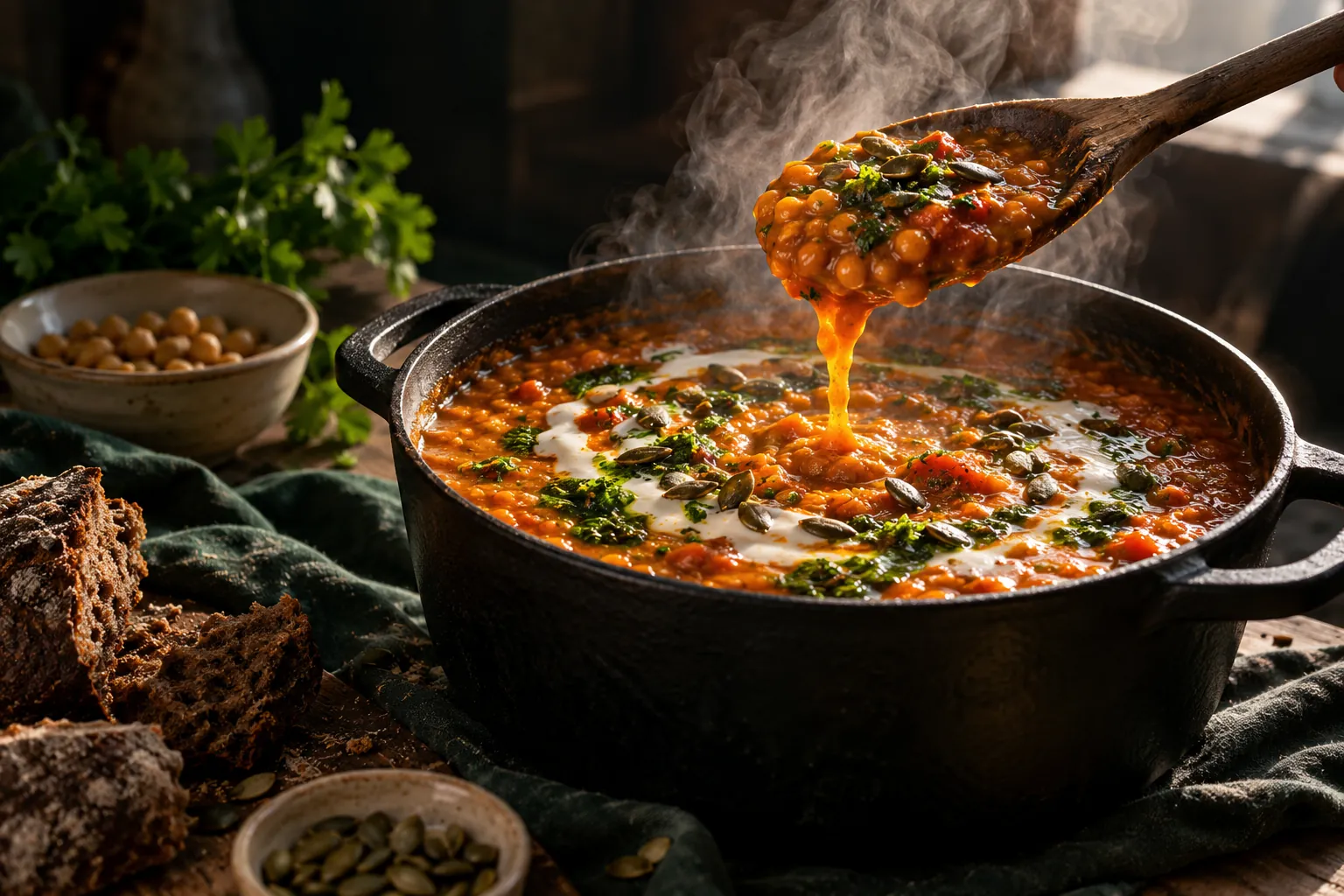
Work from the dry weight. 100 g of dry red lentils gives 24.4 g of protein and cost around SEK 2.90. 100 g of dry yellow peas gives 21.5 g of protein for around SEK 1.75. A 200 g block of tofu gives 30 g of protein. How much protein you need per day and per meal is covered in how much protein you need.
A few combinations that give plenty of protein without meat:
- Red lentil stew topped with pumpkin seeds
- Yellow pea soup with wholegrain bread
- Fried tofu with edamame and rice
- Chilli sin carne with soy mince and kidney beans
More vegetarian dinners with plenty of protein are in high-protein dinner.
How do you get legumes in every day?#
The easiest way is to plan them in. Put a legume-based dinner on the weekly menu every day, and cook a big batch of lentils or chickpeas on Sunday to cover your packed lunches. Cooked legumes freeze well in portions.
Smaklig plans your week's meals around the offers where you shop and writes the shopping list for you. At ICA and Coop you can add the items straight to your basket in the app.
If you eat vegetarian, you say so once, and the week's dinners are then planned without meat. If you want more legumes in your week, you can ask Smaklig in the chat for, say, a lentil stew or a chickpea dish, and if a day doesn't suit you, you simply replace the recipe. Every recipe shows protein per portion, so you can see at a glance which dinners carry the week's protein. If you shop at ICA or Coop, the shopping list is matched against the shop's range and the cheapest items are chosen.
Is soy bad for you? Oestrogen and hormones#
No, according to the Swedish Food Agency. Its 2025 dietary guidelines refer to a systematic review of many human studies that does not support the idea that the isoflavones in soy disrupt hormones (Messina et al., 2022, cited in L 2025 nr 04).
Tofu, tempeh, edamame and soy mince can therefore be part of an ordinary diet. Soy, peanuts, tree nuts, sesame and gluten are common allergens in this kind of food. Seitan and soy mince can contain wheat or barley, and oats without a gluten-free label can contain gluten. Always check the pack if you have an allergy.
Common mistakes#
- Comparing tinned beans with meat per 100 g. The water makes the protein look low. Compare per krona or per portion instead.
- Making nuts and seeds your main source. They are cheap per gram of protein but bring 190–300 kcal per 10 g of protein.
- Eating raw or undercooked dried beans. Lectins can cause nausea, vomiting and diarrhoea. Many legumes need both soaking and boiling, according to the Swedish Food Agency.
- Believing protein has to be combined at every meal. Varying it over the day is enough (Mariotti and Gardner, 2019).
- Buying ready-made veggie products without reading the label. Protein varies between brands; for tofu from 14 to 15 g per 100 g.
Checklist#
- Buy dried legumes in 800 g to 1 kg bags as your base, and tins when time is short.
- Cook one batch at a time and freeze it in portions.
- Plan in one legume-based meal a day, and you are following the "preferably every day" advice.
- Read the protein line on tofu, tempeh and soy mince.
- Sprinkle seeds or nuts over your food as a top-up, not as the main source.
- Have something rich in vitamin C with the meal, such as peppers or citrus fruit, for better iron absorption.
- Let Smaklig plan the week's legume dinners around the offers and write the shopping list.
Sources
- Livsmedelsverket. Swedish Food Composition Database: nutrient values for legumes, seeds, tofu, tempeh, chicken and eggs
- Livsmedelsverket. Swedish Food Agency dietary guidelines for the adult population (L 2025 nr 04)
- Food & Nutrition Research. Torheim LE, Fadnes LT: Legumes and pulses, a scoping review for Nordic Nutrition Recommendations 2023 (2024)
- Nutrients. Mariotti F, Gardner CD: Dietary Protein and Amino Acids in Vegetarian Diets, A Review (2019)
- Frontiers in Nutrition. van den Berg LA et al.: Protein quality of soy and the effect of processing, a quantitative review (2022)
- Food Chemistry. Reynaud Y et al.: True ileal amino acid digestibility and digestible indispensable amino acid scores (DIAAS) of plant-based protein foods (2021)
- British Journal of Nutrition. Mathai JK, Liu Y, Stein HH: Values for DIAAS and PDCAAS for dairy and plant proteins (2017)
- Willys (Axfood). Willys online range, unit prices and pack nutrition labels (retrieved 22 October 2026)
Frequently asked questions
What is the cheapest plant-based protein?
Dried yellow peas and lentils. In our price check at Willys in Sweden on 22 October 2026, yellow peas cost SEK 0.81 and red lentils SEK 1.17 per 10 g of protein. Porridge oats came in at SEK 0.92. Tinned beans, tofu and soy mince cost around SEK 4–5 per 10 g of protein, and tempeh around SEK 7.50. The prices are one example from one Swedish chain on one day.
How much protein is in beans, lentils and chickpeas?
Dried lentils have 24.4 g of protein per 100 g, yellow peas 21.5 g, kidney beans 19.9 g and chickpeas 18.8 g according to the Swedish Food Composition Database. Tinned and drained beans have 7.5–8.8 g because they contain water. You get more protein for your money from the dried versions: the tins cost roughly 2.5–3 times more per gram of protein.
How much protein is in tofu?
Firm tofu in the shops has around 14–15 g of protein per 100 g according to the packs we read on 22 October 2026. The Swedish Food Agency's generic value is lower, 6.6 g, so check the protein line on the brand you buy. At 15 g of protein, the tofu cost SEK 3.97 per 10 g of protein, about the same as tinned beans.
Do you have to combine protein sources in the same meal?
No. A review in Nutrients (Mariotti and Gardner, 2019) concluded that legumes, nuts and seeds are enough for adults to get sufficient protein, and that the risk of amino acid deficiency has been overstated. Varying your protein sources over the day is enough. For older adults the question is more complex, according to the same review.
How many legumes should you eat?
The Swedish Food Agency's 2025 dietary guidelines say "Pulses often, preferably every day". Today, median intake among Swedish adults is 0 grams of cooked legumes a day, and only 25 per cent eat more than 15 grams daily. One legume-based meal a day is a simple way to follow the advice.
Is soy bad for your hormones?
The Swedish Food Agency writes in its 2025 dietary guidelines that a systematic review of many human studies does not support the idea that the isoflavones in soy disrupt hormones (Messina et al., 2022). Tofu, tempeh and edamame can therefore be part of an ordinary diet. Anyone with a soy allergy should avoid them and read the pack.
Want more meal planning tips?
More guides on food, health and saving money — and a sous-chef that plans your week for you.
Get started
Founder, Smaklig
Writer at Smaklig. We write about food, health, and how to eat better without breaking the bank.
Related articles
April 12, 2026 · 11 min
Cheap Filling Meals: 20 Recipes Under 30 SEK per Serving (2026)
Cheap food doesn't have to be boring. 20 recipes under 30 SEK/serving, protein per krona, campaign tips from ICA, and how to save 1,000 SEK/month.
Read moreOctober 22, 2026 · 13 min
Vegetarian Meal Plan: 7 Easy Dinners and a Shopping List
A vegetarian meal plan with seven easy dinners, protein per portion and a shopping list for four. How to get B12 and iron without meat, per Swedish guidance.
Read moreSeptember 17, 2026 · 12 min
Air fryer vegetables: times, temperature and 3 staples
Air fryer vegetables: times and temperatures for root veg, cabbage and more — plus three cheap, long-lasting everyday staples and how to avoid acrylamide.
Read moreReady to plan smarter?
Smaklig creates your weekly menu with AI based on store campaigns. Tailored to your goals and allergies.
Get started free