Vegetarian Meal Plan: 7 Easy Dinners and a Shopping List
A vegetarian meal plan with seven easy dinners, protein per portion and a shopping list for four. How to get B12 and iron without meat, per Swedish guidance.
Download Smaklig – now on the App Store and Google Play The Smaklig app is now on the App Store (iPhone) and Google Play (Android). Download it free.
Download SmakligA vegetarian meal plan gets easy when you decide on the protein first and let the rest follow. Here are seven easy vegetarian dinners for the week, built on lentils, beans, chickpeas, halloumi, falafel and tofu. You get the protein per portion worked out, a shopping list for four people and what you need to know about B12 and iron on a vegetarian diet.
Short answer: Seven vegetarian dinners with a clear protein base each day go a long way, as long as you think about B12 and eat something rich in vitamin C with the iron-rich dishes.
- The protein base gives 9.4–22.5 g of protein per portion in the plan below, calculated from Swedish Food Agency (Livsmedelsverket) values per 100 g and the pack value for tofu. The pasta and bulgur are counted; bread, rice, noodles and lasagne sheets add more.
- 100 g of dried lentils contains 24.4 g of protein according to the Swedish Food Composition Database.
- The Swedish Food Agency advises: "Eat beans, peas and lentils often, preferably every day" (our translation).
- B12 can be too low even for lacto-ovo vegetarians, and a supplement may be needed (Swedish Food Agency).
- Vitamin C with a meal can increase the absorption of non-haem iron by 100–200 per cent (Swedish Food Agency).
Vegetarian meal plan: seven dinners#
The plan follows the Swedish Food Agency's vegetarian plate model. One part of the plate is vegetables and root vegetables, an equally large part is potatoes, pasta or grains, preferably wholegrain, and a smaller part is legumes, bean and pea products or eggs (Swedish Food Agency, vegetarian food). The plan is lacto-ovo vegetarian: it includes plant foods, dairy and eggs.
| Day | Dinner | Protein base per portion | Protein from the base |
|---|---|---|---|
| Monday | Red lentil soup with rye bread | 50 g dried lentils | 12.2 g |
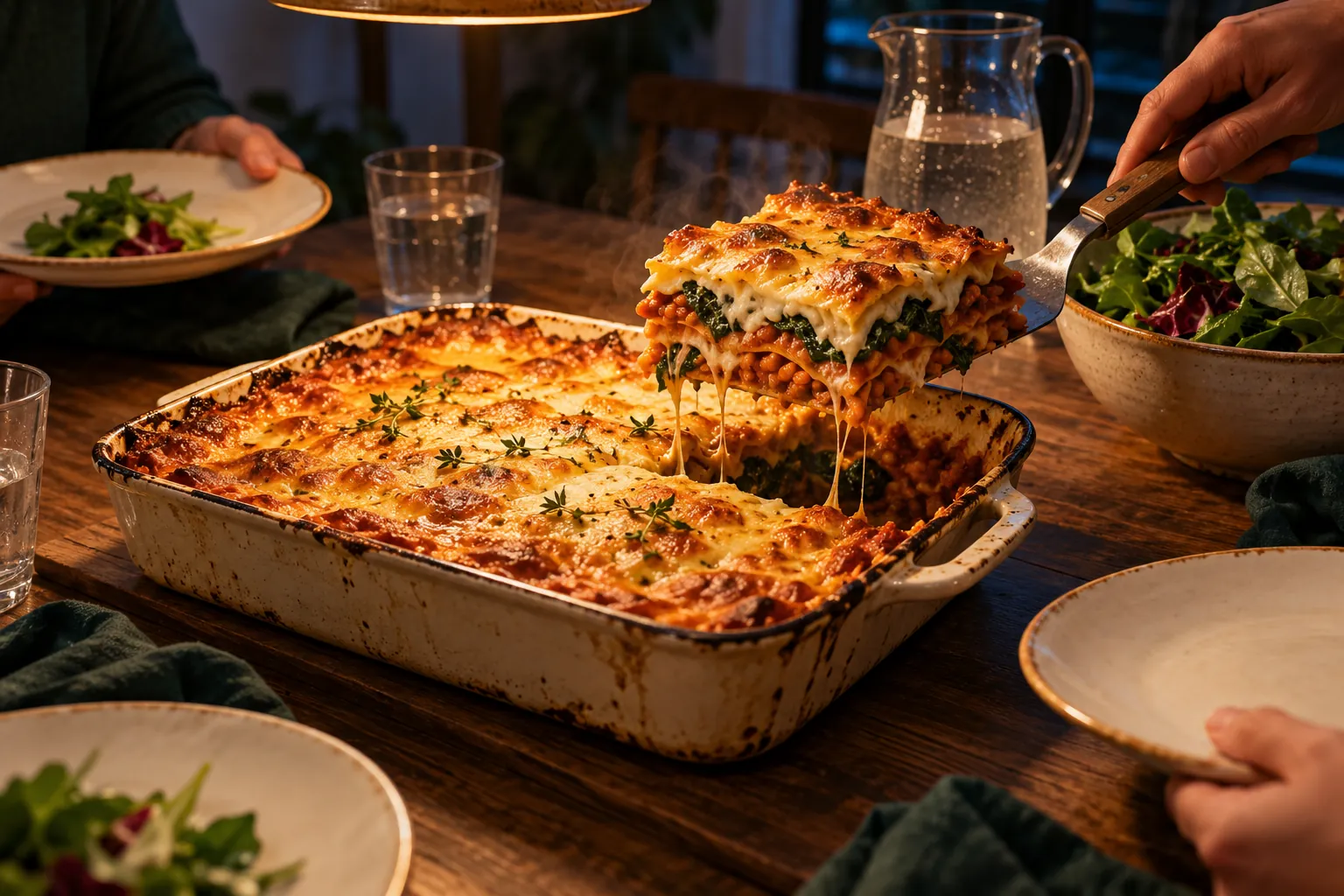
| Tuesday | Vegetarian lentil lasagne | 40 g dried lentils + 30 g grated hard cheese | 17.6 g |
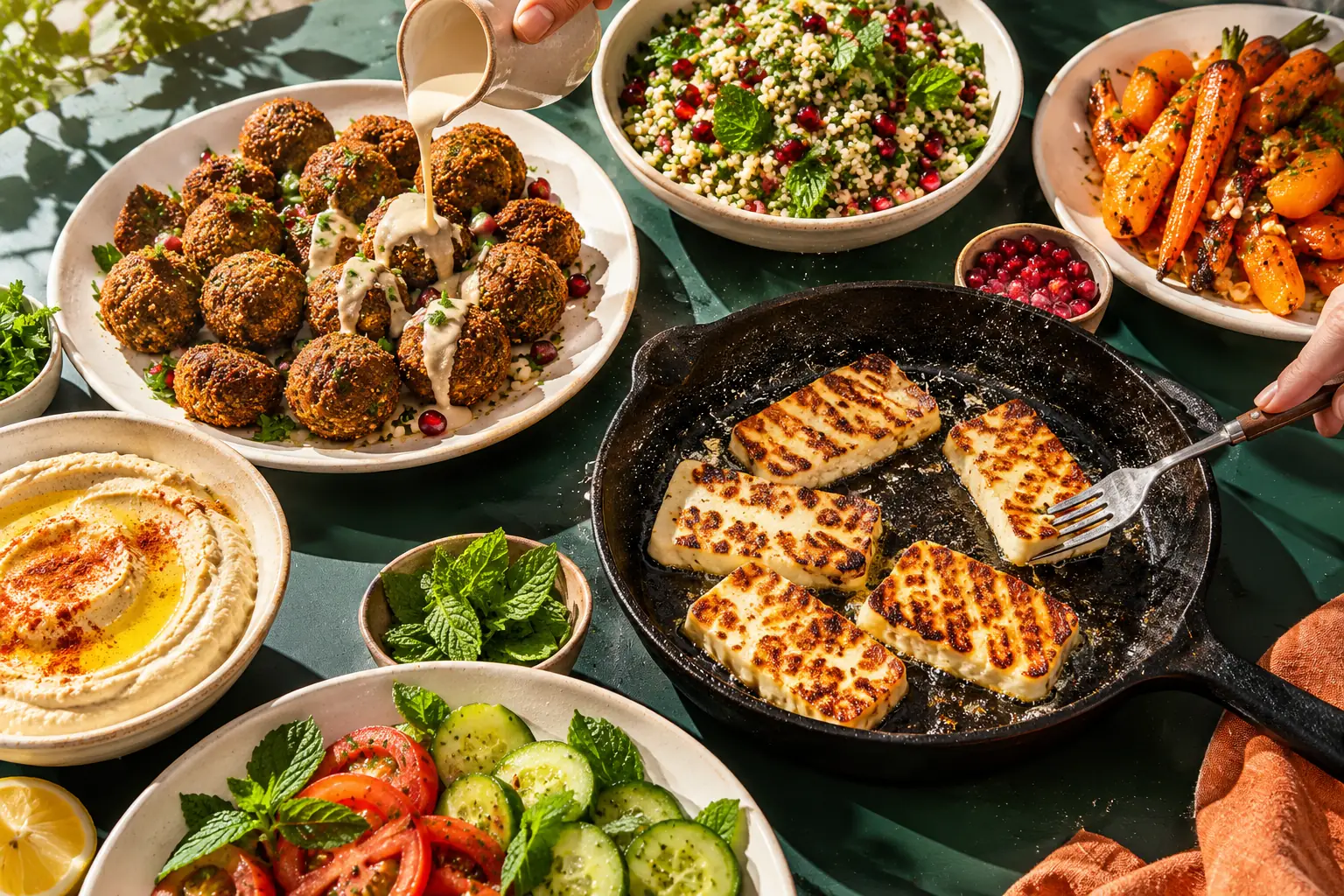
| Wednesday | Fried halloumi with bulgur and roasted root vegetables | 60 g halloumi + 60 g uncooked bulgur | 20.8 g |
| Thursday | Chickpea and tomato stew with rice | 125 g tinned chickpeas, drained | 9.4 g |
| Friday | Falafel with hummus, salad and pitta | 120 g fried falafel | 10.8 g |
| Saturday | Pasta with black beans and tomato sauce | 125 g tinned black beans + 75 g uncooked pasta | 19.1 g |
| Sunday | Tofu stir-fry with vegetables and noodles | 150 g firm tofu | 22.5 g |
Protein: Swedish Food Agency (Livsmedelsverket) values from the Swedish Food Composition Database, per 100 g: dried lentils 24.4 g, hard cheese 26.2 g, halloumi 22.3 g, uncooked bulgur 12.3 g, tinned chickpeas 7.5 g, fried falafel 9.0 g, tinned black beans 8.1 g, uncooked pasta 11.9 g. Tofu: 15 g per 100 g according to the pack, because the Swedish Food Agency's generic value (6.6 g) is far below what firm tofu in the shops states. Protein from bread, rice, noodles and lasagne sheets comes on top.
Monday: red lentil soup with rye bread#
Red lentils need no soaking and are ready in 15–20 minutes (Swedish Food Agency, beans, peas and lentils). Soften onion, carrot and garlic, add the lentils, chopped tomatoes and stock, then blend until smooth. If you would rather have a lentil stew, use less water and let the lentils keep their shape. 50 g of dried lentils per portion gives 12.2 g of protein, and the rye bread adds more.
Tuesday: vegetarian lentil lasagne#
A vegetarian lentil lasagne is a good dish to make in a double batch. The lentils cook down into the tomato sauce and take the place of mince, and the cheese on top adds both flavour and protein. 40 g of dried lentils and 30 g of grated hard cheese per portion give 17.6 g of protein together, just under 10 g from the lentils and just under 8 g from the cheese, plus the lasagne sheets.
Wednesday: fried halloumi with bulgur and roasted root vegetables#
Halloumi and bulgur make Wednesday the most protein-rich dinner of the week after the tofu stir-fry. 60 g of halloumi gives 13.4 g and 60 g of uncooked bulgur 7.4 g, a total of 20.8 g per portion. Roast carrots, beetroot and parsnips in the oven while the bulgur cooks, and fry the halloumi last.
Thursday: chickpea and tomato stew with rice#
A chickpea and tomato stew is quick when the chickpeas come from a tin. 125 g of drained chickpeas gives 9.4 g of protein per portion, which is less than 15 g from the base. So add a yoghurt sauce or a boiled egg. 50 g of boiled egg gives 6.1 g of protein (12.1 g per 100 g).
Friday: falafel with hummus, salad and pitta#
Falafel gives 10.8 g of protein per portion if you allow 120 g of fried falafel. The pitta and hummus add more, but the base is under 15 g here too. A yoghurt sauce on the side or a boiled egg in the salad makes the dinner more filling.
Saturday: pasta with black beans and tomato sauce#
Black beans in the tomato sauce turn an ordinary pasta into a vegetarian dinner with 19.1 g of protein per portion: just over 10 g from 125 g of drained beans and just under 9 g from 75 g of uncooked pasta.
Sunday: tofu stir-fry with vegetables and noodles#
150 g of firm tofu gives 22.5 g of protein at the pack's 15 g per 100 g. With the Swedish Food Agency's generic value it would have been 9.9 g, so read the protein line on the pack you buy. Press the tofu dry, fry it until crisp and stir-fry it with broccoli, pepper and ginger.
Allergens in the plan: soya (tofu, soy sauce), milk (cheese, halloumi), egg, gluten (pasta, bulgur, bread, lasagne sheets) and sesame (hummus and tahini). Smaklig helps you spot common allergens in the recipes. Always check the pack. Hard cheese and halloumi can be made with animal rennet, so choose cheese labelled vegetarian or made with microbial rennet.
Shopping list for the week#
The list is for four portions per dinner, so the protein bases in the table times four. Vegetables and store-cupboard items are listed without amounts, because they depend on how you eat.
Dried goods
- Red lentils, 200 g (Monday)
- Lentils for the lasagne, 160 g (Tuesday)
- Bulgur, 240 g (Wednesday)
- Pasta, 300 g (Saturday)
- Rice (Thursday)
- Noodles (Sunday)
- Lasagne sheets (Tuesday)
Tins and jars
- Chickpeas, 500 g drained weight (Thursday)
- Black beans, 500 g drained weight (Saturday)
- Chopped tomatoes (Monday, Tuesday, Thursday, Saturday)
- Hummus (Friday)
Dairy, eggs and tofu
- Halloumi labelled vegetarian, 240 g (Wednesday)
- Grated hard cheese labelled vegetarian, 120 g (Tuesday)
- Firm tofu, 600 g (Sunday)
- Milk for the lasagne's white sauce (Tuesday)
- Yoghurt for the sauce, and eggs (Thursday and Friday)
- Ready-made falafel, 480 g, or ingredients to make your own (Friday)
Fruit and veg
- Onions, garlic and carrots
- Root vegetables for roasting, such as beetroot and parsnips
- Lettuce, cucumber and tomatoes for the falafel
- Broccoli, peppers and fresh ginger for the stir-fry
- Lemon
Store cupboard
- Rye bread and pitta
- Vegetable stock, tomato purée and soy sauce
- Rapeseed oil and iodised salt
- Spices, such as cumin and paprika
If this is your first time planning a week ahead, there are more tips on meal planning for beginners that won't take up your whole Sunday. The shopping list also works as a starting point for vegetarian meal prep: cook the lentils and bulgur in one go.
Can you get enough protein from vegetarian dinners?#
Yes, most people can. The Swedish Food Agency writes that protein is "rarely a concern" for people who eat vegetarian, as long as they get enough energy (our translation, Swedish Food Agency, vegetarian food). Legumes and grains complement each other. The plan above gives 9.4–22.5 g from the protein base per dinner, with the pasta and bulgur already included. Bread, rice, noodles and lasagne sheets add more.
A systematic review of 141 studies found that adults on plant-based diets ate less protein than meat-eaters, but that their intake was well within the recommendations (Neufingerl and Eilander, 2021). Nor do you need to combine protein sources in the same meal. Varying them over the day is enough, which we cover in the article on which plant-based protein sources give the most for your money.
If you want high protein vegetarian dinners, eggs, yoghurt and tofu are the easiest additions. There are more ideas among our high-protein dinners.
Do vegetarians need to take B12?#
They may, even if they eat dairy and eggs. B12 is found almost only in animal and fortified foods. The Swedish Food Agency writes: "Even for lacto-ovo vegetarians, intake can be too low" (our translation), and that a supplement may therefore be needed (Swedish Food Agency, vegetarian food). Seaweed is not a reliable source of B12.
A review of 40 studies found that the share of adult and elderly vegetarians with B12 deficiency ranged from 0 to 86.5 per cent between studies, and that it was highest among vegans (Pawlak et al., 2014). The spread shows that it depends a great deal on what people eat.
How much you need, and whether to take a supplement, is a question for your GP or a pharmacist. If you are pregnant or breastfeeding, ask your midwife or GP. The Swedish Food Agency also mentions vitamin D as a nutrient to think about, so choose fortified dairy products or plant drinks where you can.
How do you get iron without meat?#
Eat legumes, tofu, wholegrains, pumpkin seeds and nuts, and add something rich in vitamin C to the same meal. Vitamin C can increase the absorption of non-haem iron by 100–200 per cent (Swedish Food Agency, beans, peas and lentils). Pepper in the stir-fry, tomato in the stew and lemon on the falafel all help.
The Swedish Food Agency points out that dishes such as bean burgers give considerably more iron than dishes with cheese as the main ingredient. That is why only one of the week's dinners is built on cheese. Wholegrains help too: wholemeal flour contains five times as much iron as white wheat flour (Swedish Food Agency, wholegrains). Spinach contains oxalic acid, which means the calcium in spinach is poorly absorbed, so do not count on spinach as a calcium source.
A meta-analysis of 24 cross-sectional studies found that adult vegetarians had lower iron stores than non-vegetarians, on average 29.71 µg/L lower ferritin (Haider et al., 2018). Cross-sectional studies show an association, not a cause, but it is a reason to plan iron-rich dinners into every week.
How do you make cheap vegetarian meals?#
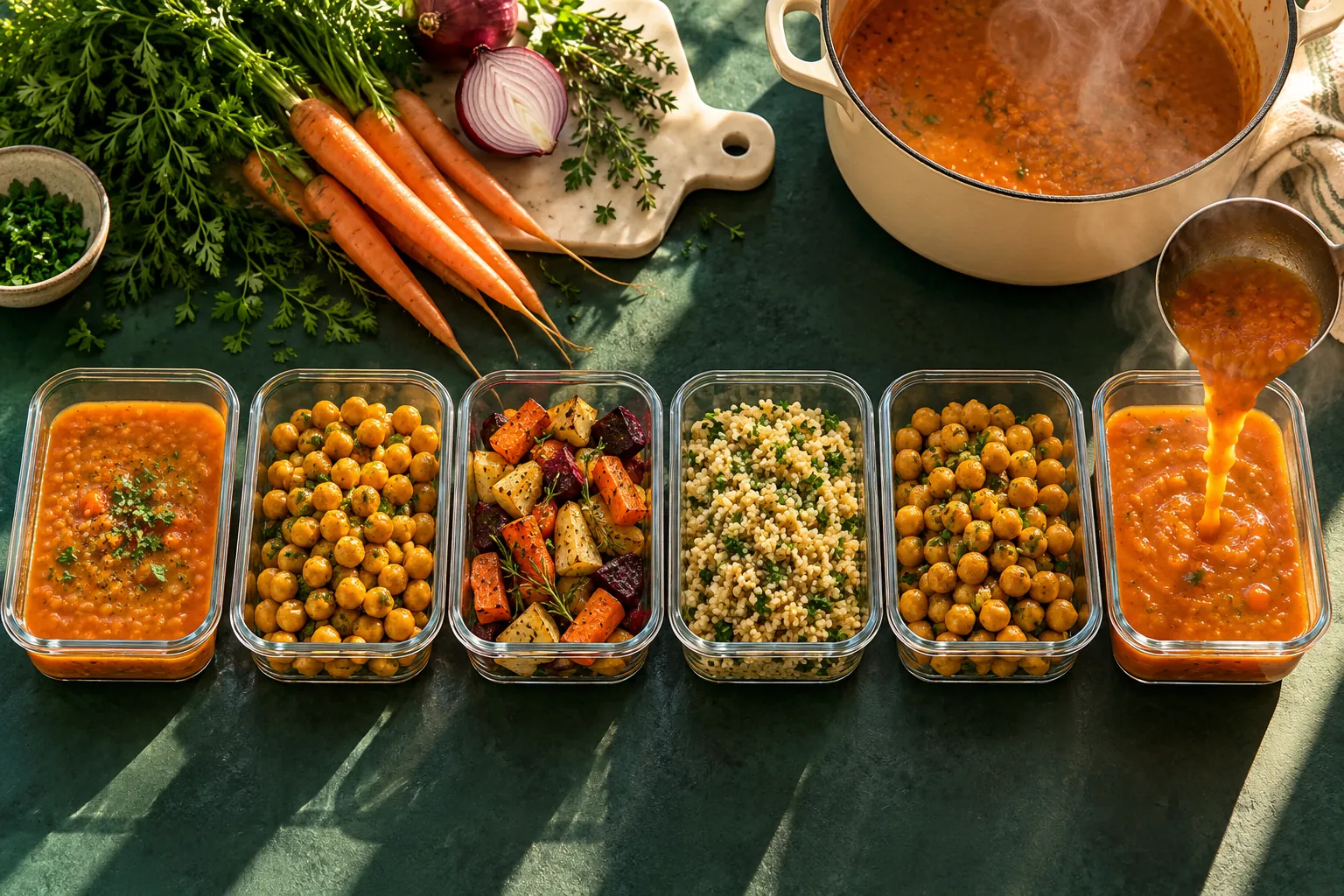
Build the week on dried goods. The Swedish Food Agency writes that cooking pulses yourself is considerably cheaper than buying them tinned (Swedish Food Agency, vegetarian food). Cook a big batch of chickpeas or beans, freeze it in portions and swap out the tins on Thursday and Saturday. Follow the cooking time on the pack.
Make the lasagne and the lentil soup in a double batch and freeze half for next week. Lentils, peas and grains keep for a long time in the cupboard, so you can buy them in larger packs. There are more ideas in the article on cheap meals that fill you up.
How do you plan vegetarian meals around the week's offers?#
Keep the dried goods as the base every week and let the offers decide the rest. Smaklig plans the week's dinners around the offers in the shop where you buy your food, across all seven Swedish chains, and writes the shopping list for you. You say once that you eat vegetarian and which allergies there are in the household, and every weekly plan is then built on that.
Lentils, beans and grains are always at home, while the week's offers decide which vegetables, which dairy and which tofu end up in the plan. If you shop at ICA or Coop, you can add the items straight to the basket in the app. If you like legumes and olive oil, there is a whole week of Mediterranean diet dinners, and for families with children there is a weekly family meal plan with more vegetarian meal ideas to mix in.
If a dinner doesn't suit you, you replace the recipe with another, and if you want something specific, you can ask Smaklig in the chat for, say, a higher-protein dish or a dinner without soy. Every recipe shows protein per portion. If you shop at ICA or Coop, the shopping list is also matched against the shop's range and the cheapest items are chosen.
Common mistakes#
- Cheese as the main protein every day. Cheese gives little iron and a lot of saturated fat. Vary with legumes, tofu and eggs.
- Counting peas and beans as vegetables. They are not included in the Swedish Food Agency's advice to eat at least 500 g of vegetables, fruit and berries a day (Swedish Food Agency, vegetables, fruit and berries). Frozen vegetables are as good for you as fresh and work well in the stir-fry and the stew.
- Forgetting B12 and vitamin D. Talk to your GP about supplements.
- Trusting the iron value in meat-free products coloured with iron oxide (E 172). The Swedish Food Agency warns about exactly this. Read the ingredients list.
- Increasing legumes too quickly. Your stomach may need time to adjust. Increase the amount gradually.
- Eating dried beans that are not properly cooked. Follow the cooking time on the pack.
Checklist#
- Dried goods in the cupboard: lentils, yellow split peas, chickpeas and grains
- Legumes in some form every day
- Something rich in vitamin C with the iron-rich dinners
- At least 500 g of vegetables, fruit and berries a day, not counting legumes
- Wholegrains in bread, grains and pasta
- Iodised salt and rapeseed oil in your cooking
- Fortified dairy products or plant drinks
- B12 as advised by your GP or pharmacist
- A big batch of legumes cooked and frozen in portions
- A weekly plan and shopping list from Smaklig, built on the week's offers
Sources
- Livsmedelsverket. Vegetarian food (Vegetarisk mat)
- Livsmedelsverket. Beans, peas and lentils (Bönor, ärter och linser)
- Livsmedelsverket. Vegetables, fruit and berries (Grönsaker, frukt och bär)
- Livsmedelsverket. Wholegrains (Fullkorn)
- Livsmedelsverket. Swedish Food Composition Database: nutrient values for lentils, chickpeas, beans, halloumi, falafel, bulgur, pasta, eggs and tofu
- European Journal of Clinical Nutrition. Pawlak R et al.: The prevalence of cobalamin deficiency among vegetarians assessed by serum vitamin B12, a review of literature (2014)
- Critical Reviews in Food Science and Nutrition. Haider LM et al.: The effect of vegetarian diets on iron status in adults, a systematic review and meta-analysis (2018)
- Nutrients. Neufingerl N, Eilander A: Nutrient Intake and Status in Adults Consuming Plant-Based Diets Compared to Meat-Eaters, a Systematic Review (2021)
Frequently asked questions
How much protein is in a vegetarian dinner?
In this meal plan the protein base gives between 9.4 and 22.5 g of protein per portion, calculated from the Swedish Food Agency's values per 100 g and the pack value for tofu. The tofu stir-fry and the halloumi give the most, the chickpea stew and the falafel the least. The pasta and bulgur in the plan are already counted; bread, rice, noodles and lasagne sheets add more. A boiled egg or a yoghurt sauce lifts the lighter dinners.
Do lacto-ovo vegetarians need a B12 supplement?
They may. The Swedish Food Agency writes that B12 intake can be too low even for people who eat dairy and eggs, and that a supplement may therefore be needed. How much you need depends on what you eat. Ask your GP or a pharmacist, and if you are pregnant or breastfeeding, ask your midwife or GP.
How do you make vegetarian food cheaper?
Build the week on dried lentils, peas and beans. The Swedish Food Agency writes that cooking pulses yourself is considerably cheaper than buying them tinned. Cook a big batch, freeze it in portions and let the week's offers decide the vegetables and dairy.
How many legumes should you eat?
The Swedish Food Agency advises eating beans, peas and lentils often, preferably every day. The Nordic Nutrition Recommendations 2023 give no amount. Denmark recommends 100 g of cooked legumes a day and Finland 50 to 100 g, according to the Swedish Food Agency.
Do peas and beans count as vegetables?
Not in the Swedish Food Agency's advice to eat at least 500 g of vegetables, fruit and berries a day. Legumes and potatoes are not counted in that amount. Eat them anyway, but add vegetables on the side, such as a salad, root vegetables or broccoli.
Want more meal planning tips?
More guides on food, health and saving money — and a sous-chef that plans your week for you.
Get started
Founder, Smaklig
Writer at Smaklig. We write about food, health, and how to eat better without breaking the bank.
Related articles
October 22, 2026 · 14 min
Gluten-Free Meal Plan: 7 Easy Dinners and a Shopping List
Gluten free meal plan with 7 weeknight dinners and a shopping list. What is naturally gluten free, where gluten hides and what the gluten-free label means.
Read moreOctober 22, 2026 · 15 min
Calorie Chart for Foods: Calories in Eggs, Bread and More
Calorie chart with kcal per 100 g and per portion for 59 common foods, from eggs and pizza to rice, cheese and beer. All values from the Swedish Food Agency.
Read moreOctober 22, 2026 · 12 min
Cheap Plant-Based Protein Sources: Beans, Lentils, Tofu
Plant based protein sources compared: protein per 100 g and price per 10 g of protein for beans, lentils, tofu and seeds. Dried yellow peas cost the least.
Read moreReady to plan smarter?
Smaklig creates your weekly menu with AI based on store campaigns. Tailored to your goals and allergies.
Get started free