Gut Health Foods: How to Improve Gut Health, by the Evidence
How do you improve gut health? Fibre, pulses, more plant types and fermented foods, with the studies showing what holds up and what is still uncertain.
Download Smaklig – now on the App Store and Google Play The Smaklig app is now on the App Store (iPhone) and Google Play (Android). Download it free.
Download SmakligShort answer: Good foods for gut health are mainly plants: vegetables, pulses, whole grains, fruit and nuts, ideally alongside fermented foods. Research supports the overall pattern better than single foods, and it cannot yet say exactly what a good microbiome is.
- 25–35 grams of fibre a day is the Swedish recommendation for adults (Swedish Food Agency)
- 8 weeks of a Mediterranean diet lowered cholesterol and changed gut bacteria in a randomised trial of 82 people (Gut, 2020)
- Over 34,000 people took part in mapping how species relate to diet and health (Nature, 2026)
- 64 studies show fibre raises bifidobacteria, but not diversity (AJCN, 2018)
- 36 people tried fibre or fermented foods: diversity rose with fermented foods (Cell, 2021)
In practice: build a pulse, a whole grain and a few extra vegetables into the week's dinners. It is easier in a plan than in the moment.
Gut health foods are everywhere online, and the advice often goes further than the research. This guide covers which foods actually have support from studies, what those studies can and cannot show, and how to turn it into ordinary everyday food. Every study is given with its type and number of participants, so you can weigh it yourself.
What is the gut microbiome, and what counts as a good one?#
The gut microbiome is the community of bacteria and other microorganisms in your gut. What you eat affects it. There is no agreed definition of a good microbiome. Researchers instead use measures such as richness, meaning how many species or genes are present, and how different species relate to health markers.
In a Danish study of 292 people, those with low bacterial richness had more body fat, insulin resistance and blood lipid problems (Le Chatelier et al., Nature 2013). In the largest mapping so far, with over 34,000 people in the US and UK, researchers built a ranking of species by health markers. In two diet trials with 746 people, favourably ranked species rose over time (Asnicar et al., Nature 2026). The authors themselves say cause and effect needs more study, and several have ties to the company ZOE.
How do you improve gut health with food?#
The best support is for a plant-rich eating pattern, not a single ingredient. In a randomised trial, 82 people with overweight either ate a Mediterranean diet at the same energy intake or kept their usual diet for eight weeks. Cholesterol fell and the gut bacteria changed, with a rise in the fibre-degrading species Faecalibacterium prausnitzii (Meslier et al., Gut 2020).
| Food | What the studies show | Strength |
|---|---|---|
| Mediterranean diet overall | Changed gut bacteria and lower cholesterol in 8 weeks, 82 people | Randomised, small |
| Fibre from food and supplements | More bifidobacteria and lactobacilli, no higher diversity, 2,099 people | Review of 64 randomised trials |
| Fermented foods | Higher diversity and lower inflammation markers, 18 people in the group | Randomised, very small |
| More plant types | Different gut bacteria at over 30 types a week, a subset of a project with over 10,000 volunteers | Observational |
| More plants on a mixed diet | Higher abundance of favourably ranked species, 21,561 people | Observational |
The most important part of the table is the right-hand column. Strong evidence for the health effects of fibre is not strong evidence for exactly what happens in the gut.
How does fibre affect gut bacteria?#
Fibre is not broken down in the small intestine. It reaches the large intestine, where bacteria can use it. A review of 64 randomised trials with 2,099 healthy adults found more Bifidobacterium and Lactobacillus and slightly higher stool butyrate, but no effect on diversity (So et al., AJCN 2018).
That does not make fibre unimportant. The Swedish Food Agency gives 25–35 grams a day for adults (Swedish Food Agency, 2026). The guide how much fibre per day shows how to get there. Build up gradually, as rapid increases can cause wind and diarrhoea.
Are fermented foods good for your gut?#

Fermented foods can be good, but the evidence base is small. In a 17-week randomised trial at Stanford, healthy adults ate either more fibre or more fermented food, 18 people per group. Diversity rose steadily in the fermented food group and several inflammation markers fell. In the fibre group, diversity stayed stable (Wastyk et al., Cell 2021).
Fermented foods are foods changed by bacteria or yeast, such as yoghurt, kefir, sauerkraut and kimchi. The trial tested food, not supplements, so it says nothing about probiotic capsules. Prefer options with little added sugar, and remember that sauerkraut and kimchi are often salty.
Are probiotics good for gut health?#
For healthy adults there is little support for capsules changing the gut microbiome. A systematic review of seven randomised trials found no difference from placebo in diversity, richness or evenness, and only one trial saw a change in overall composition (Kristensen et al., Genome Medicine 2016). The review dates from 2016 and covers healthy people, not those with illness or after antibiotics.
Fermented foods, such as yoghurt and kefir, are not the same as probiotic capsules. If you want to try them, food is the simplest step, and dairy versions bring protein and calcium as well.
Does the number of plant types matter?#
Perhaps, but "30 plants a week" is not an established limit. The figure comes from American Gut, where over 10,000 volunteers sent in samples. People eating more than 30 plant types a week differed from those eating fewer than 10 (McDonald et al., mSystems 2018). Participants chose to take part and reported their own diets.
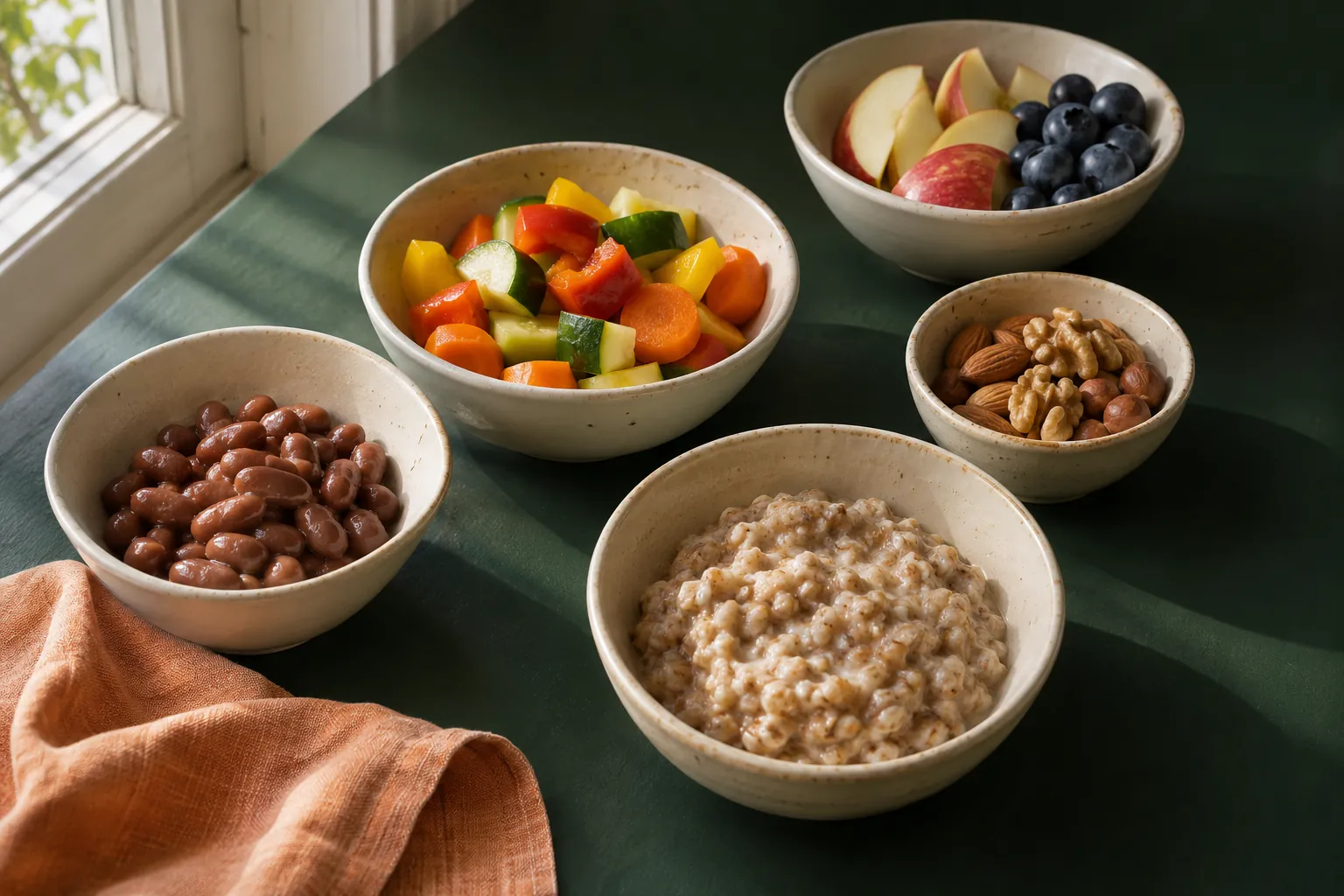
Plant types add up faster than it sounds. A vegetable mix, a tin of beans and a nut and seed mix give you many at once. The researchers also noted that categories such as "vegan" explained little compared with which plants people actually ate.
Do sweeteners affect your gut bacteria?#
Yes, at least in the short term. In a randomised trial, 120 healthy adults took saccharin, sucralose, aspartame, stevia or a control for two weeks, at doses below the acceptable daily intake. All four changed gut bacteria, and saccharin and sucralose worsened blood sugar responses (Suez et al., Cell 2022). Responses varied between people, and the study says nothing about long-term effects.
Can a gut microbiome test tell you what to eat?#
Not with any certainty. A test describes what is in one sample. The result is then compared with associations in large groups, and the authors of the largest ranking say themselves that it cannot show cause and effect. The basics stay the same whatever the test says: more plants, enough fibre and a week you can keep up.
Do you have to stop eating meat for your gut?#
No, the research does not require that. In an analysis of 21,561 people, species tied to red meat went with poorer cardiometabolic markers, but omnivores who ate more plant foods had a higher abundance of favourable species (Fackelmann et al., Nature Microbiology 2025). These are observational data.
A new Danish study led to headlines claiming meat beats greens. What it actually shows, and why the headline does not hold, is covered in vegan gut microbiome: the study. If you eat plant-based, protein is worth planning, see plant-based protein sources.
Smaklig's perspective: make it a normal week#
Eating for your gut rarely takes special products. It takes having the beans, vegetables and whole grains at home. A weekly plan solves that better than good intentions, and a vegetarian weekly meal plan is a good place to start.
Smaklig plans your week's food around the offers where you shop, at ICA, Coop, Willys, Hemköp, Lidl, City Gross or Costco, and makes the shopping list. Say in the chat that you want more fibre or more pulses and the menu follows. If you shop at ICA or Coop, the list is matched against the store's range and the items go into your ICA or Coop cart without leaving the app.
Smaklig does not test your gut bacteria and gives no medical advice. If you have lasting gut symptoms, healthcare is the right route.
Common misunderstandings about gut health#
- "Superfoods fix your gut." Studies support eating patterns, not single ingredients.
- "More diversity is always better." Diversity is one measure among several. What it means for an individual is not settled.
- "A microbiome test tells me what to eat." Rankings and tests rest on associations in groups. They are not diagnoses.
- "Fibre has to raise diversity to be worth it." No. Fibre's links to health stand regardless of that measure.
- "More fibre is always good for your stomach." Not if you increase it fast. With IBS or another gut condition, different advice may apply.
Checklist: food for your gut in everyday life#
- Add a pulse to at least two dinners a week.
- Choose whole grains in porridge, bread or pasta.
- Mix several vegetables in the same dish.
- Have fruit, berries or nuts as a snack.
- Try yoghurt, kefir or sauerkraut if you like them.
- Build up fibre gradually and drink regularly.
- Plan the week and shop for it, so it actually happens.
Sources
- Nature (Asnicar et al.) (2026). Gut micro-organisms associated with health, nutrition and dietary interventions
- Gut (Meslier et al.) (2020). Mediterranean diet intervention in overweight and obese subjects lowers plasma cholesterol and causes changes in the gut microbiome and metabolome independently of energy intake
- Cell (Wastyk et al.) (2021). Gut-microbiota-targeted diets modulate human immune status
- American Journal of Clinical Nutrition (So et al.) (2018). Dietary fiber intervention on gut microbiota composition in healthy adults: a systematic review and meta-analysis
- mSystems (McDonald et al.) (2018). American Gut: an Open Platform for Citizen Science Microbiome Research
- Nature Microbiology (Fackelmann et al.) (2025). Gut microbiome signatures of vegan, vegetarian and omnivore diets and associated health outcomes across 21,561 individuals
- Nature (Le Chatelier et al.) (2013). Richness of human gut microbiome correlates with metabolic markers
- Genome Medicine (Kristensen et al.) (2016). Alterations in fecal microbiota composition by probiotic supplementation in healthy adults: a systematic review of randomized controlled trials
- Cell (Suez et al.) (2022). Personalized microbiome-driven effects of non-nutritive sweeteners on human glucose tolerance
- Swedish Food Agency (2026). Fibrer (fibre, in Swedish)
Frequently asked questions
Are probiotics good for gut health?
For healthy adults there is little support for capsules changing the gut microbiome. A systematic review of seven randomised trials found no effect on diversity compared with placebo. That says nothing about specific conditions, where healthcare can advise. Fermented food is different from capsules and has been tested separately.
Do sweeteners affect gut bacteria?
They can. In a randomised trial of 120 healthy adults, saccharin, sucralose, aspartame and stevia changed gut bacteria within two weeks, and saccharin and sucralose worsened blood sugar responses. Effects varied between people and the trial was short, so it says nothing about the long term.
Is a gut microbiome test worth it?
A test can show which bacteria are in one sample, but nobody can say exactly what a good microbiome is for you. Rankings rest on associations in large groups and are not diagnoses. If you have symptoms, healthcare is a better first step than a test.
What are the best foods for gut health?
No single food is best. The strongest support is for a whole eating pattern rich in vegetables, pulses, whole grains and nuts, as in a Mediterranean diet. Fermented foods such as yoghurt, kefir and sauerkraut raised diversity in one small randomised trial. Superfoods and single ingredients have weaker support.
How do you improve your gut microbiome?
Eat a varied diet with plenty of plants, aim for 25–35 grams of fibre a day and build up gradually. Fermented foods can be a good addition. No test or value says exactly what a good microbiome is for you, so focus on the food rather than on a result.
Do you need 30 plants a week for gut health?
Probably not as a strict rule. In the American Gut project, with over 10,000 volunteers and the comparison made on a subset, the gut bacteria of people eating more than 30 plant types a week differed from those eating fewer than 10. That is an association, not a limit you have to reach.
Want more meal planning tips?
More guides on food, health and saving money — and a sous-chef that plans your week for you.
Get started
Founder, Smaklig
Writer at Smaklig. We write about food, health, and how to eat better without breaking the bank.
Related articles
October 31, 2026 · 8 min
Vegan Gut Microbiome: Is Meat Better? What the Study Shows
A Danish study led to claims that meat beats plants for gut bacteria. Vegans had slightly lower diversity but better blood markers. How to read the numbers.
Read moreOctober 29, 2026 · 12 min
What Is Ultra-Processed Food? Why 23% and 45% Are Both Right
What is ultra-processed food? A new Swedish study puts it at 45% of adult energy, or 23% under a narrower classification. What counts and what to check.
Read moreOctober 28, 2026 · 6 min
12 Healthy Snacks That Are Quick, Easy and Filling
Looking for healthy snacks? Here are 12 quick ideas with protein and fibre that work at the office, after training or when a sugar craving hits.
Read moreReady to plan smarter?
Smaklig creates your weekly menu with AI based on store campaigns. Tailored to your goals and allergies.
Get started free