Vegan Gut Microbiome: Is Meat Better? What the Study Shows
A Danish study led to claims that meat beats plants for gut bacteria. Vegans had slightly lower diversity but better blood markers. How to read the numbers.
Download Smaklig – now on the App Store and Google Play The Smaklig app is now on the App Store (iPhone) and Google Play (Android). Download it free.
Download SmakligShort answer: No, the study does not show that meat is better for the gut microbiome. Vegans had slightly lower bacterial diversity than omnivores, but also a more favourable species profile and better blood markers. The study is small, was done at a single point in time and cannot show cause and effect.
- 75 vegans and 75 omnivores: healthy Danes, average age 31, compared at one point in time (Microbiome, 2026)
- Lower diversity in vegans on several measures, but no statistically firm difference in species count
- About 2 percent of the variation in bacterial composition between participants could be linked to diet group
- LDL cholesterol 2.1 vs 2.6 mmol/L in the vegans' favour, with lower blood sugar and a lower inflammation marker
- 12 vs 17 percent of energy from protein: among vegans, higher protein intake went with a richer microbiome
In practice: follow dietary advice on fibre if you eat meat, and watch your protein if you eat vegan. Both can be built into the weekly menu.
The vegan gut microbiome made news when the Swedish site Omni covered a Danish study on 31 October under a headline saying meat beats greens. Omni has since changed the headline, to say that meat gives a more diverse gut microbiome, and added a correction. The first headline sounded clear-cut, but it is not what the study shows. I have read the full paper in the journal Microbiome and the University of Copenhagen's press release. The picture is more interesting than the headline: a real but small difference in diversity, alongside several findings in the vegans' favour.
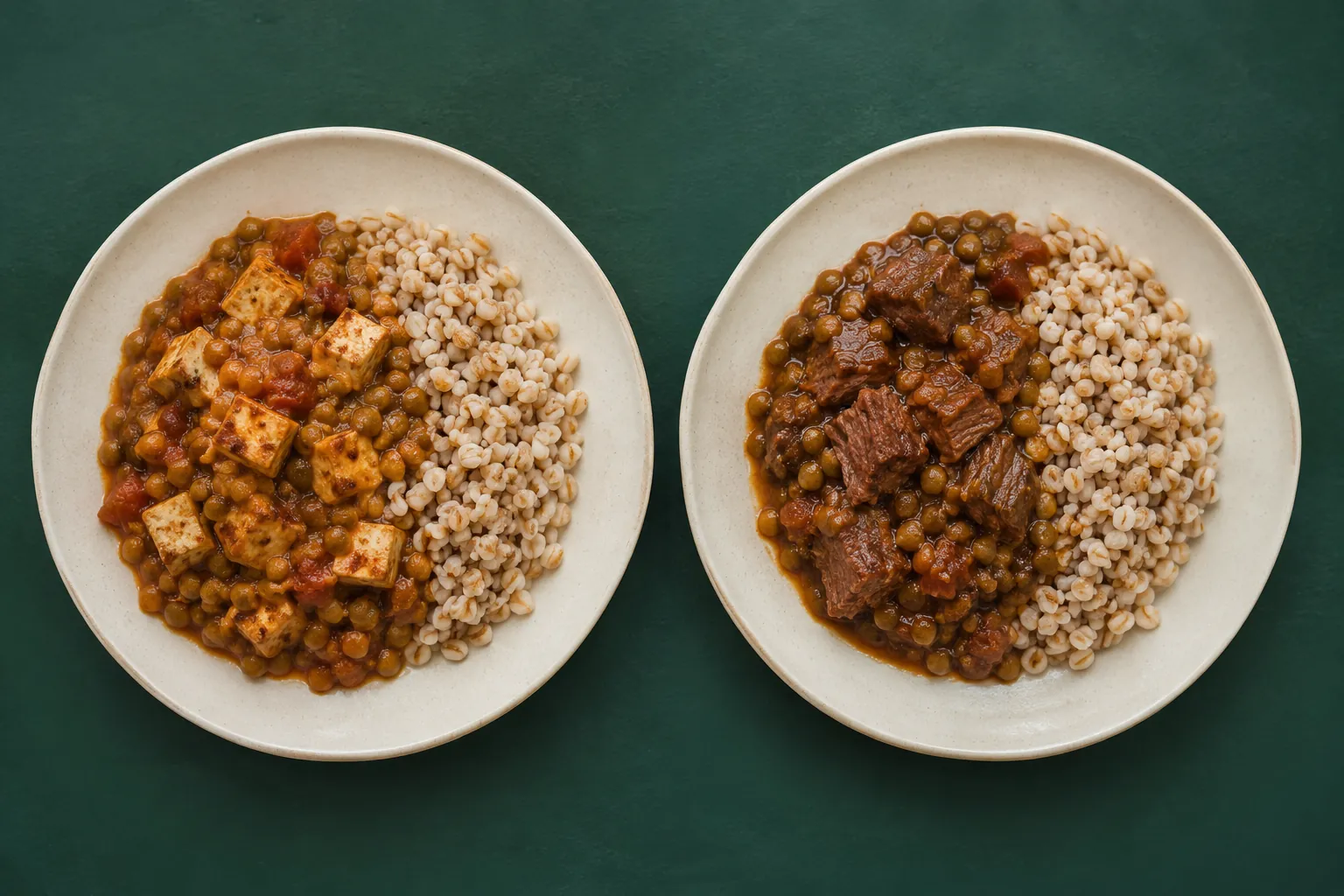
What did the study find about the vegan gut microbiome?#
Researchers compared 75 healthy Danish vegans with 75 healthy omnivores. The vegans had eaten that way for at least a year, 6.6 years on average. Participants were 31 on average and most were a normal weight. Vegans had lower diversity on several measures, but among the species more common in the group, a larger share ranked as favourable. It is a cross-sectional study, meaning a comparison at a single point in time (Thirion et al., Microbiome 2026).
The diets clearly differed. These were the group averages:
| Measure | Omnivores | Vegans |
|---|---|---|
| Fibre, grams per day | 29 | 49 |
| Protein, share of energy | 17% | 12% |
| Total cholesterol, mmol/L | 4.5 | 3.9 |
| LDL cholesterol, mmol/L | 2.6 | 2.1 |
| Plasma glucose, mmol/L | 5.2 | 5.0 |
| HbA1c, mmol/mol | 33 | 31 |
| hsCRP (inflammation marker), mg/L | 0.91 | 0.79 |
| Blood pressure, mmHg | 120/73 | 120/73 |
Waist size and body fat were the same. Energy intake did not differ meaningfully either.
Is the difference in gut diversity big or small?#
The difference is real but small. Three measures (Shannon, Simpson and gene count) were lower in vegans with p-values just under 0.05, while species count did not differ reliably (p = 0.16). The difference in composition was statistically firm, but diet explained only about 2 percent of the variation (Microbiome, 2026).
Of 632 species, 109 differed between the groups: 82 were more common in omnivores and 27 in vegans. Only 4 of 320 functional modules studied differed reliably. That does not prove the functions are the same, but different species may do the same job.
That is why diversity should not be read as a grade. High gut richness has been linked to better metabolism, for example in a Danish study of 292 people (Le Chatelier et al., Nature 2013). But that is an association, and here lower diversity went with better blood markers.
Which group had the most favourable gut bacteria?#
At species level, the vegans came out best. The researchers used a ranking based on how species relate to health markers in large populations. Among species that could be ranked, 81 percent (13 of 16) of those more common in vegans were favourable, against 42 percent (28 of 66) of those more common in omnivores (Microbiome, 2026).
Omnivores also had more antibiotic resistance genes and higher urine levels of TMAO and p-cresyl sulfate, substances formed when gut bacteria break down parts of food. Those substances had no firm links to participants' clinical values, however.
This fits a far larger analysis of 21,561 people in five cohorts, also observational. There, the vegan species pattern was linked to more favourable cardiometabolic markers, while species tied to red meat went the other way. Omnivores who ate more plant foods had a higher abundance of the favourable species (Fackelmann et al., Nature Microbiology 2025). Several authors have ties to the company ZOE, and the Danish study's ranking comes from the same source.
An older US comparison found the gut bacteria of vegans and omnivores surprisingly similar, despite large differences in blood compounds (Wu et al., Gut 2016). That too suggests diet type alone decides less than headlines imply.
Why might protein matter for the gut microbiome?#
Nobody knows for sure yet. Among vegans, a richer microbiome went with higher protein intake (rho 0.4) and more years as a vegan (rho 0.29), but not with fibre intake. In a model of 69 vegans, protein, years as a vegan and age stood out. The full model, which also included BMI and fibre among others, explained 34 percent of the variation in richness (Microbiome, 2026).
The University of Copenhagen says the vegans who ate most protein had diversity on a par with omnivores. Researcher Oluf Borbye Pedersen calls protein a possibly overlooked factor. He also stresses that the study is small and observational and that he cannot give dietary advice from it (University of Copenhagen, 2026).
The link could have other causes. People who eat more protein may differ in other ways, and the sample is small. Among omnivores there was no matching link between richness and protein.
What does this mean for what you eat?#
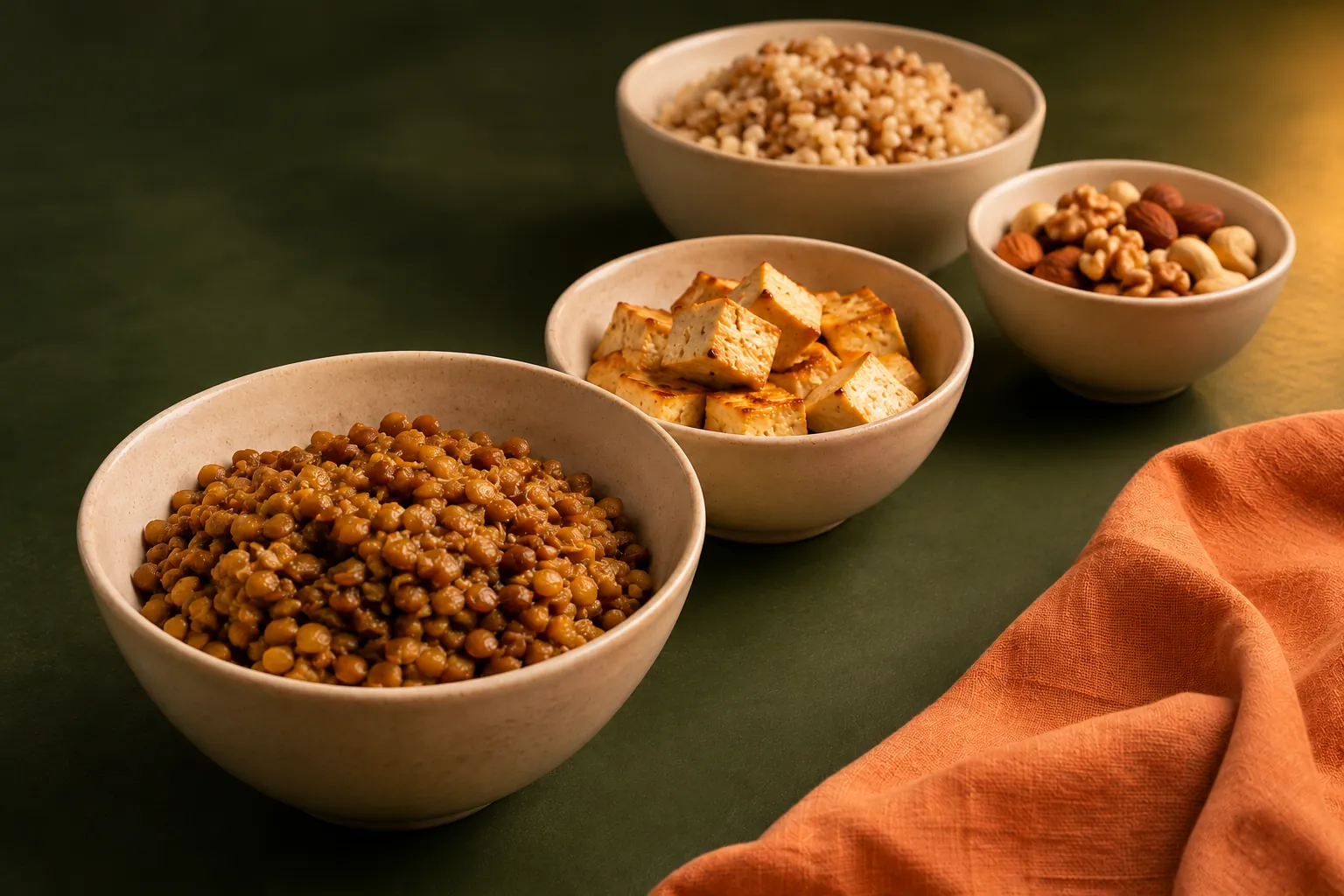
For omnivores, the study points towards fibre, not more meat. Omnivores with higher fibre intake had less of the unfavourable species, and the group averaged 29 grams of fibre a day. For vegans it points towards protein: vegans with higher protein intake had more of the favourable species. The authors read this as both groups being able to shift their profile the right way, but that is a hypothesis.
If you eat meat: aim for 25–35 grams of fibre a day, the range the Swedish Food Agency gives for adults. The guide how much fibre per day shows what that day looks like. The study is no reason to eat more red meat.
If you eat vegan: have pulses, tofu, whole grains and nuts every day. The Swedish Food Agency writes that protein is rarely a problem as long as you get enough energy, and that B12 and vitamin D call for fortified products or supplements (Swedish Food Agency). There is more on sources in plant-based protein sources and on amounts in how much protein do you need.
Want to know what to eat whatever your diet? See gut health foods.
Smaklig's perspective: a week with both fibre and protein#
The hard part is rarely understanding that you need more lentils. The hard part is having lentils at home on a Tuesday. That is why this gets decided in the week's plan, not in a single meal.
Smaklig plans your week's food around the offers where you shop, at ICA, Coop, Willys, Hemköp, Lidl, City Gross or Costco, and makes the shopping list. Say in the chat that you eat vegan or want more fibre and the menu adapts. If you shop at ICA or Coop, the list is matched against the store's range and the items go into your ICA or Coop cart without leaving the app.
Smaklig does not measure your gut bacteria and gives no medical advice. The app makes it easier to eat what you have already decided to eat.
Common misunderstandings about the study#
- "The study shows meat is healthier." No. It does not measure health outcomes over time, and the vegans had better blood markers.
- "Lower diversity means a sicker gut." Not here. The researchers describe the vegans' gut bacteria as health-promoting apart from diversity.
- "Protein raises diversity." Not proven. A link in 69 people at one point in time cannot show cause.
- "Fibre does not matter." Wrong conclusion. The link was missing in vegans, who already ate 49 grams. In omnivores, more fibre went with a lower abundance of unfavourable species.
- "The result applies to everyone." Participants were young, healthy, lean Danes. Children, pregnant women and people with illness were not included.
Checklist: how to read the next gut health headline#
- Check the study type: a comparison at one point in time cannot show cause and effect.
- Check how many people took part and who they were.
- Ask how big the difference is, not only whether it exists.
- Look at the outcomes: does it measure disease, blood markers or only bacteria?
- Read what the researchers themselves write, ideally in the original.
- Stick to the basics: varied food with enough fibre and protein.
- If you have gut symptoms, talk to a healthcare professional before changing your diet sharply.
Sources
- Microbiome (Thirion et al.) (2026). Vegans have distinct profiles of their gut microbiome and multi-compartment metabolome that align with markers of metabolic health
- University of Copenhagen (2026). Fund i veganeres tarme overrasker grøn grød-professor (press release, 30 October 2026, in Danish)
- Omni (2026). Studie: Kött ger människan mer mångfald i tarmfloran (in Swedish)
- Nature Microbiology (Fackelmann et al.) (2025). Gut microbiome signatures of vegan, vegetarian and omnivore diets and associated health outcomes across 21,561 individuals
- Gut (Wu et al.) (2016). Comparative metabolomics in vegans and omnivores reveal constraints on diet-dependent gut microbiota metabolite production
- Nature (Le Chatelier et al.) (2013). Richness of human gut microbiome correlates with metabolic markers
- Swedish Food Agency (2026). Vegansk mat (vegan food, in Swedish)
- Swedish Food Agency (2025). Kostråd för vuxna (dietary guidelines for adults, in Swedish)
- Swedish Food Agency (2026). Fibrer (fibre, in Swedish)
Frequently asked questions
Is meat better than a vegan diet for the gut microbiome?
The Danish study cannot answer that. It compared 75 vegans with 75 omnivores at a single point in time, so it cannot show cause and effect. Vegans had slightly lower bacterial diversity, but also a species profile rated as more favourable and better blood markers.
Do vegans have worse gut health?
Not clearly. Diversity was lower on average on several measures, but the difference in the number of species was not statistically firm. The researchers describe the vegans' gut bacteria as health-promoting apart from the lower diversity.
Why did vegans have lower gut diversity?
Nobody knows yet. Among the vegans, higher richness went with higher protein intake and more years as a vegan, but not with fibre intake. The researchers see protein as a possible explanation and say the link needs testing in other studies.
Should I eat more meat for my gut?
The study gives no support for that, and the researcher behind it offers no dietary advice based on the result. The Swedish Food Agency advises at most 350 grams of cooked red meat a week, with only a small part of that as processed meat. More fibre and enough protein are what you can act on whatever you eat.
How much protein does a vegan need?
The Swedish Food Agency writes that vegans rarely struggle to get enough, as long as they eat enough energy and a varied diet. Pulses, tofu, nuts and whole grains are good sources. In the Danish study, 12 percent of the vegans' energy came from protein, against 17 percent for omnivores.
Want more meal planning tips?
More guides on food, health and saving money — and a sous-chef that plans your week for you.
Get started
Founder, Smaklig
Writer at Smaklig. We write about food, health, and how to eat better without breaking the bank.
Related articles
October 31, 2026 · 8 min
Gut Health Foods: How to Improve Gut Health, by the Evidence
How do you improve gut health? Fibre, pulses, more plant types and fermented foods, with the studies showing what holds up and what is still uncertain.
Read moreOctober 29, 2026 · 12 min
Menopause Diet: Foods for Weight, Sleep and Hot Flushes
Menopause diet: what the evidence says about weight gain, protein, sleep and hot flushes, what doesn't help, and what 1177, the NHS and Livsmedelsverket advise.
Read moreOctober 29, 2026 · 12 min
What Is Ultra-Processed Food? Why 23% and 45% Are Both Right
What is ultra-processed food? A new Swedish study puts it at 45% of adult energy, or 23% under a narrower classification. What counts and what to check.
Read moreReady to plan smarter?
Smaklig creates your weekly menu with AI based on store campaigns. Tailored to your goals and allergies.
Get started free