How Much Fibre Per Day? What 30g Looks Like in Real Meals
How much fibre per day? Sweden's food agency says 25–35g for adults, yet the average is about 20g. See what 30g looks like in meals, easy swaps and mistakes.
Download Smaklig – now on the App Store and Google Play The Smaklig app is now on the App Store (iPhone) and Google Play (Android). Download it free.
Download SmakligShort answer: Adults are advised to eat about 25–35g of fibre per day, roughly 3g per megajoule of energy, according to the Swedish Food Agency. Adults in Sweden eat about 20g on average. You can reach the recommended amount with ordinary food: wholegrains, beans and lentils, vegetables, fruit and berries.
- 25–35g of fibre a day for adults, about 3g/MJ (Livsmedelsverket, page reviewed 2026-09-15)
- About 20g a day on average among adults, about 2.5g/MJ (Riksmaten adults 2010–11)
- 9.6g of fibre in 100g of cooked green lentils (Livsmedelsverket food database)
- More than ten times as much fibre in an orange as in a glass of juice (1177, 2024)
- About 32g in our worked day with porridge, lentils, potatoes and fruit
In practice: plan your weekly menu around the offers where you shop, so lentils and oats end up on your shopping list, and if you shop at ICA or Coop they go into the basket in the app.
How much fibre per day you need is one of the easiest diet questions to answer, and yet most people fall short. The Swedish Food Agency (Livsmedelsverket) recommends 25–35g for adults, while the average in Sweden is about 20g. This article shows how much fibre you need, why intake often ends up low and what a normal day with 30g actually looks like. All gram values for foods come from Livsmedelsverket's food composition database, so you can do the maths yourself with what you buy in Swedish shops.
What is fibremaxxing, and what do the guidelines actually say?#
Fibremaxxing is a name that has spread on social media for deliberately eating more fibre. There is no new diet behind it. In practice the goal is the same as the ordinary recommendation: about 25–35g a day for adults (Livsmedelsverket, 2026).
So the trend has a point, because many people eat too little. But more is not always better. The Swedish Food Agency notes that some people get diarrhoea and gas from too much fibre. Aim for the recommendation, not for a record.
What fibre does in the gut, and what the research actually shows, is covered in gut health foods.
How much fibre per day do you need?#
The Swedish Food Agency says a suitable amount for adults is about 25–35g of fibre per day. That corresponds to roughly 3g per megajoule (MJ) of energy (Livsmedelsverket, 2026).
Because the target is set per unit of energy, people who need less energy land lower in the range and people who need more land higher. A worked example: at 8 MJ a day, about 1,900 kcal, 3g/MJ comes to roughly 24g. At 11 MJ, about 2,600 kcal, it comes to roughly 33g. If you do not know your energy needs, you can work them out with our guide to TDEE and macros.
What is dietary fibre?#
- Dietary fibre
- The carbohydrates from plants that are not broken down during digestion (Livsmedelsverket). Found in vegetables, fruit, root vegetables, beans, lentils and wholegrain products.
Fibre is only found in plant foods. Meat, fish, eggs and dairy do not contribute.
How much fibre do children need?#
The Swedish Food Agency gives no fixed gram figure for children. Young children need to find a suitable amount by trying. School-age children should increase their fibre intake with age and reach the same amount as adults in their teens (Livsmedelsverket, 2026).
Why do most people fall short on fibre?#
Adults in Sweden get about 20g of fibre a day on average, or about 2.5g/MJ. The figure comes from the Swedish Food Agency's dietary survey Riksmaten adults 2010–11, and the agency notes that many people need to eat more fibre (Livsmedelsverket, 2026). It is the survey the agency itself refers to today.
The gap comes from everyday choices. 1177, the Swedish public health information service, names white bread and cornflakes as examples of low-fibre foods, and points out that much of the fibre is lost when fruit is pressed into juice (1177, 2024).
Why does fibre matter for health?#
A large review in The Lancet in 2019 pooled 185 prospective studies and 58 clinical trials. In the prospective studies, higher fibre intake was associated with a lower risk of conditions including cardiovascular disease, type 2 diabetes and colorectal cancer. The largest risk reductions were seen at intakes of 25–29g a day (Reynolds et al., 2019, The Lancet).
Cohort studies show associations, not cause and effect. Even so, the authors rated the evidence for fibre as moderate certainty.
What does 30g of fibre look like in a day?#
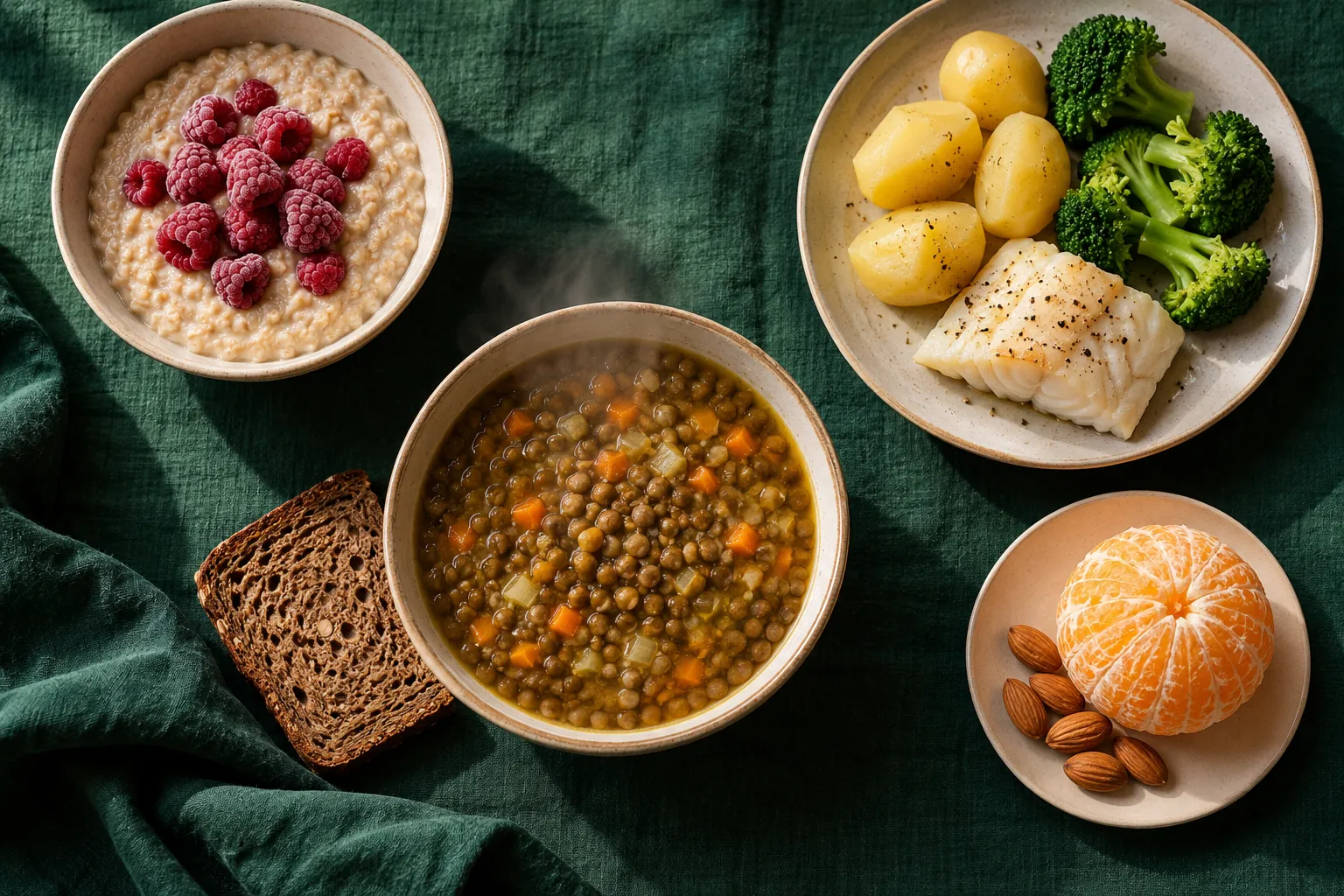
A day with oat porridge and berries for breakfast, lentils for lunch, potatoes and broccoli for dinner and an orange as a snack comes to about 32g. No single meal has to be extreme. It is enough for every meal to include something high in fibre.
The table is a worked example. The values per 100g come from Livsmedelsverket's food composition database, and the amounts are our assumptions of a normal portion. For the breads we use the database's analysed fibre value, which differs from the percentage in the food name (rye bread "fibre approx. 7%" has 6.5g per 100g and white bread "fibre 3.5%" has 4.3g).
| Meal | Food | Amount | Fibre per 100g | Fibre |
|---|---|---|---|---|
| Breakfast | Wholegrain rolled oats (for porridge) | 50g | 7.5g | 3.8g |
| Breakfast | Raspberries, frozen | 100g | 4.5g | 4.5g |
| Breakfast | Wholegrain rye bread, one slice | 40g | 6.5g | 2.6g |
| Lunch | Green lentils, cooked (in soup or stew) | 125g | 9.6g | 12.0g |
| Dinner | Potatoes, boiled | 200g | 2.1g | 4.2g |
| Dinner | Broccoli | 100g | 2.6g | 2.6g |
| Snack | Orange | 150g | 1.2g | 1.8g |
| Total | approx. 31.5g |
The lentils provide more than a third of the day. That is why beans and lentils are the fastest route to more grams. For more breakfast ideas that are filling and add fibre, see our article on high-protein breakfasts.
Which high fibre foods give you the most?#
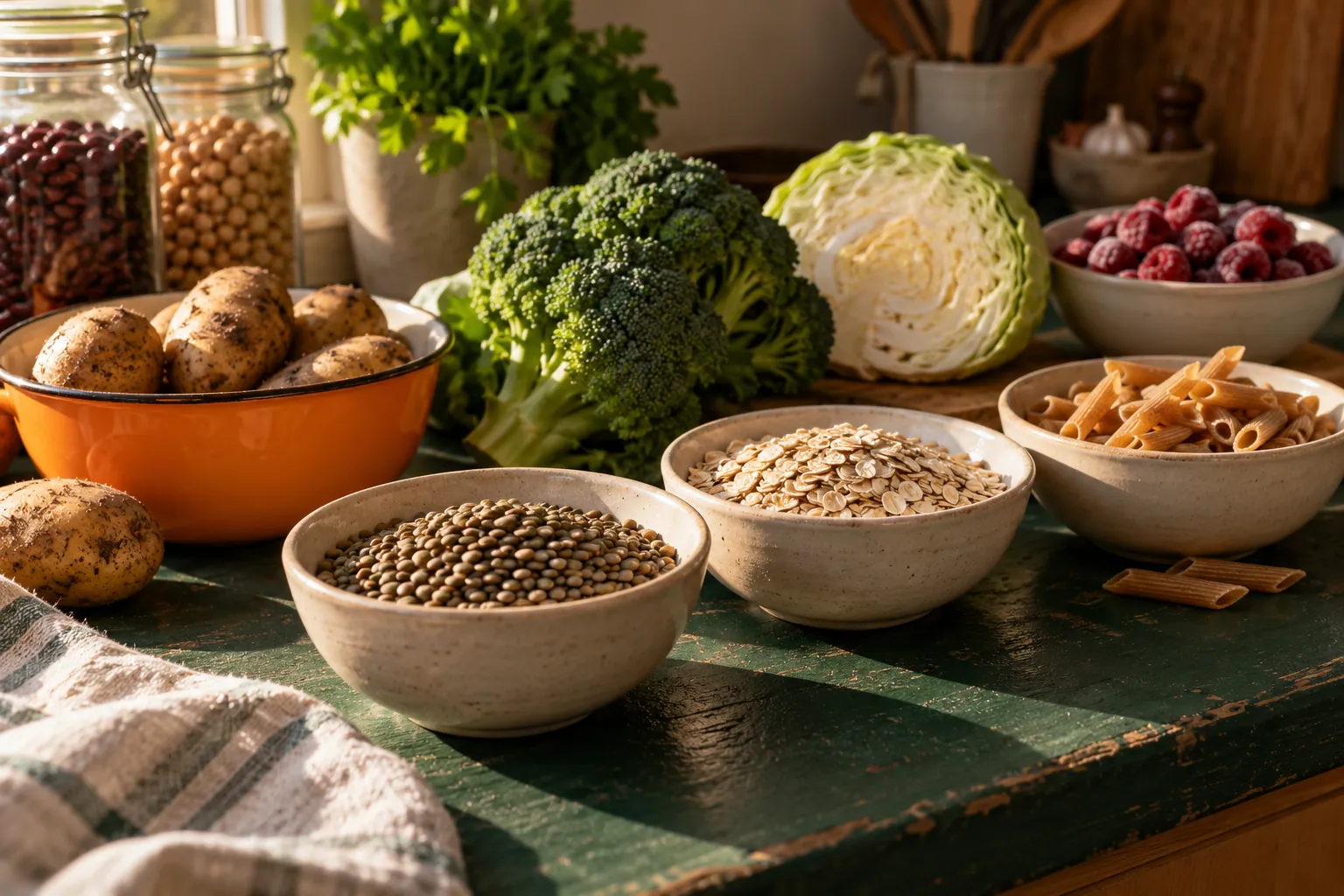
Beans, lentils and wholegrain products give the most fibre per portion. The Swedish Food Agency lists vegetables, fruit, root vegetables, beans and lentils, plus wholegrain bread, cereals, grains, pasta and rice as high-fibre foods (Livsmedelsverket, 2026).
This is how some everyday staples look in the food composition database:
- Green lentils, cooked: 9.6g per 100g
- Wholegrain rolled oats: 7.5g per 100g (uncooked)
- Raspberries, frozen: 4.5g per 100g
- Wholegrain pasta (at least 50% wholegrain), cooked: 3.7g per 100g
- Broccoli: 2.6g per 100g
- Potatoes, boiled: 2.1g per 100g
1177 gives a worked example for beans: 80g of kidney beans and chickpeas provide about five grams of fibre (1177, 2024). White cabbage is another source, covered in our article on fibre in cabbage. How to eat beans and lentils on a budget is covered in the guide to plant-based protein sources on a budget.
Which easy swaps add the most fibre?#
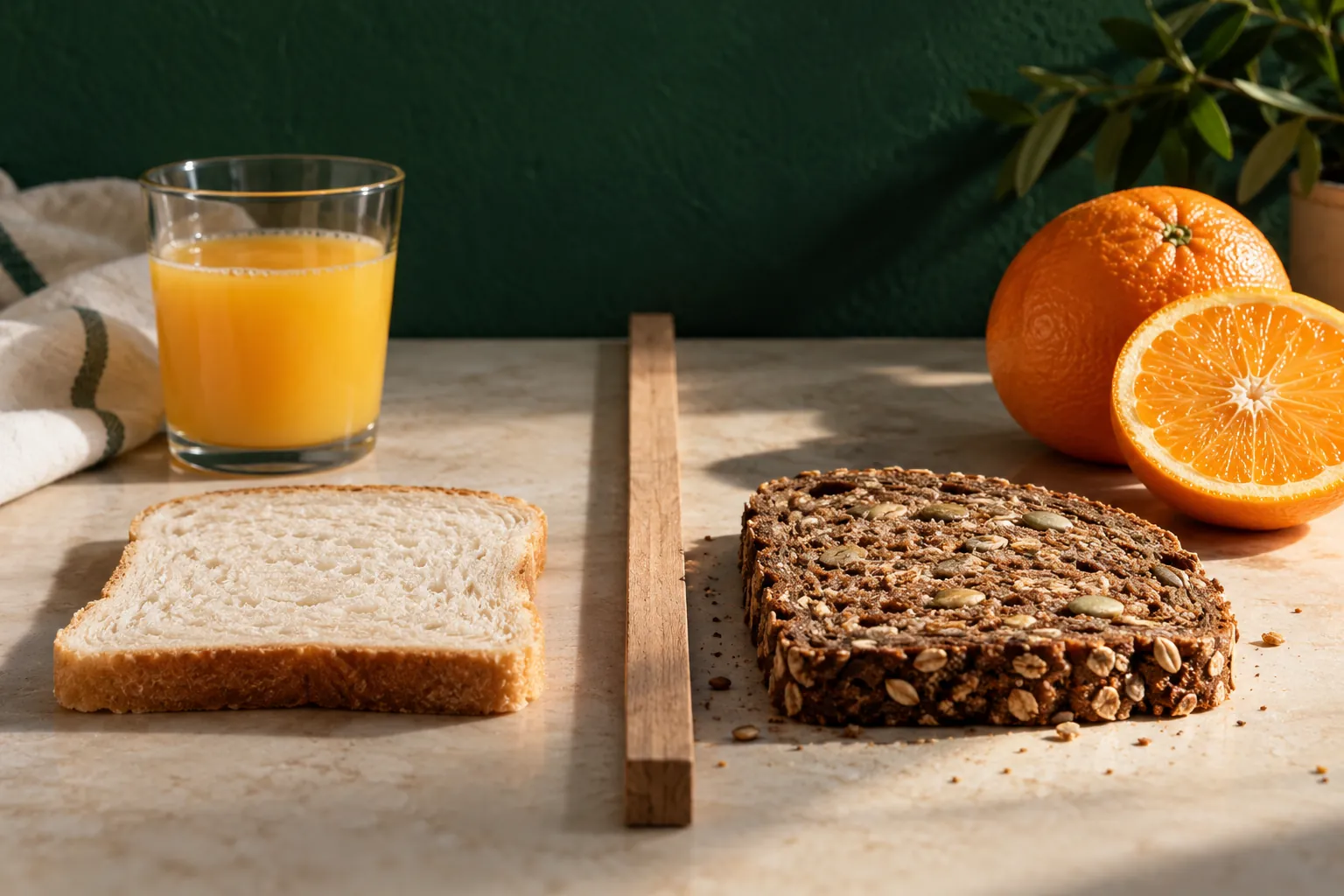
The biggest gains come from swapping something you already eat, not from adding something new. Wholegrain instead of white and whole fruit instead of juice are two swaps that need no new habits.
| Before | After | Extra fibre | Source |
|---|---|---|---|
| 200g cooked pasta | 200g cooked wholegrain pasta | +3.4g (4.0 → 7.4g) | Food composition database |
| One slice of white bread, 40g (4.3g per 100g) | One slice of wholegrain rye bread, 40g (6.5g per 100g) | approx. +0.9g (1.7 → 2.6g) | Food composition database |
| A glass of orange juice | A whole orange | the orange has more than ten times as much | 1177, 2024 |
| Plain yoghurt | 100g frozen raspberries in the yoghurt | +4.5g | Food composition database |
| No beans or lentils in the mince sauce | 100g cooked green lentils in the sauce | +9.6g | Food composition database |
So 100g of lentils in the sauce adds more than ten times as much fibre as swapping one slice of white bread for rye bread.
If you use imported frozen raspberries in yoghurt or on porridge without heating them, boil the berries for one minute and let them cool first. Livsmedelsverket keeps this advice for consumers to reduce the risk of norovirus (Livsmedelsverket, 2021).
Plan lentils and oats into your weekly menu in weeks they are on offer, and they land on your shopping list.
How can Smaklig help you eat more fibre?#
Smaklig plans your week's food around the offers where you shop, in all seven major Swedish chains: ICA, Coop, Willys, Hemköp, Lidl, City Gross and Costco. Staples such as lentils, oats and frozen berries are easy to plan around. The app then builds your shopping list, and if you shop at ICA or Coop the items go straight into your basket in the app.
For example, type "make a weekly menu with lots of beans, lentils and wholegrains" in the chat. You get back a weekly menu built on this week's offers where you shop, a shopping list and, if you shop at ICA or Coop, the items in your basket without leaving the app. It's free during the beta.
When you are in the shop comparing bread, cereals or pasta, you can scan the barcode. Smaklig then shows the product's nutrition values, including fibre. That makes it easy to pick the higher-fibre option without reading every Swedish label in detail. Smaklig's chat knows your household, your shop, your allergies and what is in your pantry, and your recipes and weekly menu are built from that. Smaklig is free during the beta and available on the App Store, Google Play and the web.
What mistakes cause bloating and gas?#
The most common mistake is increasing too much at once. The Swedish Food Agency notes that some people get diarrhoea and gas from too much fibre, and that people with constipation need both fibre and enough water (Livsmedelsverket, 2026).
- Going from 15 to 35g overnight. Add one high-fibre food at a time and give your stomach time to adjust.
- Forgetting water. Drink enough, especially when you eat more wholegrains, beans and lentils.
- Relying on a single source. Mix vegetables, fruit, wholegrains and beans, and your meals get both richer and tastier.
- Drinking fruit instead of eating it. Juice has lost much of its fibre (1177).
- Ignoring the signals. If you have persistent stomach problems or a digestive disease, talk to a healthcare professional or 1177 before making big changes to your diet.
Your 30g checklist: eat more fibre starting today#
These steps give the most grams for the least effort.
- Have oat porridge or wholegrain cereal for breakfast, ideally with berries.
- Choose bread with wholegrain and a high fibre content. Scan the barcode if you are unsure.
- Eat beans or lentils a few times a week: lentil soup, beans in a stew or hummus on toast. In Smaklig you add them to your weekly menu, and they go on your shopping list.
- Swap half the mince for lentils in bolognese and tacos.
- Have vegetables, fruit or berries with every meal. Frozen berries and vegetables count.
- Eat fruit whole rather than as juice.
- Choose high-fibre snacks, for example from our list of healthy snacks.
- Increase at your own pace and drink water with your meals.
Fibre and protein also work well together in the same meal. Read more about how much protein you need per day.
Sources
- Livsmedelsverket (Swedish Food Agency) (2026). Fibrer (Dietary fibre). Livsmedelsverket, page reviewed 2026-09-15.
- Livsmedelsverket. Livsmedelsdatabasen — Swedish food composition database. Livsmedelsverket food composition database.
- 1177 (2024). Kloka val: livsmedel och näringsinnehåll (Smart choices: foods and nutrients). 1177, last updated 2024-09-17.
- Reynolds A, Mann J, Cummings J, Winter N, Mete E, Te Morenga L (2019). Carbohydrate quality and human health: a series of systematic reviews and meta-analyses. The Lancet 393(10170):434–445.
- Livsmedelsverket (2021). Livsmedelsburna virus i hallon och andra bär – riskhantering. Livsmedelsverkets rapportserie L 2021 nr 12.
Frequently asked questions
How much fibre should you eat per day?
The Swedish Food Agency (Livsmedelsverket) says a suitable amount for adults is about 25–35g of fibre per day, which corresponds to roughly 3g per megajoule (MJ) of energy.
How much fibre do women and men need per day?
The recommendation is the same for all adults: 25–35g a day, about 3g per MJ. If you need less energy you land lower in the range. At 8 MJ (about 1,900 kcal) a day that is roughly 24g; at 11 MJ (about 2,600 kcal) roughly 33g.
How much fibre do children need?
The Swedish Food Agency gives no gram figure for children. Young children need to find a suitable amount by trying, and school-age children should eat more fibre as they get older, reaching adult levels in their teens.
What is dietary fibre?
According to the Swedish Food Agency, fibre is the carbohydrates from plants that are not broken down during digestion. You find it in vegetables, fruit, root vegetables, beans, lentils and wholegrain products.
Is fibremaxxing good for you, or can you eat too much fibre?
Eating more fibre is a good goal for most people who fall short, but the Swedish Food Agency gives no upper limit and notes that some people get diarrhoea and gas from too much fibre. Increase at your own pace and drink enough water. If you have stomach problems, contact 1177.
Want more meal planning tips?
More guides on food, health and saving money — and a sous-chef that plans your week for you.
Get started
Co-founder & Growth, Smaklig
Writer at Smaklig. We write about food, health, and how to eat better without breaking the bank.
Related articles
October 31, 2026 · 8 min
Gut Health Foods: How to Improve Gut Health, by the Evidence
How do you improve gut health? Fibre, pulses, more plant types and fermented foods, with the studies showing what holds up and what is still uncertain.
Read moreOctober 31, 2026 · 8 min
Vegan Gut Microbiome: Is Meat Better? What the Study Shows
A Danish study led to claims that meat beats plants for gut bacteria. Vegans had slightly lower diversity but better blood markers. How to read the numbers.
Read moreOctober 30, 2026 · 9 min
Budget meal plan: turn this week's offers into dinners
A budget meal plan built on this week's supermarket offers: start with what you have, stretch each deal over several dinners and check unit price and terms.
Read moreReady to plan smarter?
Smaklig creates your weekly menu with AI based on store campaigns. Tailored to your goals and allergies.
Get started free