Stopping Mounjaro Without Regaining It All: What Helps
Stopping Mounjaro or Wegovy without regaining it all? What the trials show about weight regain, and how protein, strength training and planning help after.
Download Smaklig – now on the App Store and Google Play The Smaklig app is now on the App Store (iPhone) and Google Play (Android). Download it free.
Download SmakligShort answer: Most people regain a large share of the weight after stopping Ozempic, Wegovy (semaglutide) or Mounjaro (tirzepatide). The trials suggest that physical training can slow the regain. Protein-rich meals, filling food and a planned week make everyday life easier when your hunger returns. When and how you stop is something you decide with your prescriber. In everyday life the plan becomes a weekly menu around the offers where you shop, a shopping list and, if you shop at ICA or Coop, the items in the basket in the app.
- Roughly two thirds of the weight lost came back one year after stopping semaglutide (STEP 1 extension, semaglutide arm: 228 of 327 adults without diabetes, 2022)
- +14.0 percent body weight over 52 weeks for those who switched from tirzepatide to placebo (SURMOUNT-4, 670 adults, 2024)
- About 0.4 kg a month average regain after stopping weight management medicines (BMJ, 37 studies, 9,341 participants, 2026)
- 60 percent of the weight loss back after one year, modelled across six randomised trials of GLP-1 medicines (eClinicalMedicine, 3,236 participants, 2026)
- 5.1 kg more weight loss for those who combined liraglutide with exercise versus liraglutide alone, measured one year after treatment ended, although the difference did not survive the trial's correction for multiple comparisons (Jensen et al., 109 adults, 2024)
Stopping Ozempic, Wegovy or Mounjaro raises the same worry for most people: will it all come back? This article is for you if you have stopped, are about to stop or are thinking about it. The decision about when and how is made with your prescriber, and this article takes no position on it. It is about what you control afterwards: your food, your training and your week. The figures come from the major trials, with population and year, so you can see what they actually measured.
Do you gain weight when you stop Ozempic?#
Yes, usually a substantial share. The STEP 1 extension followed 327 adults without diabetes for a year after treatment ended: 228 who had received semaglutide 2.4 mg (the same substance as in Ozempic and Wegovy) and 99 who had received placebo. The semaglutide arm had lost 17.3 percent and regained 11.6 percentage points, leaving them 5.6 percent below their starting weight (Wilding et al., 2022, Diabetes Obes Metab). Roughly two thirds of the loss came back in that group.
The STEP trials studied semaglutide 2.4 mg, the Wegovy dose, in people without diabetes. Ozempic contains the same substance but is a type 2 diabetes medicine, so these results are not data on stopping Ozempic when you have diabetes.
The same pattern applies to tirzepatide, the substance in Mounjaro. In SURMOUNT-4, 670 adults first lost 20.9 percent over 36 weeks. They were then randomised to continue or switch to placebo. Those who switched regained 14.0 percent over 52 weeks, while those who continued lost a further 5.5 percent (Aronne et al., 2024, JAMA). Individual variation is large, and some people keep more of the loss than the average.
Why does the weight come back after GLP-1?#
Because the medicines work for as long as you take them. GLP-1 medicines dampen appetite and prolong fullness. When the effect wears off, hunger and cravings return. On top of that, the weight loss itself sets off compensatory changes in the body that work against keeping the loss off (Wilding et al., 2022, Diabetes Obes Metab). That is expected physiology, not a failure.
The regain also comes fairly quickly. A BMJ meta-analysis of 37 studies with 9,341 participants found an average regain of 0.4 kg a month after stopping weight management medicines. That was 0.3 kg a month faster than after weight programmes without medication, regardless of how much weight had been lost. Cardiometabolic markers, measures of heart and metabolic health, were projected to return to baseline 1.4 years after stopping (West et al., 2026, BMJ). How the body adapts after weight loss is covered in our guide to stabilisation after weight loss.
What should you eat after Ozempic or Mounjaro?#
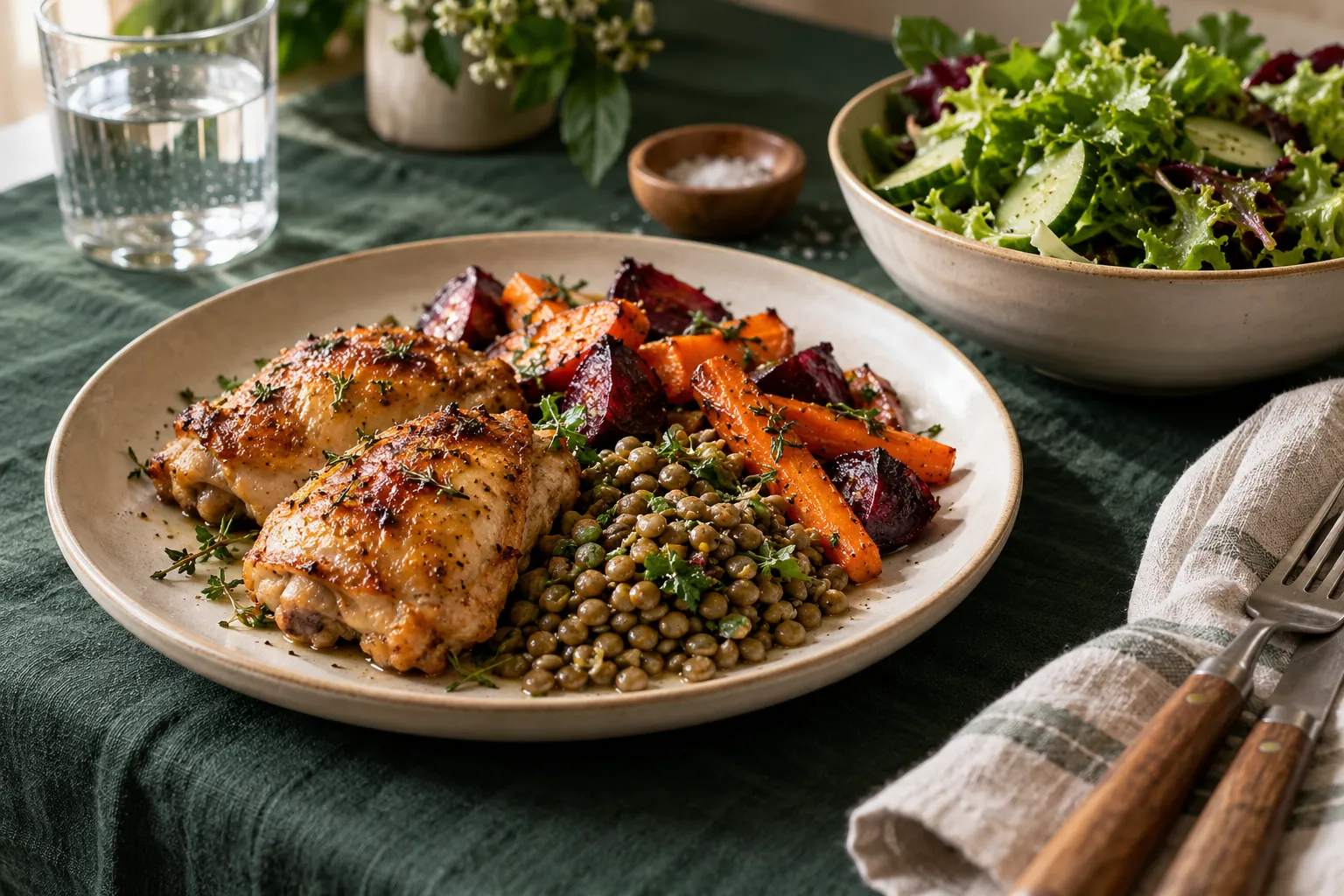
Build every meal around a protein source and plenty of vegetables, pulses or whole grains. That gives fullness per calorie, which is what the medicine used to provide. Eat regularly, so hunger does not build up before your next meal.
During treatment appetite was low, and many people ate small portions with little protein. As your appetite returns, it is easy to slip back to pre-treatment portions. Three things make a difference day to day:
- Protein at every meal. How much you need depends on your weight and activity. Work out how much protein you need instead of guessing.
- Volume with low energy density. Vegetables, soups, pulses and fruit fill the plate without much energy. Plan pulses and frozen vegetables into your week when they are on offer where you shop, so they end up on your shopping list.
- A goal to maintain, not to lose. Work out your maintenance calories and start from there.
No single food group replaces the effect of the medicine. Food makes it easier to hold your weight, but it does not do what the medicine does. If you ate in a particular way during treatment, see our tips on food while you are on Mounjaro.
Does strength training help you keep the weight off after the medicine?#

The research suggests exercise can help, but none of these trials tested strength training on its own. In a Danish randomised trial, adults with obesity first lost 13.1 kg on an eight-week low-calorie diet. For one year they then received supervised exercise, liraglutide 3.0 mg, both, or placebo. The exercise was mixed: indoor cycling followed by circuit training in groups twice a week, plus individual exercise twice a week. One year after treatment ended, 109 participants were assessed (Jensen et al., 2024, eClinicalMedicine).
Those who had combined liraglutide and exercise during the treatment year then had 4.2 times higher odds than those on liraglutide alone of keeping a weight loss of at least 10 percent of their initial body weight, meaning their weight before the low-calorie diet. They had also lost 5.1 kg more than the liraglutide-only group, counted from the start of the treatment year, but that difference did not survive the trial's pre-specified correction for multiple comparisons. In the year after stopping, the liraglutide-only group regained 6.0 kg more than the exercise-only group. The trial used liraglutide, not semaglutide or tirzepatide, and the exercise took place during treatment, not only after it ended.
Many people also want to keep their muscle mass after major weight loss. In the Danish trial, lean mass rose by a similar amount in all groups, so the trial does not show that exercise protected muscle (Jensen et al., 2024, eClinicalMedicine). Our suggestion is still to include strength in your training and to start where you are. Our guide to periodisation in strength training helps you build it up over time.
How do you plan the week when your hunger comes back?#
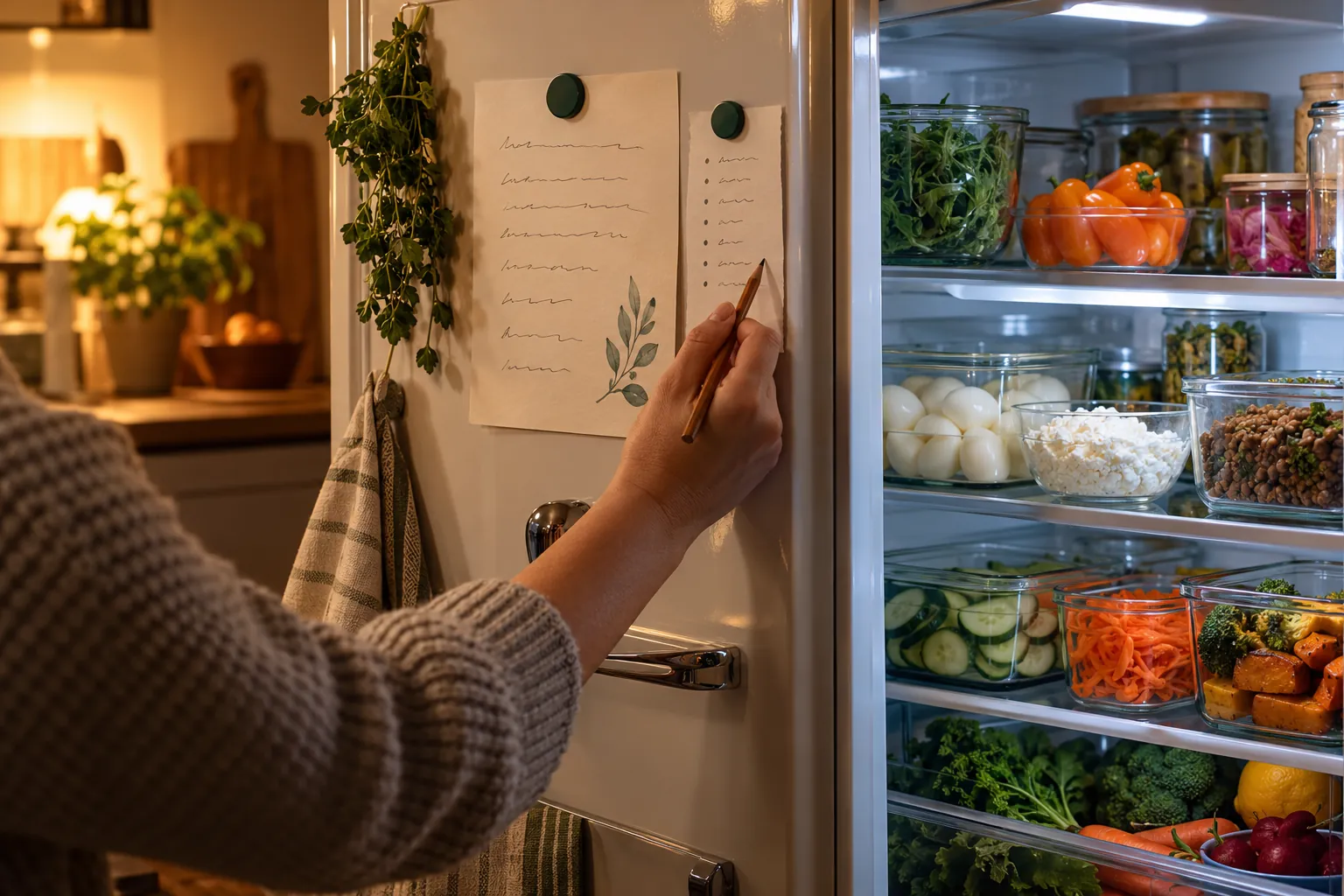
Decide the week's dinners in advance, shop from a list and keep protein-rich quick options at home for the evenings when cravings hit. That cuts the number of decisions you have to make while hungry. In Smaklig the week's dinners become a shopping list, and if you shop at ICA or Coop you add the items to your basket without leaving the app.
Switch your goal from weight loss to maintaining your weight, and let your weekly menu follow it. A ready-made maintenance weekly menu is a good starting point. Our suggestion is to weigh yourself regularly, for example once a week, so that you and your care team spot a rise early and can talk about it while it is still small.
How do the trials differ?#
The studies measure different things: randomised withdrawal (STEP 4, SURMOUNT-4), follow-up after a planned stop (STEP 1 extension) and pooled analyses of many studies (BMJ, eClinicalMedicine). They all point the same way, but populations and time frames differ, so read each figure on its own terms. The STEP trials studied semaglutide 2.4 mg in people without diabetes, so they do not tell you what happens when you stop Ozempic with type 2 diabetes.
| Study | Year | Population and design | Result | Source |
|---|---|---|---|---|
| STEP 1 extension | 2022 | 327 adults without diabetes (228 semaglutide, 99 placebo), followed 52 weeks after 68 weeks of semaglutide 2.4 mg or placebo | Semaglutide arm: −17.3% on treatment, 11.6 percentage points back after one year | Wilding et al., Diabetes Obes Metab |
| STEP 4 | 2021 | 803 adults without diabetes, randomised after 20 weeks of semaglutide (−10.6%) | Placebo +6.9%, continued semaglutide −7.9% (weeks 20–68) | Rubino et al., JAMA |
| SURMOUNT-4 | 2024 | 670 adults, randomised after 36 weeks of tirzepatide (−20.9%) | Placebo +14.0%, continued tirzepatide −5.5% (weeks 36–88) | Aronne et al., JAMA |
| BMJ meta-analysis | 2026 | 37 studies, 9,341 participants, various weight management medicines | About 0.4 kg regain per month after stopping | West et al., BMJ |
| eClinicalMedicine meta-regression | 2026 | 6 randomised trials, 3,236 participants, GLP-1 medicines | 60% of the loss back after one year, modelled plateau 75.3% | Budini et al., eClinicalMedicine |
| Danish exercise trial | 2024 | 109 adults followed one year after liraglutide, exercise, both or placebo | Combination: 4.2 times higher odds than liraglutide alone of keeping at least 10% loss from initial weight; 5.1 kg more loss, not confirmed after correction | Jensen et al., eClinicalMedicine |
In SURMOUNT-4, 89.5 percent of those who stayed on tirzepatide kept at least 80 percent of their weight loss at week 88, compared with 16.6 percent of those who switched to placebo (Aronne et al., 2024, JAMA). In STEP 4 the two groups ended 14.8 percentage points apart (Rubino et al., 2021, JAMA). The eClinicalMedicine model is based on six randomised trials and extends the curve beyond 52 weeks. The 75.3 percent plateau is therefore a calculation, not a measurement (Budini et al., 2026, eClinicalMedicine).
How does Smaklig help after treatment?#
Smaklig makes it easy to switch from losing weight to holding it. You change your goal to maintain in your profile, and recipes and weekly menus adapt to it, to your household and to the store where you shop.
Type, for example, “make a weekly menu for maintaining my weight, with protein at every dinner” in the chat. You get back a weekly menu around this week's offers where you shop, at any of the seven major Swedish chains, and the app builds the shopping list from it. If you shop at ICA or Coop you add the items to your basket without leaving the app.
You set your own nutrition targets for calories and protein and see in the food log how your day looks. With Smakblick you photograph your food instead of typing it in, and barcode scanning shows nutrition per product, including fibre. Smaklig is free during the beta and available on the App Store, Google Play and the web.
What mistakes make the weight come back faster?#
The most common mistake is going back to the same portions as before treatment without a plan. Hunger returns gradually, and it is easy not to notice the portions growing.
- Skipping protein because your appetite is still low in the first weeks.
- Stopping training just as the medicine stops working.
- Waiting to weigh yourself until the rise is already large.
- Treating the regain as a failure. It is expected physiology, and a plan slows it better than guilt.
- Changing or stopping treatment on your own. That decision is made with your prescriber.
Checklist: the first weeks after treatment ends#
These are our suggested steps, whether you stopped Ozempic, Wegovy or Mounjaro.
- Agree a follow-up plan with your prescriber, especially if you have diabetes.
- Switch your goal from weight loss to maintaining your weight.
- Work out your protein needs and add a protein source to every meal.
- Let vegetables and root vegetables fill a large part of your plate, as in the Swedish Food Agency's plate model, and choose whole grains when you eat bread, pasta and grains.
- Plan the week's dinners and shop from a list.
- Train regularly, ideally including strength, and start where you are.
- Weigh yourself, for example once a week, and talk to your care team if the rise picks up.
If you want to compare with how others lose weight without medication, see our guide on how to lose weight without Ozempic.
Sources
- Diabetes, Obesity and Metabolism (2022). Wilding et al. Weight regain and cardiometabolic effects after withdrawal of semaglutide: The STEP 1 trial extension
- JAMA (2021). Rubino et al. Effect of continued weekly subcutaneous semaglutide vs placebo on weight loss maintenance (STEP 4)
- JAMA (2024). Aronne et al. Continued treatment with tirzepatide for maintenance of weight reduction in adults with obesity: the SURMOUNT-4 randomized clinical trial
- BMJ (2026). West et al. Weight regain after cessation of medication for weight management: systematic review and meta-analysis
- eClinicalMedicine (2026). Budini et al. Trajectory of weight regain after cessation of GLP-1 receptor agonists: a systematic review and nonlinear meta-regression
- eClinicalMedicine (2024). Jensen et al. Healthy weight loss maintenance with exercise, GLP-1 receptor agonist, or both combined followed by one year without treatment
- Livsmedelsverket (2026). Livsmedelsverket (Swedish Food Agency) — The plate model
Frequently asked questions
Do you gain weight when you stop Ozempic?
Most people regain a large share. In the STEP 1 extension (Wilding et al., 2022), the 228 adults without diabetes who had received semaglutide 2.4 mg had lost 17.3 percent and regained 11.6 percentage points one year after stopping, roughly two thirds. Ozempic is the same substance but a diabetes medicine, so these are not diabetes data.
Can you stop Ozempic whenever you want?
How and when you stop is a decision for you and your prescriber. Ozempic is a type 2 diabetes medicine, so if you have diabetes your care team also needs to plan how your blood sugar will be treated. This article does not give tapering advice.
Can you stop Mounjaro once you reach your goal weight?
That is for you and your care team to decide. In SURMOUNT-4, those who switched from tirzepatide to placebo regained 14.0 percent over 52 weeks, so you need a plan for food, training and follow-up if you stop.
What should you eat after Ozempic?
Regular meals built around a protein source with plenty of vegetables, pulses and whole grains. That gives fullness per calorie as your appetite returns. No single food group replaces the effect of the medicine.
Does exercise help after stopping Wegovy?
The research suggests exercise can help. In a Danish trial (Jensen et al., 2024), those who combined liraglutide with supervised exercise during the treatment year had 4.2 times higher odds than those on liraglutide alone of keeping a weight loss of at least 10 percent of their initial body weight one year after treatment ended. The trial used liraglutide, not semaglutide or tirzepatide.
Want more meal planning tips?
More guides on food, health and saving money — and a sous-chef that plans your week for you.
Get started
Co-founder & Growth, Smaklig
Writer at Smaklig. We write about food, health, and how to eat better without breaking the bank.
Related articles
October 29, 2026 · 11 min
What to Eat on the Wegovy Pill: Morning Dose Food Guide
What to eat on the Wegovy pill: take it fasting with up to 120 ml of water, wait at least 30 minutes, then eat a small protein-first breakfast. Plus Foundayo.
Read moreOctober 28, 2026 · 10 min
Retatrutide vs Ozempic: Side Effects, Diet and Muscle Loss
Retatrutide more than doubled Ozempic's weight loss in Lilly's new trial. The side effects, whether it is approved, and what to eat to keep your muscle.
Read moreApril 12, 2026 · 17 min
GLP-1-boosting foods: 15 natural alternatives to Ozempic (2026)
15 foods that raise GLP-1 naturally: fiber, protein, fermented. Activate the same satiety hormone as Ozempic — without a prescription or drug side effects.
Read moreReady to plan smarter?
Smaklig creates your weekly menu with AI based on store campaigns. Tailored to your goals and allergies.
Get started free